 MineArchive
Ireland Colliery
| Location | Staveley, near Chesterfield, Derbyshire — 53.2626, -1.3471 (exact) |
|---|---|
| Commodity | Coal |
| Type | Coal |
| Worked | 1876 (sinking from 1872)–1986 |
| Maximum depth | 376 yards by 1967; the shaft reached the Deep Soft at 364 yards in 1876 and was later deepened towards the Blackshale. |
| Operators | Staveley Coal and Iron Company (1872–1947), National Coal Board (1947–1986) |
Overview
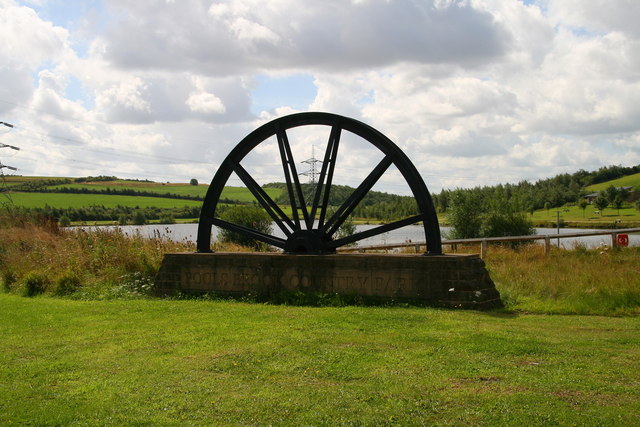
The Staveley Coal and Iron Company's deep winning at Staveley near Chesterfield, a single fifteen-foot shaft sunk through 141 yards of water-bearing ground to the Deep Soft at 364 yards between 1872 and 1876 and named after a company director. Worked with the neighbouring Hartington shafts for ventilation and pumping, it grew to 1,855 men in 1923, was still a main National Coal Board production pit in the 1980s, and its site is now Poolsbrook Country Park; the Ireland Colliery Chesterfield brass band keeps the name.
History
The Staveley company's early pits at Hollingwood and Speedwell were shallow and troubled: a fire in an underground lamp cabin at the Hollingwood pit in November 1857 killed twelve men including the manager, D. Cooper, and the flooding used to put it out drowned ninety acres of coal. The New Hollingwood Deep Winning of 1858, a single bratticed shaft 218 yards to the Deep Soft, and a fan pit of 1869 followed, and with trade improving in 1872 the company decided on a new colliery further south, to the dip of all its workings. This fifteen-foot single shaft met heavy water in sinking and was lined with 141 yards of cast-iron tubbing before it reached the Deep Soft, or Hollingwood bed, at 364 yards in 1876; the company's report of June 1875 records the tubbing carried down and the water held back after considerable difficulty. A twin-cylinder vertical winding engine of 36 by 90 inches, working at 65 pounds' pressure and capable of 58 winds an hour, was installed, and the shaft became known as the Ireland colliery, after a company director rather than the country. It was planned from the start to work with the New Hollingwood pit, renamed Hartington in 1880, which was given a second shaft, a 40-foot Guibal fan of 1879 and a differential pumping engine to ventilate and drain both; a staple pit at Hartington proved the Blackshale in 1879 and the shafts were deepened to it. Ireland raised gas and household coal from the Deep Soft: 553 men in 1894, 1,122 in 1910, 1,426 in 1915 and 1,855 in 1923, with coke ovens on the surface, and the company's Markham sinkings to the south took the deeper coal as Speedwell, Seymour and Campbell were worked out around 1900. A scheme begun in 1921 to sink the Hartington shafts to the Blackshale, with a 440-horsepower electric winder, was halted by the General Strike; Hartington stopped drawing coal in 1927 and Ireland took its coal thereafter, Hartington serving only for pumping and ventilation and as Ireland's second means of egress. Nationalised in 1947 with 1,259 men and 414,000 tons of coking, gas and household coal, the pit was 376 yards deep by 1967 and 98 per cent mechanised, working the Deep Hard and Piper seams. It was still described as a main production mine of the National Coal Board in 1985, and appears to have ceased as an independent colliery in 1986, after which the Hartington shaft was kept pumping to protect Markham and Bolsover from flooding. The Ireland Colliery Band, later the Ireland Colliery Chesterfield Band, carries the name on.
Geology
Sunk through heavily watered strata, held back by 141 yards of cast-iron tubbing, to the Deep Soft or Hollingwood bed of the Middle Coal Measures at 364 yards; the Blackshale lies below and was proved by a staple pit from the Hartington shafts in 1879, and the Deep Hard and Piper seams were being worked by the 1960s. The workings ran to the dip, southward, of the older Hollingwood and Speedwell pits.
Geological setting: Sedimentary Beds and Seams (well documented example)
Workings
A single fifteen-foot downcast shaft with a vertical steam winder, worked as one system with the two Hartington shafts to the north for ventilation and pumping: a 40-foot Guibal fan of 1879 at Hartington drew 144,000 cubic feet a minute round the airways, a duplicate stood by, and a reversible Waddle fan was added after the 1911 Act; a 1879 differential pumping engine kept the combined workings dry. Horse and pony haulage on self-acting inclines in the 1890s and 1900s, coke ovens and a branch railway on the surface, and 98 per cent mechanised output by 1967.
Closure
The year rests on a Derbyshire Record Office catalogue heading giving the colliery's dates as 1874-1986 and on secondary accounts that Ireland was absorbed into the Markham complex as Markham No. 5 in 1986, neither of which could be read in full; the 1985 NMRS account still describes it as a main production mine, and the Hartington shaft was afterwards kept solely for pumping to protect Markham and Bolsover. Treat the date as probable rather than settled.
What remains
Cleared and landscaped as Poolsbrook Country Park, 180 acres of woodland, grassland and lakes developed on the colliery site, with the former railway running through it. At Hartington the 1879 pump house survived into the 1980s in use as a store, one Guibal fan house bricked up with its fan said to be still inside.
Nothing of the colliery itself; the site is the country park.
Redevelopment
Poolsbrook Country Park.
Related mines
- Hartington Colliery — Built to work as one system: the second Hartington shaft was sunk in 1877-78 expressly to ventilate and pump for both pits, a Guibal fan drew air down both shafts, and after Hartington stopped drawing coal in 1927 Ireland raised the Hartington coal while Hartington pumped and ventilated for it.
- Hollingwood Colliery — Ireland was the next winning to the dip in the same Deep Soft seam, begun in 1872 further south, and its own record describes its workings as running to the dip of the older Hollingwood and Speedwell pits.
- Markham Colliery — Both Staveley Coal and Iron Company pits; Markham took the deeper coal to the south as the older Staveley pits were worked out, and after Ireland closed the Hartington shaft was kept pumping to protect Markham from flooding.
- Seymour Colliery — Both Staveley company pits, and Ireland took some of the Seymour workforce at the 1918 closure.
- Speedwell Colliery, Staveley — Staveley Coal and Iron Company pits; one account has Ireland superseding Speedwell on the same site, and James Martin moved from Speedwell to be Ireland's checkweighman.
Nearby mines
- Speedwell Colliery, Staveley — 0.0 miles (0.0 km) E
- Hartington Colliery — 0.8 miles (1.3 km) N
- Seymour Colliery — 1.0 miles (1.6 km) E
- Markham Colliery — 1.4 miles (2.2 km) SW
- Hollingwood Colliery — 1.4 miles (2.3 km) W
Straight-line distance, within 9 miles (15 km). Show on the map.
What's uncertain
Points where sources disagree or the record could not be settled; both accounts are kept. All open questions in the archive.
- The Durham Mining Museum and a 1967 NCB leaflet give the sinking as 1858, which is the date of the New Hollingwood Deep Winning rather than of the Ireland shaft. (disputed) 3,2
- The colliery closed as an independent pit in 1986, when it is said to have been absorbed into the Markham complex as Markham No. 5. (uncertain) 1
Recorded claims
Individual factual claims, each attached to the source(s) that support it below. Where sources disagree, both are kept.
- The decision to sink a new colliery to the dip was taken in 1872; the 15-foot single shaft needed 141 yards of tubbing against water, reached the Deep Soft at 364 yards and was completed in 1876, becoming known as the Ireland colliery. 1,2
- The Durham Mining Museum and a 1967 NCB leaflet give the sinking as 1858, which is the date of the New Hollingwood Deep Winning rather than of the Ireland shaft. (disputed) 3,2
- A twin-cylinder vertical winding engine of 36 by 90 inches at 65 lb pressure, capable of 58 winds an hour, was installed at the shaft. 2
- A 40-foot Guibal fan at Hartington, at work early in 1879, delivered 144,000 cubic feet a minute and drew air down the Hartington and Ireland shafts; a duplicate stood by, and a reversible Waddle fan was installed after the 1911 Coal Mines Act. 2
- Ireland employed 553 in 1894, 1,122 in 1910, 1,426 in 1915, 1,855 in 1923, 1,700 in 1933 and 1,259 in 1947, when it raised 414,000 tons of coking, gas and household coal from the Deep Soft. 3
- By 1967 the pit was 376 yards deep, working the Deep Hard and Piper seams with 98 per cent mechanised output. 3
- Hartington Colliery closed in 1927, its downcast capped, while Ireland continued to draw the Hartington coal; Hartington was kept for pumping and ventilation and as Ireland's second egress, and after Ireland closed for pumping alone to protect Markham and Bolsover. 1,2
- The colliery closed as an independent pit in 1986, when it is said to have been absorbed into the Markham complex as Markham No. 5. (uncertain) 1
- Poolsbrook Country Park, 180 acres with 85 acres of woodland and 23 of water, was developed on the site of the former Ireland Colliery. 4
- The Ireland Colliery Chesterfield Band, formerly the Ireland Colliery Band (1980-90) and also known as Ireland Colliery Welfare, is named after the pit. 5,6
- The BGS mine-plans catalogue holds a Mining Remediation Authority abandonment plan titled 'Ireland' (catalogue 16524, Spoil Tip Nos.:- 11/038; 11/039; 11/040; 11/041, dated 1987). 7
Photographs & further reading
The Staveley company's pits from Speedwell to Ireland and Hartington, with the ventilation and pumping plant described in detail.
View sourceThe brass band that carries the colliery's name, based in Chesterfield and Staveley.
View sourceCompany annual reports of the 1870s on the sinking, and a first-hand account of the Hartington shafts in their last pumping years.
View sourceSources
- (secondary) Hartington and Ireland Collieries (oldminer.co.uk, quoting Staveley Coal and Iron Company annual reports 1875-78) — oldminer.co.uk (Andrew Bridgewater)
- (secondary) Notes on 19th century coal mining at Staveley, Derbyshire (British Mining No. 28, NMRS Memoirs 1985) — Northern Mine Research Society
- (primary) Durham Mining Museum: Ireland Colliery — Durham Mining Museum
- (observational) Poolsbrook Country Park, developed on the site of the former Ireland Colliery (Geograph photograph, 14 August 2008) — Geograph / David Rogers
- (secondary) Staveley, Derbyshire (Wikipedia) — Wikipedia
- (secondary) Ireland Colliery Chesterfield Band (Brass Band Results) — Brass Band Results
- (primary) BGS / Mining Remediation Authority mine plans: IRELAND — British Geological Survey / Mining Remediation Authority
- (primary) The National Archives, Kew COAL 80/544/31: Ireland Colliery, Netherthorpe, Staveley, Chesterfield, Derbyshire. Photograph depicting: aerial view of Ireland colliery village -... (National Archives Discovery) — The National Archives
Record created: 9 September 2026 · Last researched: 9 September 2026