 MineArchive
Hollingwood Colliery
| Also known as | Old Hollingwood Colliery, Old Hollingwood |
|---|---|
| Location | Hollingwood Common, Staveley, near Chesterfield, Derbyshire — 53.2635, -1.3817 (approximate) |
| Commodity | Coal |
| Type | Coal |
| Worked | 1840s–1872 (Deep Soft abandoned) |
| Maximum depth | Unknown. The Old Hollingwood pumping shaft was 254 feet deep, and after the fire of 1857 the coal worked lay two hundred feet above the level at which the fire began. |
| Operators | Richard Barrow (?–1863), Staveley Coal and Iron Company (1863–?) |
Overview
Richard Barrow's pit on Hollingwood Common worked the Deep Soft or Sitwell seam near its outcrop and down the dip, under safety lamps through the 1850s because the strata gave off methane, with a large underground furnace for ventilation and tubs drawn by ropes from an old broad-gauge Great Western Railway tank engine standing at the surface. In November 1857 a fire in an underground lamp cabin killed twelve men including the manager; brick stoppings set to smother it exploded the gas instead, and the workings were then flooded from the Chesterfield Canal alongside, drowning and losing ninety acres of coal. What was left was worked only to the rise, two hundred feet above the seat of the fire, and the seam gave its name to the district: the Deep Soft is also the Hollingwood bed.
History
Ward and Barrow had a blast furnace at Staveley from 1786, and by the 1840s George Hodgkinson Barrow was the proprietor of extensive foundries and collieries there. His plan for the decade was of a piece: two large furnaces, the Norbriggs arm added to the Chesterfield Canal, collieries sunk along the canal's banks, and an eighty horse power steam engine to drain the shallow wet mines. Hollingwood was one of the pits that came out of it, sunk with Speedwell, Hopewell, Springwell and Seymour. His son Richard Barrow, who succeeded him, owned by 1862 the largest collieries in Derbyshire, capable of 800,000 tons a year from five shafts, one of which raised 1,100 tons in a single day; in 1863 he sold the whole concern to a joint stock company, the Staveley Coal and Iron Company, whose £600,000 of capital was subscribed in a few days without a prospectus.
The seam was the Deep Soft or Sitwell, a house coal sent to London and other markets and reckoned better at Staveley than at any of the surrounding mines. Barrow worked it from the Hollingwood colliery on Hollingwood Common, near the outcrop and down to the deep. Because the strata gave off methane from time to time, the mine was worked as a safety-lamp mine through the 1850s, and a large sum was spent on a big underground furnace to ventilate it powerfully. Its oddest feature was its haulage: an old broad-gauge Great Western Railway tank engine was fixed on the surface, and its ropes ran down the shaft and along the roadways to draw the tubs of coal underground.
In November 1857 a fire started in an underground lamp cabin. Twelve men died, among them the mine manager, D. Cooper. The Derbyshire Times of 21 November reported a serious incident on the Sunday morning before, with twelve men dead and serious damage to property at the Staveley works. An attempt was made to put the fire out by building brick stoppings to smother it; the methane that accumulated behind them exploded instead. The workings were then flooded deliberately from the adjacent Chesterfield Canal, and the whole of the dip workings, ninety acres of coal, were drowned out and lost. From that time the pit worked only to the rise, at a level two hundred feet above the point where the fire had begun.
The company worked round the damage rather than through it. In 1858 a single twelve-foot shaft called the New Hollingwood Deep Winning was sunk 218 yards to take the Deep Soft to the dip of the drowned ground, divided down the middle by a wooden brattice so that one half served as downcast and the other as upcast over an underground furnace — leaving very little room for air to pass when the cages were running. It was renamed Hartington in 1879 and the archive holds it under that name. A communication was later driven between the old pit and the new so that part of the new one could be ventilated through a furnace shaft set apart for the purpose, and in 1869 another shaft was sunk and fitted with a thirty-foot Guibal fan, one of the largest then erected, to ventilate the workings on Hollingwood Common. From 1872 a further winning was begun to the south and again to the dip, which became Ireland Colliery. In 1876 a shaft was sunk near the Campbell colliery at Handley Wood and a heading driven into the old pit's workings early in 1877, put down expressly to replace it and cut the cost of production; output from the seam then ran at about 900 tons a day.
Draining the ground it had lost was the pit's long burden. The Old Hollingwood pumping engine was a 62-inch by 90-inch stroke Cornish beam engine built by Thornewill and Wareham of Burton-on-Trent in 1842, working at 10 lb pressure and between seven and nine strokes a minute; in a 254-foot shaft it raised water through two fourteen-inch bucket lifts and pumped over sixty million gallons a year until it was stopped in November 1879. Underground, a single-cylinder differential engine by Hathorn Davey and Co. of Leeds, works number 2352, was supplied on 8 September 1875 at a cost of £520 to deliver water to the beam engine's pumps; its steam came from boilers on the surface through a hundred yards of six-inch pipe down the shaft and 665 yards more underground, and experiments in 1879 found that with no insulation the pipework lost nearly ten pounds of steam a minute when the engine stood idle.
Under the Staveley company the pit shows up in the Derbyshire papers in the ordinary way. Jonathon Wagstaffe was killed at Old Hollingwood in August 1864. In June 1869 a collier was severely hurt by the premature explosion of a shot he was preparing to fire, struck by stone that broke his right arm, put out his left hip and cut his shoulder and head. In August 1870 Thomas Purdy, a boy of thirteen from Brimington driving a pony, had his light go out on an incline, ran ahead of his laden train in the dark, was overtaken and had both bones of his right leg broken by the first wagon.
Geology
The Deep Soft or Sitwell seam of the Middle Coal Measures, a house coal worked at Staveley for a great many years and reckoned of better quality there than at the surrounding mines; it is also called the Hollingwood bed after this colliery. The pit took it near its outcrop and followed it down the dip. The strata gave occasional discharges of methane, which is why the mine was worked under safety lamps in the 1850s, and a series of old water-filled workings along the outcrop had begun to leak into the live workings by the 1870s, so that as the seam dipped away the water problem grew rather than eased.
Geological setting: Sedimentary Beds and Seams (well documented example), Strike and Dip (well documented example)
Workings
A shaft on Hollingwood Common, ventilated by a large underground furnace and, from 1869, by a thirty-foot Guibal fan in a shaft sunk for the purpose and driven by a horizontal high-pressure engine of 25 inches by two-foot stroke at 60 revolutions a minute, giving 2.52 inches water gauge at the fan centre and moving 84,800 cubic feet of air a minute. Coal was drawn underground by ropes from an old broad-gauge Great Western Railway tank engine fixed at the surface, the ropes running down the shaft and along the roadways. A separate 254-foot pumping shaft held two fourteen-inch bucket lifts, the lower delivering into a cistern for the upper, worked by the Cornish beam engine of 1842; a Hathorn Davey differential engine placed underground fed water to those pumps through 800 yards of twelve-inch pipework against a lift of 240 feet. After the heading of early 1877 the coal came out through the newer shaft at Handley Wood.
Closure
The abandonment plan deposited for Old Hollingwood records the Deep Soft seam abandoned in 1872, and that is the date carried here. It is not the end of the coal: Chapman has a shaft sunk near the Campbell colliery at Handley Wood in 1876, expressly to replace the old pit, with a heading driven into its workings early in 1877, so the same ground went on being worked through a newer and better-placed shaft. The pit's own decline began twenty years earlier, when the fire of 1857 and the flooding that followed it cut the workings back to the rise and cost ninety acres of coal. Its pumping engine was stopped in November 1879, once the new engine at Hartington took over the drainage of the whole seam.
What remains
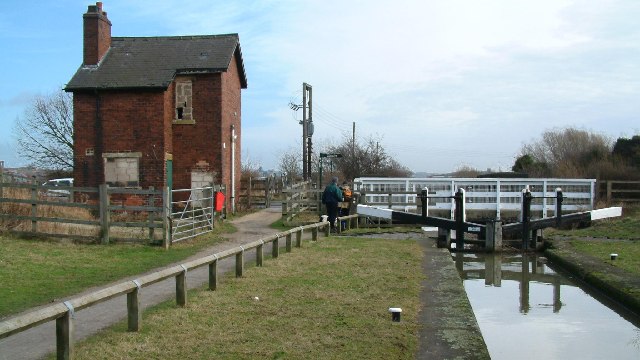
Hollingwood is now a village on the eastern edge of Staveley, built up around the canal and the Barrow Hill road. Nothing of the colliery is recorded standing. The Chesterfield Canal, whose water was let into the workings in 1857, has been restored through Hollingwood: the lock is in use, the old lock cottage has become the Chesterfield Canal Trust's Hollingwood Hub visitor centre, and a trip boat runs from it.
None recorded.
Redevelopment
The coal at Hollingwood was taken again from the surface in the twentieth century: an opencast plan for Hollingwood in the Deep Hard seam was deposited on abandonment in February 1961. The colliery site itself is within the built-up area of Hollingwood, and the canal frontage is now a restored waterway with a visitor centre.
Related mines
- Hartington Colliery — Hartington began in 1858 as the New Hollingwood Deep Winning, sunk to take the Deep Soft to the dip of Hollingwood's drowned workings; a communication was later driven between the two pits so that part of the new one could be ventilated through Hollingwood's furnace shaft.
- Ireland Colliery — Ireland was the next winning to the dip in the same Deep Soft seam, begun in 1872 further south, and its own record describes its workings as running to the dip of the older Hollingwood and Speedwell pits.
- Seymour Colliery — Another of the pits Richard Barrow sank at Staveley in the 1840s and 1850s and sold with the rest of the concern in 1863.
- Speedwell Colliery, Staveley — Both were Richard Barrow's Staveley pits, sunk in the 1840s along his extended canal and sold together to the Staveley Coal and Iron Company.
Nearby mines
- Hartington Colliery — 2.3 km NE
- Ireland Colliery — 2.3 km E
- Markham Colliery — 2.4 km SE
- Speedwell Colliery, Staveley — 2.4 km E
- Seymour Colliery — 4.0 km E
Straight-line distance, within 15 km. Show on the map.
None
Recorded claims
Individual factual claims, each attached to the source(s) that support it below. Where sources disagree, both are kept.
- Richard Barrow worked the Deep Soft or Sitwell seam from the Hollingwood colliery on Hollingwood Common, near the outcrop and down to the deep. 1
- The mine was worked as a safety-lamp mine during the 1850s because of occasional discharges of methane from the strata, and a large sum was spent on a big underground furnace to ventilate it. 1
- Tubs of coal were hauled underground by ropes worked from an old broad-gauge Great Western Railway tank engine fixed on the surface, the ropes running down the shaft and along the roadways. 1
- A fire in an underground lamp cabin in November 1857 killed twelve men, including the mine manager, D. Cooper. 1,2
- An attempt to put the fire out by building brick stoppings to smother it resulted instead in an explosion of the accumulated methane. 1
- The workings were flooded from the adjacent Chesterfield Canal, drowning out and losing the whole of the dip workings, ninety acres of coal. 1
- After 1857 the coal worked by the mine was confined to the rise, at a level two hundred feet above the point at which the fire had originated. 1
- The Old Hollingwood pumping engine was a 62-inch by 90-inch stroke Cornish beam engine built by Thornewill and Wareham of Burton-on-Trent in 1842, which raised over sixty million gallons a year from a 254-foot shaft until it was stopped in November 1879. 1
- The plan deposited for Old Hollingwood records the Deep Soft seam abandoned in 1872. 3
- The colliery passed with the rest of Richard Barrow's Staveley concern to the Staveley Coal and Iron Company, formed in 1863 with £600,000 subscribed in a few days. 4
- Jonathon Wagstaffe was killed at Old Hollingwood colliery, then belonging to the Staveley Coal and Iron Company, in August 1864. 4
- Thomas Purdy, a boy of thirteen from Brimington driving a pony, had his light put out on an incline in August 1870, ran ahead of his laden train in the dark and had both bones of his right leg broken by the first wagon. 4
- The coal at Hollingwood was worked again from the surface, an opencast plan for the Deep Hard seam being deposited on abandonment in February 1961. 5
- The Chesterfield Canal still runs past Hollingwood, under the road from Barrow Hill, where its water was let into the colliery workings in 1857. 6
Photographs & further reading
The substantive account of this colliery: the seam, the safety lamps, the underground furnace, the tank-engine haulage, the 1857 fire and its consequences, and the pumping and ventilating machinery of the whole Staveley group described engine by engine.
View sourceA North Derbyshire collection of newspaper extracts on the Staveley company and its pits, with a section of reports of accidents at Old Hollingwood colliery in the 1860s and 1870s.
View sourceSources
- (secondary) Notes on 19th century coal mining at Staveley, Derbyshire (British Mining No. 28, NMRS Memoirs 1985) — Northern Mine Research Society
- (secondary) Accidents and disasters — oldminer.co.uk — oldminer.co.uk
- (primary) Abandonment plan EM344: OLD HOLLINGWOOD, Deep Soft seam, abandoned 1872 — Mining Remediation Authority, via the British Geological Survey
- (secondary) Staveley collieries (oldminer.co.uk) — oldminer.co.uk (Andrew Bridgewater)
- (primary) Opencast plan EM972OC: HOLLINGWOOD, Deep Hard seam, abandoned 25 February 1961 — Mining Remediation Authority, via the British Geological Survey
- (observational) The Chesterfield Canal at Hollingwood — Alan Walker, via Geograph
Record created: 24 September 2026 · Last researched: 28 September 2026