 MineArchive
Markham Colliery
| Location | Duckmanton, near Staveley and Chesterfield, Derbyshire — 53.2450, -1.3620 (approximate) |
|---|---|
| Commodity | Coal |
| Type | Coal |
| Worked | 1882 (lease)–2 July 1993 (production) |
| Maximum depth | Blackshale seam at 690 yards; Deep Softs/Clay Cross Softs seam at 1,512ft (No.2 pit) |
| Operators | Staveley Coal and Iron Company (1882–1947), National Coal Board (1947–1994) |
Overview
A major Staveley Coal and Iron Company colliery struck by three separate disasters across 36 years — explosions in 1937 and 1938, and a shaft accident in 1973 — that together killed 106 men, now commemorated by a walking trail of 106 steel figures leading to the former pit village of Duckmanton.
History
The Staveley Coal and Iron Company leased 5,000 acres of coal reserves at Duckmanton, near Chesterfield, in 1882; Markham No.1 pit was in full production by 1885, and a second pit, sunk in 1886, reached the Deep Softs (Clay Cross Softs) seam at 1,512 feet. A third seam, the Blackshale, was reached in the mid-to-late 1920s at 690 yards depth. Markham was designed from the outset as effectively two separate collieries working different seams, each with its own staff and workforce, until Markham 1, 2 and 4 were merged into a single colliery in 1967, after nationalisation.
The colliery was struck by three major disasters across 36 years: an explosion on 21 January 1937 that killed 9 men, a far larger explosion on 10 May 1938 that killed 79, and a shaft winding accident on 30 July 1973 that killed a further 18 — 106 men in total (see Disasters, below). Despite this history, Markham remained a major colliery: by the early 1980s a workforce of 2,250 was producing 1.65 million tonnes of coal a year from the Second Waterloo, Deep Soft, Deep Hard, First Piper, Threequarter and Blackshale seams, and the colliery joined the Central Group of British Coal Corporation in 1986, setting a record weekly output of 62,405 tonnes in May 1991.
Coal production at Markham ended on 2 July 1993, during the national 'coal crisis' pit-closure programme of 1992-94, with the colliery formally closing in 1994 as the last of Derbyshire's six remaining collieries and the last large colliery in the North Derbyshire coalfield.
Geology
Markham worked a sequence of seams at increasing depth as the colliery developed: the Deep Softs (Clay Cross Softs) at 1,512 feet from 1886, and the Blackshale, the third seam developed, at 690 yards from the mid-to-late 1920s; later working also reached the Second Waterloo, Deep Hard, First Piper and Threequarter seams.
Workings
Markham was effectively run as two separate collieries sharing one site, each with its own staff, workforce and numbered pits, until Markham 1, 2 and 4 were merged into a single colliery in 1967. Coal and men were raised via a No.3 shaft, the location of the 1973 winding accident.
Closure
Coal production at Markham ended on 2 July 1993, during the national 'coal crisis' pit-closure programme of 1992-94; the colliery formally closed in 1994 as the last of Derbyshire's six remaining collieries and the last large colliery in the North Derbyshire coalfield.
What remains
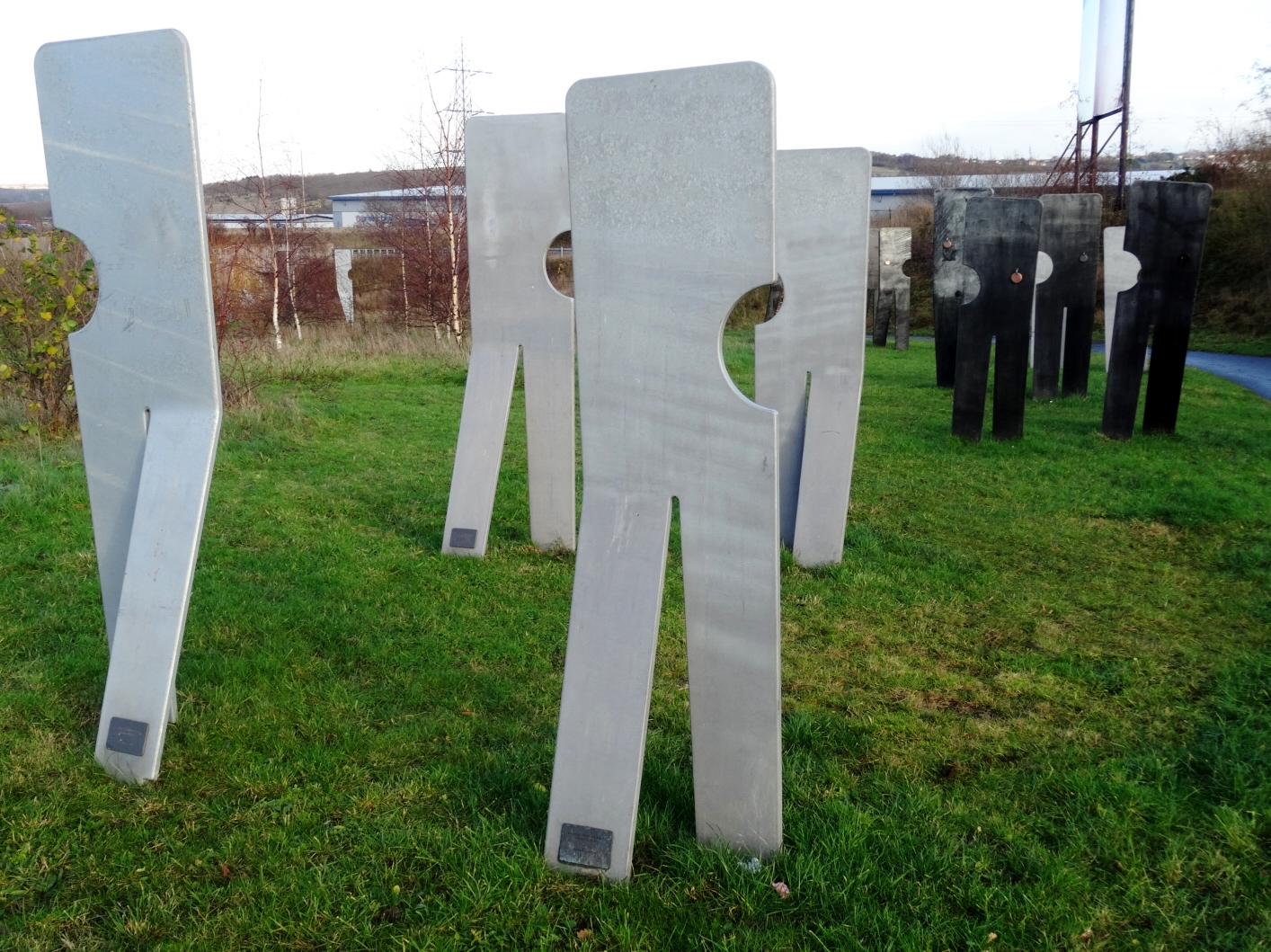
The former colliery site has been redeveloped as the Markham Vale business park. A walking trail memorial, 'Walking Together' by sculptor Stephen Broadbent, leads from Markham Vale to the former pit village of Duckmanton; its 106 steel figures, installed in stages from 2013 and completed in October 2022, commemorate each of the 106 men killed in the colliery's three disasters, sited near the former No.3 shaft where the 1973 accident happened.
No original colliery structures are known to survive; the site is now the Markham Vale business park, with the Walking Together memorial trail marking its mining history.
Related mines
- Arkwright Colliery — Both Staveley Company pits: Arkwright was opened in 1938 to work coal too remote for Markham, and an underground link into Markham's Second Piper workings was planned for 1988 but abandoned when Arkwright closed.
- Ireland Colliery — Both Staveley Coal and Iron Company pits; Markham took the deeper coal to the south as the older Staveley pits were worked out, and after Ireland closed the Hartington shaft was kept pumping to protect Markham from flooding.
- Oxcroft Colliery — Both Staveley Coal and Iron Company group pits; Oxcroft's men transferred to Markham when it closed in 1974.
- Seymour Colliery — Both Staveley Coal and Iron Company pits; Seymour men went to Markham among others when it closed in 1918.
Nearby mines
- Arkwright Colliery — 1.2 miles (1.9 km) S
- Ireland Colliery — 1.3 miles (2.1 km) NE
- Speedwell Colliery, Staveley — 1.4 miles (2.2 km) NE
- Hollingwood Colliery — 1.5 miles (2.4 km) NW
- Seymour Colliery — 2.0 miles (3.2 km) NE
Straight-line distance, within 9 miles (15 km). Show on the map.
Disasters & major incidents
-
Markham Colliery overwind, 1887
3 October 1887 · Winding / Shaft Accident · 4 fatalities
An overwind in the new No. 2 shaft at the Staveley company's Markham Colliery, near Chesterfield, killed four sinkers on 3 October 1887. -
Markham Colliery explosion, 1937
21 January 1937 · Explosion · 9 fatalities
A firedamp explosion at Markham Colliery, ignited by a faulty electrical coal-cutter after a roof break released trapped gas, killed 9 men by carbon monoxide poisoning on 21 January 1937. -
Markham Colliery explosion, 1938
10 May 1938 · Explosion · 79 fatalities
Runaway tubs colliding with steel roof supports dislodged a damaged electrical cable at Markham Colliery's Blackshale Pit, sparking a coal-dust explosion that killed 79 men on the night of 9-10 May 1938 — the worst of the colliery's three disasters. -
Markham Colliery shaft accident, 1973
30 July 1973 · Winding / Shaft Accident · 18 fatalities
A descending cage carrying miners at Markham Colliery's No.3 shaft failed to slow before reaching the pit bottom on 30 July 1973, after a fatigue-cracked brake rod fractured; 18 men were killed and 11 seriously injured.
Recorded claims
Individual factual claims, each attached to the source(s) that support it below. Where sources disagree, both are kept.
- The Staveley Coal and Iron Company leased 5,000 acres at Duckmanton in 1882; Markham No.1 pit was in full production by 1885, and a second pit, sunk in 1886, reached the Deep Softs seam at 1,512 feet. 1
- Markham was run as effectively two separate collieries with their own staff and workforce until Markham 1, 2 and 4 were merged into a single colliery in 1967, after nationalisation. 1
- By the early 1980s a workforce of 2,250 produced 1.65 million tonnes of coal a year from six named seams; the colliery set a record weekly output of 62,405 tonnes in May 1991. 1
- Coal production ended on 2 July 1993 during the national 'coal crisis' pit-closure programme, with the colliery formally closing in 1994 as the last of Derbyshire's six remaining collieries. 1
- A walking trail memorial, 'Walking Together' by sculptor Stephen Broadbent, with 106 steel figures installed in stages from 2013 and completed in October 2022, commemorates the 106 men killed in the colliery's three disasters, leading from the former colliery site to Duckmanton village. 2
Sources
- (secondary) Markham (Coal and Community case study) — University of Wolverhampton, Coal and Community project
- (secondary) Markham Colliery disaster — Wikipedia
Record created: 27 August 2026 · Last researched: 27 August 2026