 MineArchive
Markham Colliery explosion, 1938
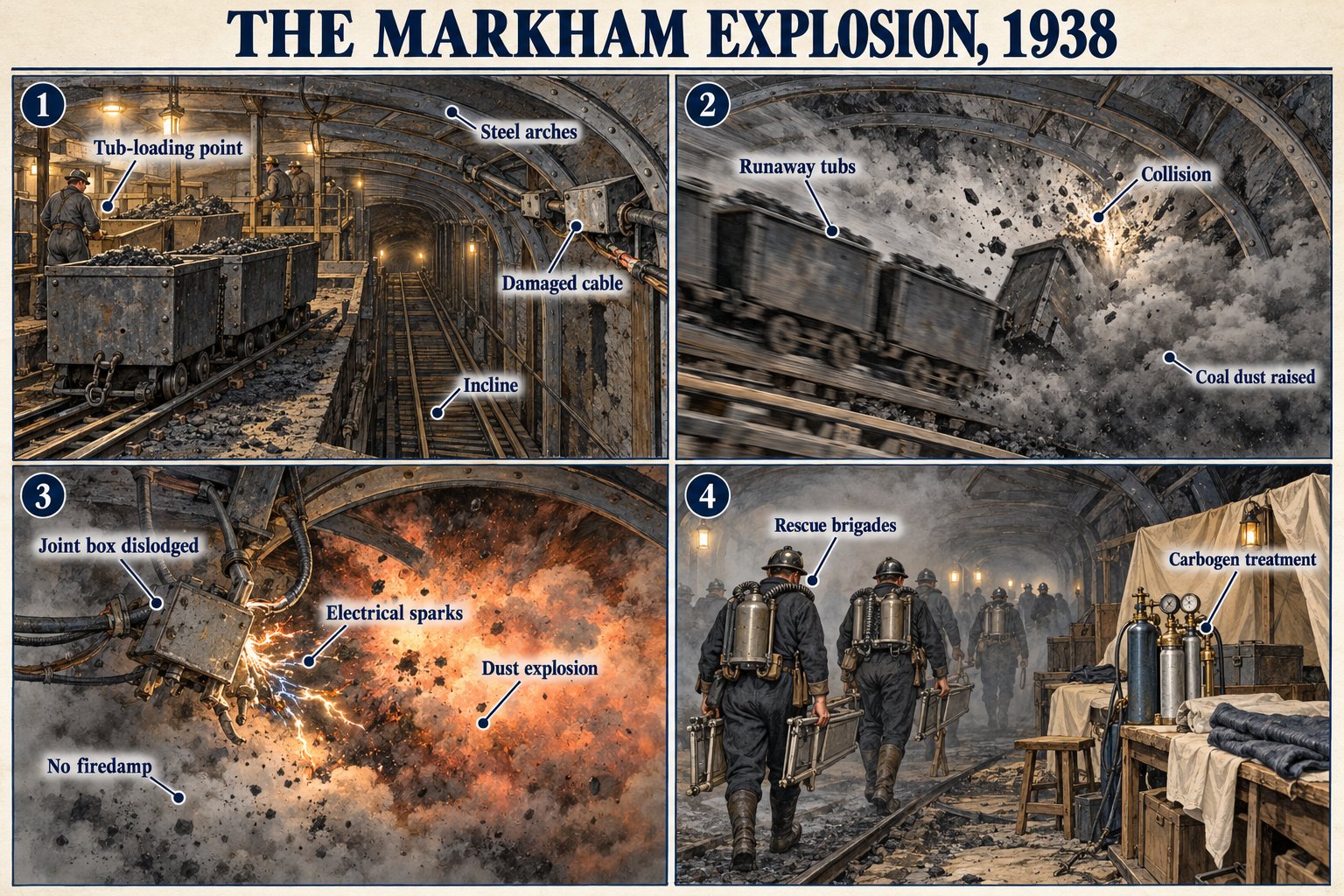
Runaway tubs colliding with steel roof supports dislodged a damaged electrical cable at Markham Colliery's Blackshale Pit, sparking a coal-dust explosion that killed 79 men on the night of 9-10 May 1938 — the worst of the colliery's three disasters.
| Date | 10 May 1938 |
|---|---|
| Mine | Markham Colliery |
| Region | Derbyshire |
| Type | Explosion |
| Fatalities | 79 (The Northern Mine Research Society's own detailed casualty account gives 83 dead; Wikipedia and the colliery's own 'Walking Together' memorial both give 79, and this figure is also the one consistent with the memorial's combined total of 106 across all three Markham disasters (9 + 79 + 18 = 106) — 79 is used here accordingly, with the NMRS discrepancy flagged rather than silently resolved.) |
| Injuries | 40 men were seriously injured, many treated for carbon monoxide poisoning with carbogen. |
| Context | During active mining |
Cause
Runaway coal tubs collided with steel arches supporting the roof, dislodging a damaged electrical cable and joint box; the resulting sparks ignited a cloud of coal dust raised by the collision. The official inquiry found no firedamp was involved.
Contributing factors
The inquiry, led by Paul Ernest Sandlands, described the disaster as the result of 'a sequence of events each one almost fantastically improbable' — the tub-loading area's position relative to an incline, inadequate tub-catching arrangements, and stonedusting practice were all identified as contributing weaknesses.
What happened
On the night shift of 9-10 May 1938, with no coal-cutting machines running, workers heard what was described as a heavy bump at around 5:32am, followed by clouds of dust and a powerful rush of air that knocked many men off their feet.
Rescue & recovery
A colliery rescue party was dispatched by 6:05am; professional rescue brigades from Chesterfield, Mansfield and Ilkeston arrived between 6:25 and 7:50am. Forty men suffering carbon monoxide poisoning were treated with carbogen.
Investigation & inquiry
The inquiry, held in June-July 1938 under Paul Ernest Sandlands, concluded the explosion was caused by runaway tubs colliding with roof supports, dislodging a damaged cable whose sparks ignited a coal-dust cloud, with no firedamp involved; it recommended examining or restricting the future use of electricity in mines, relocating tub-loading areas away from inclines, improving tub-catching mechanisms, and revising stonedusting regulations.
Changes to practice & legislation
The inquiry's recommendations targeted electrical safety near tub-loading points and stonedusting practice specifically, in response to a cause the inquiry itself considered an almost improbable chain of events.
Memorials & commemoration
Commemorated, alongside the colliery's 1937 and 1973 disasters, by the 'Walking Together' memorial trail of 106 steel figures (see the mine's own record); a dedicated memorial service marking the 80th anniversary was held in 2018.
Recorded claims
Individual factual claims, each attached to the source(s) that support it below. Where sources disagree, both are kept.
- Runaway tubs collided with steel roof arches, dislodging a damaged electrical cable and joint box whose sparks ignited a cloud of coal dust raised by the collision; the inquiry found no firedamp was involved. 1
- 79 men died and 40 were seriously injured, several requiring carbogen treatment for carbon monoxide poisoning. 2
- The inquiry recommended examining or restricting future electricity use in mines, relocating tub-loading areas away from inclines, improving tub-catching mechanisms, and revising stonedusting regulations. 1
Related terminology
Mining terms this disaster is structurally linked to, with the nature of the relationship.
- Coal (contextual relationship)
Named twice in this record, first in the cause: “Runaway coal tubs collided with steel arches supporting the roof, dislodging a…” - Colliery (contextual relationship)
Named 4 times in this record, first in the summary: “…steel roof supports dislodged a damaged electrical cable at Markham Colliery's Blackshale Pit, sparking a coal-dust explosion that killed 79 men…” - Incline (contextual relationship)
Named in this record’s contributing factors: “…improbable' — the tub-loading area's position relative to an incline, inadequate tub-catching arrangements, and stonedusting practice…” - Tub (contextual relationship)
Named 3 times in this record, first in the summary: “Runaway tubs colliding with steel roof supports dislodged a damaged electrical…”
Sources
- (secondary) Markham Colliery No.1 Blackshale Pit Explosion - Chesterfield - 1938 — Northern Mine Research Society
- (secondary) Markham Colliery disaster — Wikipedia
Record created: 27 August 2026 · Last researched: 27 August 2026