 MineArchive
Gray Colliery
| Also known as | Grey's Colliery, Grey Colliery, Gray's Colliery, Gray Pit |
|---|---|
| Location | Abertillery, Ebbw Fach valley, Blaenau Gwent — 51.7343, -3.1340 (exact) |
| Commodity | Coal |
| Type | Coal |
| Worked | 1893–11 March 1950 |
| Maximum depth | 275 metres |
| Operators | Powell's Tillery Steam Coal Company Limited (1889–?), Ebbw Vale Steel, Iron and Coal Company (?–1927), Partridge Jones and John Paton (1936–1950) |
Overview
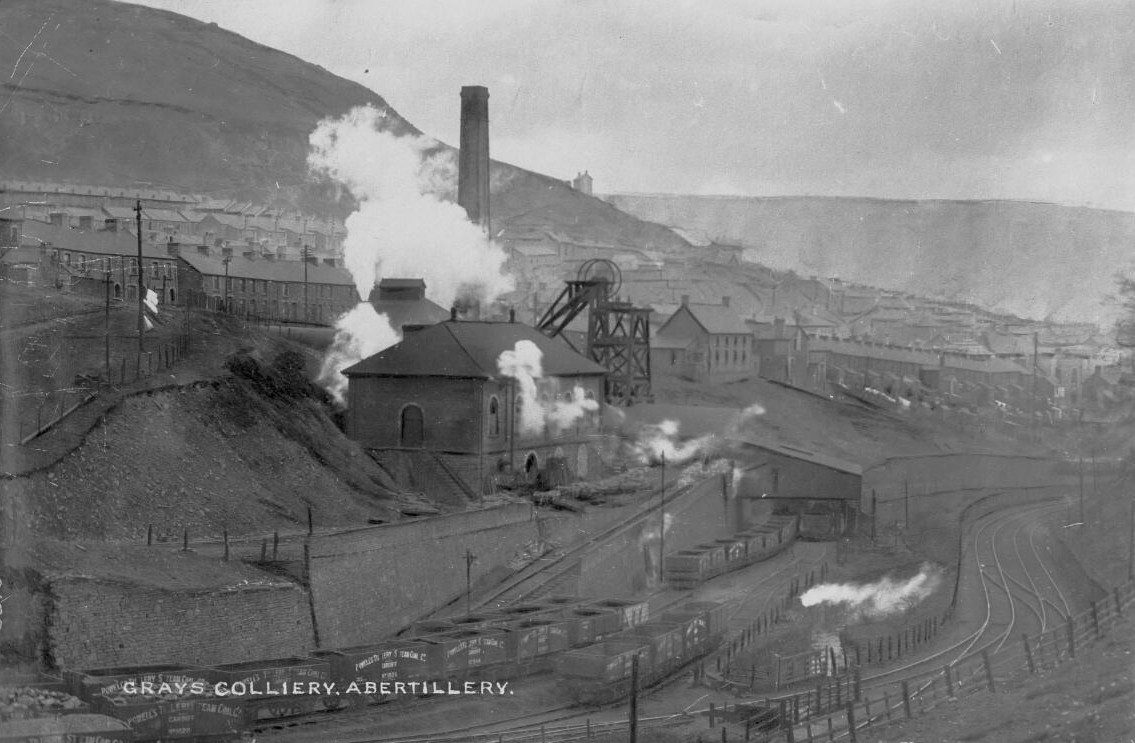
A steam-coal pit at Abertillery, sunk by Powell's Tillery Steam Coal Company and raising coal from 1893, worked with the company's Vivian and Penybont pits. It stopped producing in 1927, was kept for ventilation and as a training pit for new recruits, and was abandoned in 1950; a school's games courts now cover the site.
History
Gray Colliery, often called Gray's or Grey's, was sunk at Abertillery by Powell's Tillery Steam Coal Company. Welsh Coal Mines dates the sinking to the late 1880s, with the Black Vein struck in June 1891, ten feet thick, and the first coal raised in 1893; the Northern Mine Research Society says it was sunk in 1894. Output in 1894 was 73,898 tons, and in 1896 it employed 414 men on the Black Vein under T. J. Lamb. The shaft went down 275 metres, passing the Four-Feet seam at 189.9 metres and the Nine-Feet at 232.1 metres to the Five-Feet/Gellideg at 274.3 metres. Its Nine-Feet coal was a prime coking coal, used for foundry and blast-furnace coke.
Gray worked together with the company's Vivian and Penybont collieries, to which it was linked underground, and the three were usually counted together: 2,766 men in 1908, about 2,900 in 1910-11. In October 1896 the men of the Gray, Vivian and Tillery pits voted a penny-a-week levy in support of the Bwllfa men. In 1923, under the Ebbw Vale Steel, Iron and Coal Company, it employed 698 men on the Big Vein, Black Vein and Old Coal seams. After 18 months idle it restarted in March 1926, but it closed as a production unit in October 1927 and was kept for ventilation; Partridge Jones and John Paton owned it from 1936. It was used as a training centre for recruits to the industry until the late 1940s and was abandoned on 11 March 1950. NMRS gives a final closure in 1938 and the shaft filled in 1959.
Deaths at the pit were single accidents, mostly falls of roof: William Lane in 1896; Thomas Jenkins in 1910; John John and Wilfred Cook in 1914; Edward Gore in 1916; and in 1917 the haulier David George Cobbett, buried by a fall in the pit's Dardanelles district. The site is now occupied by the games courts of Abertillery's comprehensive school.
Geology
Steam and coking coals of the Lower and Middle Coal Measures: the Black Vein (Nine-Feet) was struck ten feet thick, the Four-Feet at 189.9 metres, the Nine-Feet at 232.1 metres and the Five-Feet/Gellideg at 274.3 metres; the Big Vein, Elled and Old Coal were also worked.
Workings
A shaft 275 metres deep, linked underground to the Vivian and Penybont collieries; it later served as an upcast ventilation shaft for the group.
Closure
Closed as a production unit in October 1927 under the Ebbw Vale company and kept for ventilation; used to train new recruits until the late 1940s; abandoned on 11 March 1950.
What remains
The site is occupied by the games courts of Abertillery's comprehensive school.
Redevelopment
Abertillery comprehensive school and its games courts.
Related mines
- Penybont Colliery — Sister pits of Powell's Tillery Steam Coal Company, linked underground and counted together.
- Vivian Colliery — Sister pits of Powell's Tillery Steam Coal Company, linked underground and counted together.
Nearby mines
- Penybont Colliery — 0.2 miles (0.3 km) N
- Vivian Colliery — 0.6 miles (1.0 km) S
- Cwmtillery Colliery — 0.8 miles (1.2 km) N
- Six Bells Colliery — 1.0 miles (1.6 km) S
- Hafod Van Colliery — 1.0 miles (1.7 km) S
Straight-line distance, within 9 miles (15 km). Show on the map.
What's uncertain
Points where sources disagree or the record could not be settled; both accounts are kept. All open questions in the archive.
- The Black Vein was struck in June 1891 and the first coal raised in 1893. (disputed) 1
- The pit was sunk in 1894. (disputed) 2
- It was abandoned on 11 March 1950. (disputed) 1
- It was finally closed in 1938 and filled in 1959. (disputed) 2
Recorded claims
Individual factual claims, each attached to the source(s) that support it below. Where sources disagree, both are kept.
- The Black Vein was struck in June 1891 and the first coal raised in 1893. (disputed) 1
- The pit was sunk in 1894. (disputed) 2
- The shaft was 275 metres deep, reaching the Five-Feet/Gellideg seam at 274.3 metres. 2
- It belonged to Powell's Tillery Steam Coal Company and worked with the Vivian and Penybont pits. 2,1,3
- It closed as a production unit in October 1927. 2,1
- It was abandoned on 11 March 1950. (disputed) 1
- It was finally closed in 1938 and filled in 1959. (disputed) 2
- It was used for training recruits to the industry until the late 1940s. 2,1
- The site is now occupied by the games courts of Abertillery comprehensive school. 1,3
Photographs & further reading
A colour postcard of the colliery, postmarked February 1908.
View sourceA history of the pit with three photographs, one dated 1909.
View sourceRay Lawrence's account of the sinking, seams, workforce and closure.
View sourceThe Welsh national monuments record entry, with the site's grid reference.
View sourceSources
- (secondary) Welsh Coal Mines: Gray Colliery, Abertillery — Welsh Coal Mines
- (secondary) NMRS: Grey's Colliery — Northern Mine Research Society
- (secondary) Coflein: Gray Pit, Abertillery (NPRN 421103) — Royal Commission on the Ancient and Historical Monuments of Wales
- (primary) BGS / Mining Remediation Authority mine plan: TILLERY COLLIERY GRAY PIT (Elled Vein, Big Vein) — British Geological Survey
- (primary) Museum Wales: Gray's Colliery, Abertillery (postcard) — Amgueddfa Cymru - Museum Wales
- (primary) South Wales Daily News, 2 September 1896: Abertillery, fatality at the Gray Colliery — Welsh Newspapers Online (National Library of Wales)
- (primary) South Wales Daily News, 27 October 1896: Abertillery, the coal trade — Welsh Newspapers Online (National Library of Wales)
- (secondary) 1916 fatalities — Welsh Coal Mines
- (secondary) 1917 (Welsh mining fatalities by date) — Welsh Coal Mines
- (secondary) Fatalities 1914 — Welsh Coal Mines — Welsh Coal Mines
- (secondary) Mining fatalities, 1903 - Welsh Coal Mines — Welsh Coal Mines
- (secondary) Welsh Coal Mines fatalities, 1910 — Welsh Coal Mines
- (secondary) Welsh mining fatalities, 1898 — Welsh Coal Mines
- (secondary) Welsh mining fatalities, 1908 — Welsh Coal Mines
Record created: 11 October 2026 · Last researched: 11 October 2026