 MineArchive
Penybont Colliery
| Also known as | Tillery Colliery, Pen-y-bont Colliery, Penybont Pit |
|---|---|
| Location | Abertillery, Ebbw Fach valley, Blaenau Gwent — 51.7370, -3.1338 (exact) |
| Commodity | Coal |
| Type | Coal |
| Worked | 1850–1938 |
| Maximum depth | Unknown. |
| Operators | T. P. and D. Price (?–1851), Jayne's Tillery Colliery Company (1851–?), Tillery Coal Company Limited (1882–1888), Powell's Tillery Steam Coal Company Limited (1900–1935), Ebbw Vale Steel, Iron and Coal Company (?–1935), Partridge Jones and John Paton (1935–1947), National Coal Board (1947–?) |
Overview
The oldest of the Abertillery steam-coal pits, also called the Tillery Colliery, sunk around 1850-51 and working longwall by 1866. Under Powell's Tillery company it was worked with the Gray and Vivian pits, more than 2,700 men between them; it stopped producing in 1938 and later trained recruits for the National Coal Board.
History
Penybont Colliery, also known as the Tillery Colliery, was the first pit at Abertillery to reach the steam-coal seams of the Middle and Lower Coal Measures, despite a name taken from the Tillery seam of the Upper Coal Measures. Welsh Coal Mines has it opened by Messrs T. P. and D. Price in the late 1840s; in November 1850 they celebrated reaching the steam coal by giving their workmen and friends a dinner. The Northern Mine Research Society and Coflein date its sinking to 1851 by Jayne's Tillery Company. The Four-Feet seam was struck at 174.3 metres and the Nine-Feet at 217.9 metres, and its coal was a prime coking coal for foundry and blast-furnace coke. It was working longwall as early as 1866. Two men died in gas explosions in 1852, and many of its early dead were boys of 12 to 15.
In 1888 the Tillery Coal Company Limited was working the Three-Quarter (Upper Six-Feet) and Elled (Four-Feet) seams under T. J. Davidson; the shaft had been deepened in 1886. It employed 681 men in 1896. Powell's Tillery Steam Coal Company controlled it by 1900, and from then it was worked with the company's Gray and Vivian pits, 2,777 men together in 1913 and about 2,900 in 1915; with Rose Heyworth, Cwmtillery, Griffin and Six Bells, more than 9,400 men worked within a mile of it. Ness Edwards, later Member of Parliament for Caerphilly, started work at Penybont on his thirteenth birthday, 5 April 1910. In 1923 it employed 1,010 men on the Black Vein, Three-Quarter, Big Vein and Meadow Vein.
The Ebbw Vale Steel, Iron and Coal Company, by then Powell's Tillery's parent, closed it temporarily in October 1924 with 900 men, but by 1927 the group was back to some 2,500. Partridge Jones and John Paton bought the Ebbw Vale company's pits in 1935, when Penybont employed 620 men producing 200,000 tons from the Three-Quarter seam. It closed as a production unit in 1938, with 17 men left; in 1945 thirteen men were kept for pumping and ventilation, and after 1947 the National Coal Board used it for a time as a training centre for recruits. The Tyleri Court day centre now stands on the site.
Geology
Steam and prime coking coals of the Middle and Lower Coal Measures: the Four-Feet (Elled) at 174.3 metres and Nine-Feet at 217.9 metres, with the Three-Quarter (Upper Six-Feet), Black Vein, Big Vein, Old Coal and Meadow Vein worked; the Big Vein group spanned 52 feet 11 inches with dirt bands.
Workings
A shaft, deepened in 1886, worked longwall from at least 1866; linked in working with the Gray and Vivian pits of the same company.
Closure
Closed temporarily in October 1924 and as a production unit in 1938; kept for pumping and ventilation, and used after 1947 as a training centre. Coflein says it closed after the Second World War.
What remains
The Tyleri Court day centre occupies the site.
Redevelopment
Tyleri Court day centre.
Related mines
- Gray Colliery — Sister pits of Powell's Tillery Steam Coal Company, linked underground and counted together.
- Vivian Colliery — Sister pits of Powell's Tillery Steam Coal Company, counted together from 1900.
Nearby mines
- Gray Colliery — 0.2 miles (0.3 km) S
- Cwmtillery Colliery — 0.6 miles (0.9 km) N
- Vivian Colliery — 0.8 miles (1.3 km) S
- Rose Heyworth Colliery — 0.9 miles (1.5 km) NW
- Cwmtillery Red Ash Colliery — 1.1 miles (1.7 km) N
Straight-line distance, within 9 miles (15 km). Show on the map.
What's uncertain
Points where sources disagree or the record could not be settled; both accounts are kept. All open questions in the archive.
- Messrs T. P. and D. Price reached the steam coal in November 1850. (disputed) 1
- It was sunk in 1851 by Jayne's Tillery Company. (disputed) 2,3
Recorded claims
Individual factual claims, each attached to the source(s) that support it below. Where sources disagree, both are kept.
- Messrs T. P. and D. Price reached the steam coal in November 1850. (disputed) 1
- It was sunk in 1851 by Jayne's Tillery Company. (disputed) 2,3
- Penybont Colliery was also known as the Tillery Colliery. 2,1,3
- The Four-Feet seam was struck at 174.3 metres and the Nine-Feet at 217.9 metres. 2
- It employed 681 men in 1896. 2,1
- In 1923 it employed 1,010 men. 1
- It closed as a production unit in 1938. 2
- Ness Edwards started work at Penybont colliery on 5 April 1910, his thirteenth birthday. 4
- The Tyleri Court day centre now occupies the site. 1
Photographs & further reading
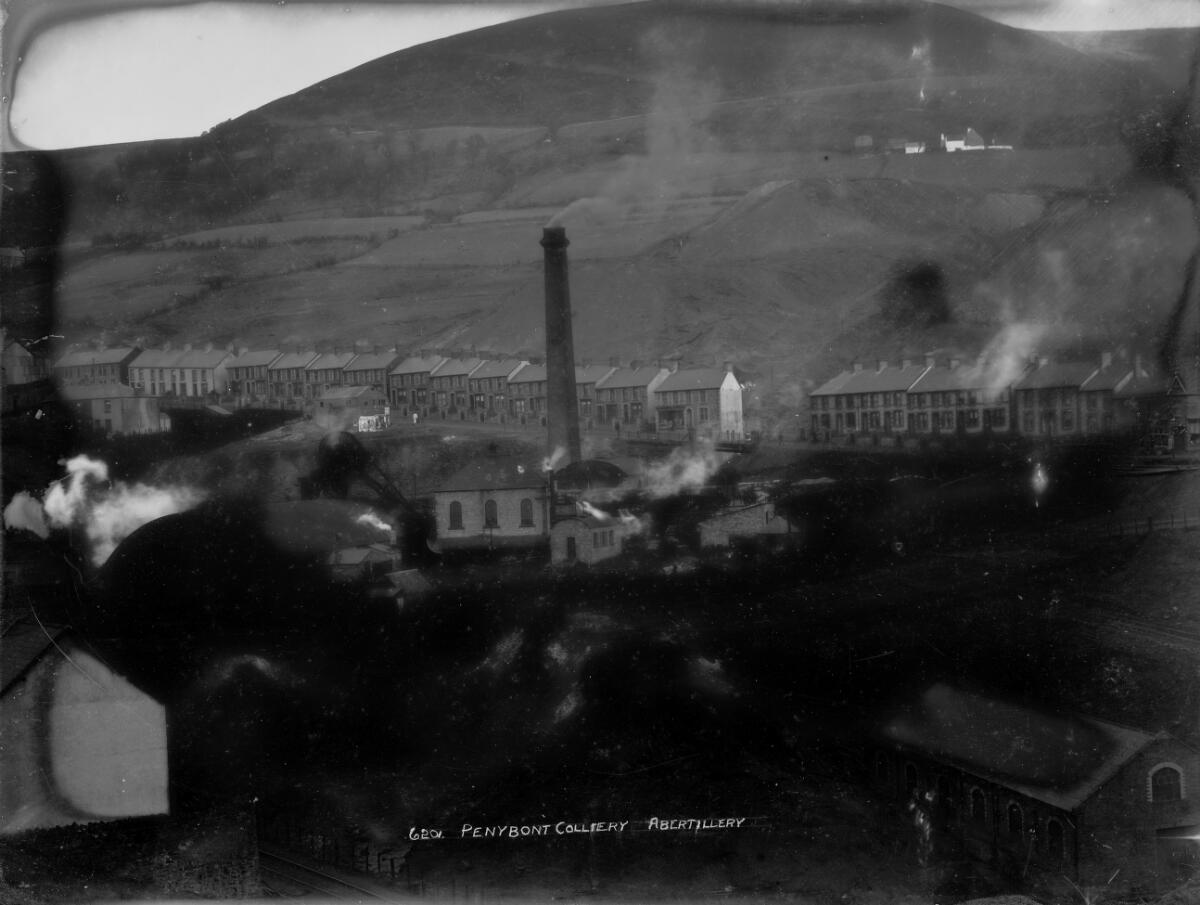
A black and white postcard view of the colliery.
View sourceRay Lawrence's account of the pit, its seams, owners and workforce, with a list of deaths from 1852 to 1912.
View sourceA history of the pit from the Prices' sinking to 1945, with photographs.
View sourceThe Welsh national monuments record entry, with the site's grid reference.
View sourceSources
- (secondary) Welsh Coal Mines: Penybont Colliery, Abertillery — Welsh Coal Mines
- (secondary) Tillery Colliery — Northern Mine Research Society
- (secondary) Coflein: Pen-y-Bont Colliery (NPRN 421059) — Royal Commission on the Ancient and Historical Monuments of Wales
- (secondary) Wikipedia: Ness Edwards — Wikipedia
- (primary) BGS / Mining Remediation Authority mine plan: TILLERY COLLIERY (Three Quarter seam) — British Geological Survey
- (primary) Museum Wales: Penybont Colliery (postcard) — Amgueddfa Cymru - Museum Wales
- (primary) South Wales Daily News, 21 May 1895: Abertillery, fatality at the Penybont pit — Welsh Newspapers Online (National Library of Wales)
- (secondary) 1915 fatalities — Welsh Coal Mines
- (secondary) Mining fatalities, 1903 - Welsh Coal Mines — Welsh Coal Mines
- (secondary) Welsh Coal Mines fatalities, 1910 — Welsh Coal Mines
- (secondary) Welsh Coal Mines: fatalities, 1891 — Welsh Coal Mines
- (secondary) Welsh mining fatalities, 1895 — Welsh Coal Mines
Record created: 11 October 2026 · Last researched: 11 October 2026