 MineArchive
Frongoch Mine
| Location | Near Pontrhydygroes, Ceredigion — 52.3515, -3.8969 (exact) |
|---|---|
| Commodities | Lead, Zinc |
| Type | Metal |
| Worked | 1792–1910 |
| Maximum depth | 154 fathoms (c. 280m) |
| Operators | John Taylor & Sons (1834–1878), John Kitto (1878–1897), Société Anonyme des Mines de Frongoch (1899–1902) |
Overview
Frongoch, in the hills above Pontrhydygroes, was one of the richest lead and zinc mines in Wales, worked at large scale for over a century and modernised at the very end of its life under Belgian ownership, complete with one of the earliest hydroelectric power stations in the area.
History
Development at Frongoch began around 1792 under John Probert, closing around 1818 as lead prices fell; the Williams brothers of Cornwall leased the mine from 1824 but abandoned it again in 1834 amid a further market collapse. John Taylor & Sons then took over as the Lisburne Mines Company, installing a 40-foot waterwheel for pumping and, by 1841, steam engines for winding and crushing; this 44-year management is credited with around £600,000 in profit. John Kitto acquired the mine in 1878 and, unusually for the site's earlier operators, made a point of processing zinc blende alongside lead, pioneering a backfilling method using crushed waste rock; Vaughan's New Shaft, begun in 1875, intersected ore at 90 fathoms, and workings eventually reached 154 fathoms. Operations under Kitto ceased in 1897. In 1899 the mine was bought by a Belgian company, which installed a new dressing mill and headgear, linked by tramway, and built a hydroelectric power station at Pont Ceunant down the valley at a cost of £11,400 — one of the earliest such installations in the area — employing around 100 Italian workers housed in an on-site barracks. Accounts of the mine's final years diverge: the Northern Mine Research Society records the Belgian-run operation closing in December 1902, matching the hydroelectric plant's own recorded 1899–1903 operating span, while other accounts describe underground mining continuing at Frongoch until around 1910, with the extensive waste tips reworked for zinc during the 1920s before the site was finally abandoned.
Geology
The mine exploited near-vertical lead-zinc veins hosted in Silurian-age grey and greenish-grey shales, flags and mudstones typical of the Central Wales orefield.
Geological setting: Veins and Lodes (well documented example)
Workings
Underground workings included Vaughan's New Shaft (begun 1875, intersecting ore at 90 fathoms) and reached a maximum depth of around 154 fathoms; ore was brought to surface via the Belgian-era headgear and moved to the dressing mill by tramway.
Closure
Leased by the Williams brothers of Cornwall from 1824 and abandoned again in 1834 amid a market collapse; operations under Kitto ceased in 1897.
What remains
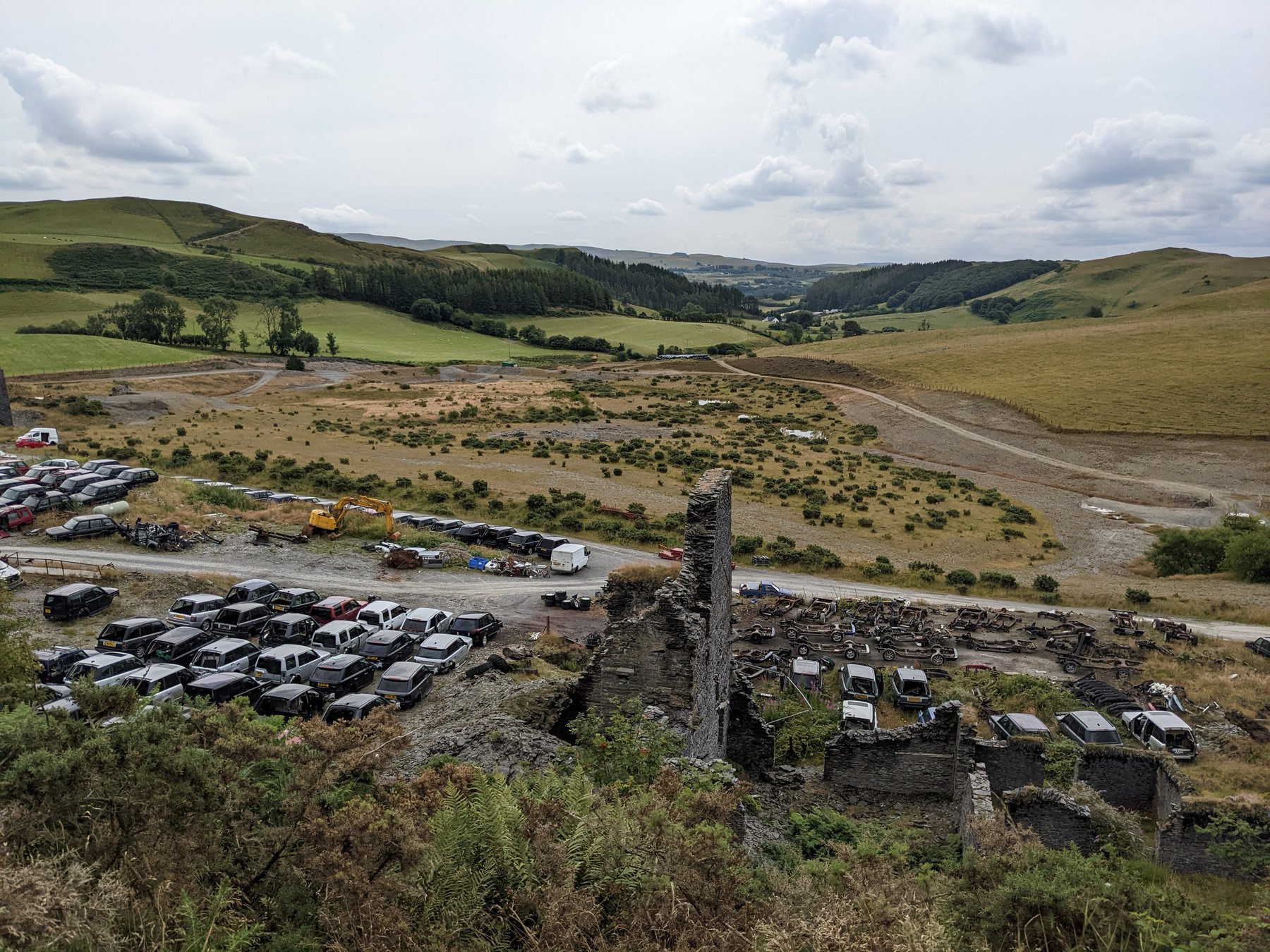
Little now stands beyond the ruins of the 1899 Belgian dressing mill and the associated hydroelectric power station at Pont Ceunant; underground, the workings are extensively flooded and partly collapsed, with natural stoping voids and areas of timber roof support still in place. The surface ground has since found an unexpected second use: a photograph taken in July 2022 shows it serving as a Range Rover breaker's yard, with vehicles ranked across the old mine site.
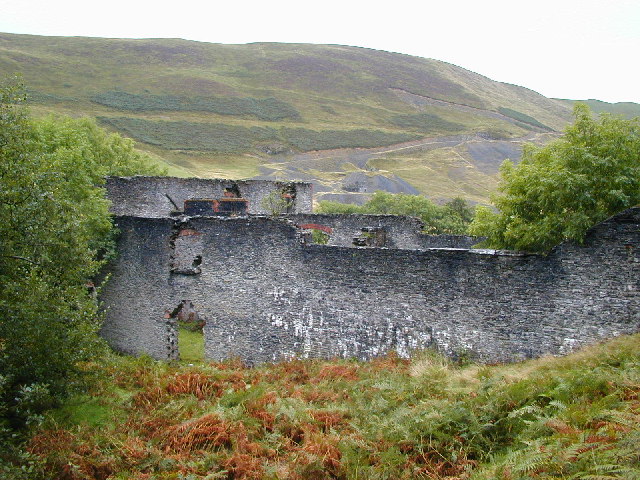
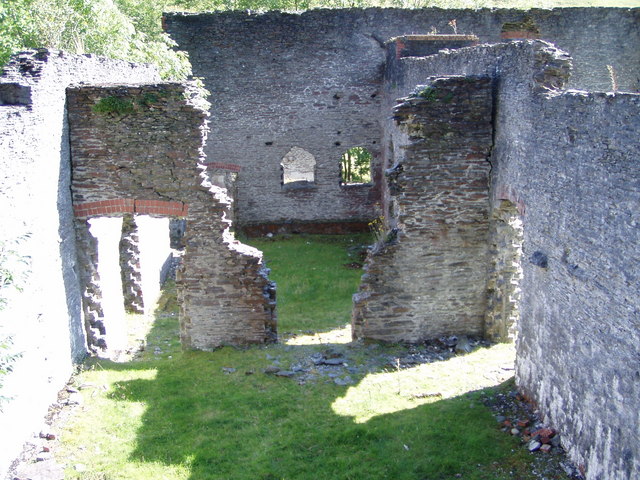
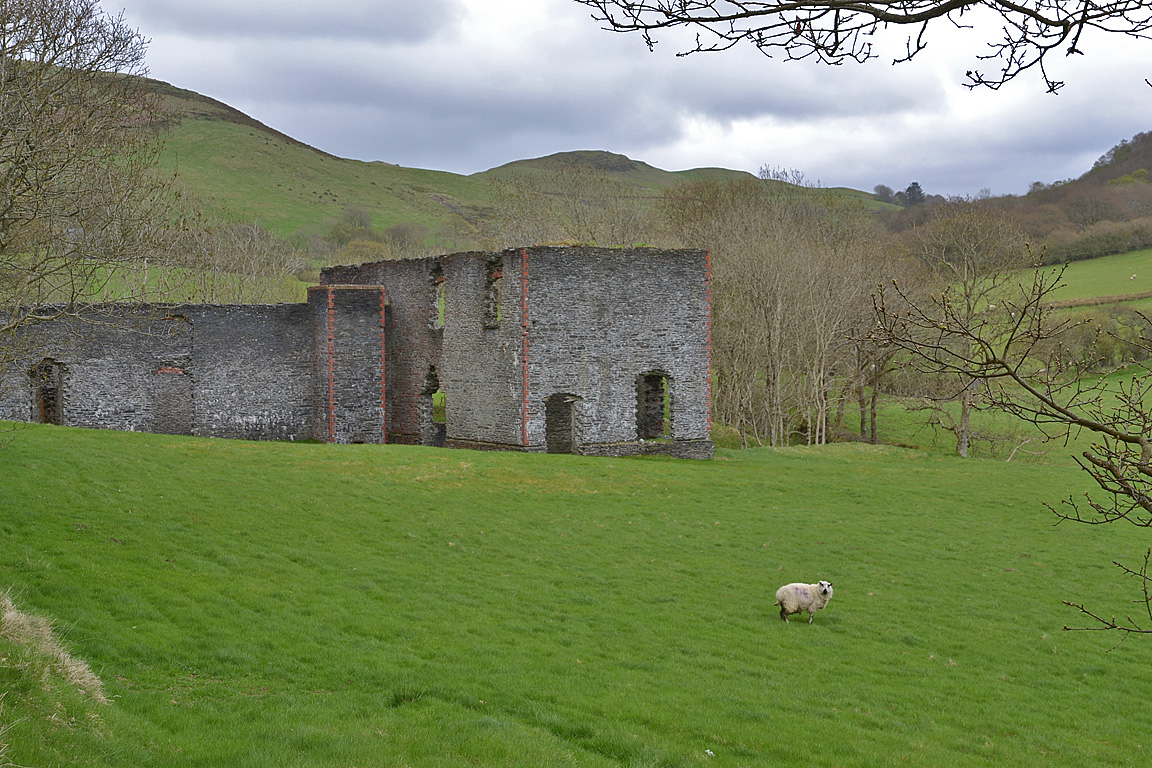
Ruins of the Belgian mill and power station remain in the valley, along with the nearby derelict farmhouse of Lletysynod, once associated with the mine community.
Related mines
- Minera Lead Mines — Both were worked under the Cornish mine-management firm John Taylor & Sons, which took its Cornish methods into the Welsh orefields.
Nearby mines
- Grogwynion Mine — 1.4 miles (2.2 km) S
- Logaulas Mine — 2.5 miles (4.1 km) SE
- Cwm Rheidol Mine — 2.6 miles (4.2 km) N
- Ystumtuen Mine — 3.2 miles (5.1 km) NE
- Penrhiw Mine — 3.2 miles (5.2 km) NE
Straight-line distance, within 9 miles (15 km). Show on the map.
What's uncertain
Points where sources disagree or the record could not be settled; both accounts are kept. All open questions in the archive.
- The Northern Mine Research Society gives the Belgian-run operation's closure as December 1902, consistent with the hydroelectric plant's recorded 1899–1903 operating span. (disputed) 1
- Other accounts describe underground mining at Frongoch continuing until around 1910, with the extensive waste tips reworked for zinc during the 1920s before the site was finally abandoned. (disputed) 3
- A 2012 underground report describes extensively flooded and partly collapsed workings at Frongoch, including a collapsed false floor between two shafts, natural stoping voids, and old wooden roof supports still in place near Williams Shaft. (uncertain) 4
- A 2011 surface report describes the 1899 Belgian dressing mill at Frongoch surviving only as ruins, with the associated hydroelectric power station down the valley also abandoned but still structurally standing. (uncertain) 5
- A photograph taken on 27 July 2022 shows the Frongoch site in use as a Range Rover breaker's yard, with vehicles ranked across the former mine ground; the photographer notes how incongruous it looks in country this remote. (uncertain) 7
Recorded claims
Individual factual claims, each attached to the source(s) that support it below. Where sources disagree, both are kept.
- Development at Frongoch began around 1792 under John Probert, closing around 1818 amid depressed lead prices; the Williams brothers of Cornwall leased the site from 1824 but abandoned it again in 1834. 1
- John Taylor & Sons operated Frongoch as the Lisburne Mines Company from 1834, installing a 40-foot waterwheel for pumping and steam engines for winding and crushing by 1841; this 44-year management is credited with around £600,000 in profit and produced an estimated 100,000 tons of combined lead and zinc ore. 1
- Under John Kitto's management from 1878, Frongoch was notable for processing zinc blende that earlier operators had largely ignored, and pioneered a backfilling technique using crushed waste rock. 1
- Vaughan's New Shaft, begun in 1875, intersected ore at 90 fathoms; workings at Frongoch eventually reached a depth of around 154 fathoms. 1
- In 1899 Frongoch was bought by a Belgian company which installed a new dressing mill and headgear, powered by a hydroelectric station built at Pont Ceunant at a cost of £11,400; around 100 Italian workers were employed and housed in a barracks on site. 2
- The Northern Mine Research Society gives the Belgian-run operation's closure as December 1902, consistent with the hydroelectric plant's recorded 1899–1903 operating span. (disputed) 1
- Other accounts describe underground mining at Frongoch continuing until around 1910, with the extensive waste tips reworked for zinc during the 1920s before the site was finally abandoned. (disputed) 3
- A 2012 underground report describes extensively flooded and partly collapsed workings at Frongoch, including a collapsed false floor between two shafts, natural stoping voids, and old wooden roof supports still in place near Williams Shaft. (uncertain) 4
- A 2011 surface report describes the 1899 Belgian dressing mill at Frongoch surviving only as ruins, with the associated hydroelectric power station down the valley also abandoned but still structurally standing. (uncertain) 5
- The BGS holds a Frongoch working plan with a publicly viewable scan, along with Lisburne group abandonment sheets that name the setts worked together here — Ball's, Edwards, Frongoch West, Glanville's, Llwynwoch, Miller's, Pryse's, Taylor's, Vaughan's, Williams and Wemyss — independently corroborating Vaughan's Shaft as a named working at the mine. 6
- A photograph taken on 27 July 2022 shows the Frongoch site in use as a Range Rover breaker's yard, with vehicles ranked across the former mine ground; the photographer notes how incongruous it looks in country this remote. (uncertain) 7
Photographs & further reading
An underground report covering Engine Shaft, Williams Shaft and the Wemyss drainage adit, with extensive flooding and collapse.
View sourceA surface report on the ruined Belgian mill, hydroelectric station and the nearby derelict Lletysynod farmhouse.
View sourceSources
- (secondary) Frongoch Mine — Northern Mine Research Society
- (secondary) Frongoch mine — an interpretation — Geraint Roberts
- (secondary) Frongoch Mine, Pontrhydygroes, Ceredigion, Wales — Mindat
- (observational) Frongoch Lead and Zinc Mine, April 2012 — 28DaysLater
- (observational) Frongoch Mine & Lletysynod, Pontrhydygroes - Mar '11 — Derelict Places
- (primary) Frongoch mine plans (BGS catalogue) — British Geological Survey
- (observational) Frongoch lead mine is repurposed — Geograph Britain and Ireland
Record created: 19 August 2026 · Last researched: 28 August 2026