 MineArchive
Wemyss Mine
| Also known as | Wemyss Lead and Zinc Mine |
|---|---|
| Location | Cwmnewydion, near Pont-rhyd-y-groes, about 15 km south-east of Aberystwyth, Ceredigion — 52.3508, -3.8894 (exact) |
| Commodities | Lead, Zinc |
| Type | Metal |
| Worked | By the 1840s–1899 |
| Maximum depth | 66 fathoms (about 121 m) |
| Operators | Société Anonyme des Mines de Frongoch (1898–?) — The Belgian company that bought Frongoch and Wemyss in 1898 and built the dressing mill here in 1899; in liquidation by 1904. John Taylor & Sons — Held with Frongoch from the 1840s; the firm named and opened West Frongoch in 1845-54. |
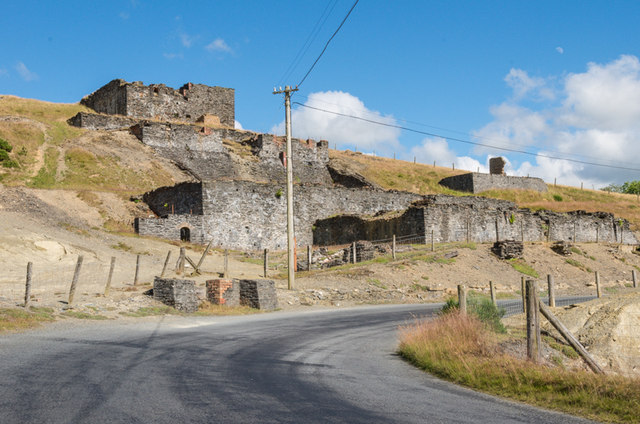
Wemyss was a lead and zinc mine at the head of the Cwmnewydion valley, south-east of Aberystwyth, on the westward continuation of the Frongoch lode. It was worked with Frongoch for most of its life, its adit became Frongoch's drain, and when it closed in 1899 a large dressing mill for Frongoch ore was built on the site. The ruins of that mill and its spoil tips dominate the valley today.
Location
Recorded location. The large pin is this mine; the small round markers are the nearest mines on record. Click one for its page. View on full map
History
Wemyss stood on a different property from Frongoch but on the same lodes, and the two were seldom worked apart. In the 1840s both came under one ownership, and the Wemyss drainage adit was driven on into the Frongoch workings to become the Frongoch adit. The name West Frongoch was given about 1845 to a separate trial 500 yards further west, which John Taylor and Sons opened up in 1854 without much result.
Wemyss itself returned ore from 1861. Its record is patchy: 1861, most years from 1863 to 1873, then a steadier run from 1882 to 1892 and a few years in the 1890s. In all it sold 1,274 tons of lead ore and 1,975 tons of blende, the blende all from 1882 onward. Levels were driven west from the shafts at 44, 56 and 66 fathoms, but they met only short bunches of ore.
The mine closed in 1899. By then Frongoch had been bought by a Belgian company, which electrified the works from a hydro-electric station at Pont Ceunant and built a five-level dressing mill at Wemyss, joined to Frongoch by a tramway. It did not last. By 1904 the company was in liquidation and the machinery was sold at auction.
Geology
Wemyss lies on the westward continuation of the lodes worked at Frongoch. The main lode dips south; a narrow north lode, almost vertical, crosses it about 110 fathoms west of the Boundary shaft. At West Frongoch the lode is 10 feet wide and more, highly silicified, with pale blende, and dips south at about 70 degrees.
Geological setting: Veins and Lodes (well documented example)
Workings
The workings lie east of the road through Cwmnewydion. The adit mouth is about 50 yards east of the road, on the footwall of the main lode, along which the adit runs east for some 150 fathoms before turning north-east and on into Frongoch; the two mines met at the Boundary shaft, near the junction of the two properties. New or Ball's shaft was sunk to the 66-fathom level, and Glanville's shaft to a shallow adit on the north lode. Old shallow workings run almost continuously down to the adit mouth. A 56-foot waterwheel, fed by a leat from Frongoch, stood on the site, and another leat once carried water on from Wemyss to the Graig Goch mine down the valley.
Closure
Wemyss shut in 1899, when the dressing mill was built on the site to treat Frongoch ore. The Belgian company that built it was in liquidation by 1904.
What remains
The site is dominated by the ruins of the dressing mill and by large spoil tips, bounded by the Cwmnewydion stream to the south and the Mill Race stream to the west. Both streams are eroding the tips, and the metals they carry leave the Cwmnewydion, Magwr and Ystwyth failing their standards for zinc, lead and cadmium; a 2009 survey found the Cwmnewydion almost without fish below the mine.
The stepped stone walls of the five-level dressing mill of 1899, a fine wheelpit for the 56-foot waterwheel, and the spoil tips.
Redevelopment
Natural Resources Wales is treating the site under its metal mines programme. Temporary scour protection was fitted to the main spoil heap along the Mill Race in April 2025, and a scheme to manage surface water across the tips was at detailed design that year.
Related mines
- Frongoch Mine — The Frongoch adit drains through Wemyss, the two were worked together from the 1840s, and the Wemyss mill of 1899 dressed Frongoch ore.
- Red Rock Mine — A leat once carried water on from the Wemyss mine to Graig Goch, down the valley.
Nearby mines
- Frongoch Mine — 0.3 miles (0.5 km) W
- Red Rock Mine — 0.7 miles (1.1 km) W
- Gwaithgoch Mine — 1.1 miles (1.8 km) S
- Grogwynion Mine — 1.3 miles (2.0 km) S
- Blaencennant Mine — 2.1 miles (3.4 km) NW
Straight-line distance, within 9 miles (15 km). Show on the map.
Further reading
The Royal Commission's site record, with photographs of the wheelpit and the mill.
View sourceThe regulator's page on the mine's history, the pollution from its tips and the work planned to deal with it.
View sourceSources
- (primary) Frongoch Lead Mine: Wemyss Lead and Zinc Mine (NPRN 33907) — Coflein, Royal Commission on the Ancient and Historical Monuments of Wales
- (secondary) Wemyss Lead & Zinc Mine — Natural Resources Wales
- (secondary) Abandoned Mine Case Study: Wemyss Lead & Zinc Mine (June 2016) — Natural Resources Wales
- (primary) Lead and Zinc: The Mining District of North Cardiganshire and West Montgomeryshire (Special Reports on the Mineral Resources of Great Britain, vol. XX), O. T. Jones, 1922 — Memoirs of the Geological Survey
- (primary) Frongoch Lead Mine Dressing Mill; Wemyss Dressing Mill (NPRN 33870) — Coflein, Royal Commission on the Ancient and Historical Monuments of Wales
- (primary) Mine plan: West Frongoch or Wemyss Mine, SN77SW 10 (KP17018) — British Geological Survey
Record created: 18 November 2026 · Last researched: 18 November 2026