 MineArchive
Fountains Fell Colliery
| Location | Fountains Fell, Malham Moor, North Yorkshire — 54.1405, -2.2065 (approximate) |
|---|---|
| Commodity | Coal |
| Type | Coal |
| Worked | About 1807–Worked to about 1860 |
| Maximum depth | No depth figure has yet been located. |
| Operators | Lord Ribblesdale (1807–?) |
Overview
A coal mine on the top of Fountains Fell, nearly 2,000 feet up, founded about 1807 by Lord Ribblesdale to fuel the calamine works at Malham and later the lead smelting on Malham Moor. Nearly two hundred shafts pit the summit, and a beehive coke oven of roughly coursed sandstone still stands among them.
History
The colliery was founded around 1807 by Lord Ribblesdale, primarily to provide fuel for processing calamine as part of the growing zinc industry at Malham; after 1815 its coke was also used for smelting lead on Malham Moor. It developed slowly, but by 1810 was far enough on to justify building a track for moving coal and materials up and down the fell. Maximum output came in 1812, after which production slowly declined, and coal was worked on the summit into the middle of the century; the coal was sold as lime coal, fire coal and smithy coal, and some of it was coked on the fell. It is not known exactly how long the oven and the colliery stayed in use. A detailed survey by Martin Roe recorded 192 shafts around the summit.
Geology
The colliery worked thin coal in the Yoredale rocks capping Fountains Fell, at nearly 2,000 feet — among the highest coal workings in England, and won at a height and in a climate that would have made every ton hard-earned.
Workings
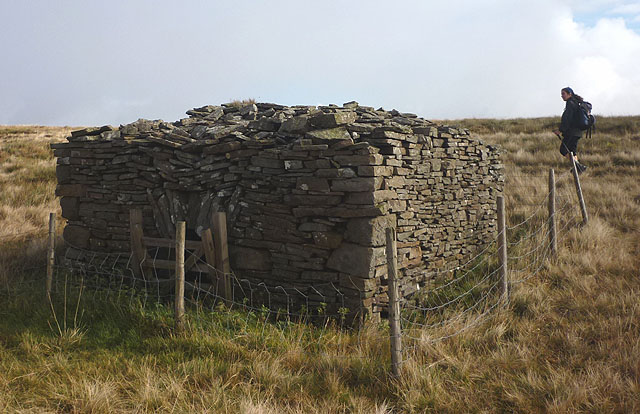
Coal was reached by numerous shafts, some still open with their stone linings visible, each ringed by a mound of spoil which will keep evidence of the pit-top gear — winding arrangements, gin circles and the first sorting of the coal. The shafts and mounds extend over a wide area, of which only a sample is scheduled. A complex of trackways connects the shafts to the coke oven and gave access to the mine. The oven itself is a square structure of roughly coursed sandstone rubble about 4 m square, standing 2 m high on the south side, with an arched opening in that face; inside is the hemispherical dome, 2.2 m across and 1.3 m to the apex, that gives the beehive oven its name, though the top has now subsided.
Closure
Output peaked in 1812 and fell away afterwards; coal was worked on the summit until about 1860, but how long the coke oven and the colliery went on is not recorded.
What remains
The coke oven and a sample of the surrounding shafts and shaft mounds are a scheduled monument on exposed moorland. The oven stands complete but for the subsided crown of its dome, and is now fenced; the shafts, some open and stone-lined, and their mounds pit the summit plateau.
The beehive coke oven, open and capped shafts with stone linings, shaft mounds, and the network of trackways linking the shafts to the oven.
Redevelopment
None. The summit is open access moorland on the Pennine Way.
Nearby mines
- Foredale Quarry — 5.5 km W
- Arcow Quarry — 6.0 km W
- Dry Rigg Quarry — 6.8 km W
- New Providence Lead Mine — 10.3 km NE
- Providence Mine — 10.6 km E
Straight-line distance, within 15 km. Show on the map.
Recorded claims
Individual factual claims, each attached to the source(s) that support it below. Where sources disagree, both are kept.
- The colliery was founded around 1807 by Lord Ribblesdale, primarily to provide fuel for processing calamine at Malham; after 1815 the coke was also used for smelting lead on Malham Moor. 1
- Maximum output was achieved in 1812, after which production slowly declined. 1
- A detailed survey by Martin Roe recorded 192 shafts around the summit of the fell. 2
- The coke oven is about 4 m square and 2 m high, of roughly coursed sandstone rubble, with a hemispherical dome inside 2.2 m across and 1.3 m to the apex. 1,2
Photographs & further reading
The Yorkshire Dales National Park Authority's gazetteer entry for the oven and its colliery, with the survey count of shafts and the uses the coal and coke were put to.
View sourceSources
- (primary) Nucleated coal mine and coke oven on Fountains Fell, Halton Gill (List entry 1017715) — Historic England
- (primary) Fountains Fell coke oven (Yorkshire Dales Historic Environment Record) — Yorkshire Dales National Park Authority
Record created: 22 September 2026 · Last researched: 22 September 2026