 MineArchive
Dry Rigg Quarry
| Also known as | Combs Thorn Quarry |
|---|---|
| Location | Helwith Bridge, Horton-in-Ribblesdale, North Yorkshire — 54.1200, -2.3040 (approximate) |
| Commodity | Sandstone |
| Type | Quarry |
| Worked | 1938–Still active |
| Maximum depth | 322 ft (98 m) in 2021; permitted to reach 738 ft (225 m) |
| Operators | George Greenwood (1940–1964), Tarmac (2015–?) |
Overview
A working gritstone quarry at Helwith Bridge in upper Ribblesdale, inside the Yorkshire Dales National Park, opened in 1938 and worked today by Tarmac. Its stone is a Silurian greywacke with an unusually high resistance to polishing, which makes it one of a small number of British sources of high-specification road aggregate: it has surfaced runways at Manchester Airport, in the Falklands and in Orkney, and both carriageways of the M6 at Tebay. The lorry traffic it generates through the dale has been the subject of long public argument, part-answered in 2016 by reopening a rail connection at the neighbouring Arcow Quarry.
History
Quarrying at Helwith Bridge is much older than Dry Rigg itself. Combs Quarry, immediately west, was started in the eighteenth century and had stopped by 1880; the abundance of workable stone here was one of the arguments for a proposed Settle to Lancaster canal in 1774, which came to nothing. Several small quarries appear on mapping of 1909 that have since gone. The present workings were established in 1938 by a Mr Walker of Cullingworth to meet what was described as an insatiable demand for aggregate, and as they expanded they swallowed the older Combs Thorn Quarry to the west.
At first Dry Rigg supplied flagstone, mostly used locally but also sent to towns across northern England — the area was known for its blue flag and slate stones. The owners gave that up in favour of crushed rock, and the quarry has fed road building ever since. Ownership passed from Walker to George Greenwood about 1940, to Redland in 1964, to Lafarge Aggregates in 1998 and to Tarmac in 2015.
Geology
The rock is a gritstone, properly a greywacke, belonging to the Horton Formation and laid down in the Silurian. Its value is not strength alone but its polished stone value, the measure of how well a road surface resists being buffed smooth by traffic: Dry Rigg typically rates 65, and it is one of only fifteen sites in England and Wales able to produce stone to that specification. It is one of four quarries in the Yorkshire Dales National Park producing high-specification aggregate, with Horton, Ingleton and Arcow.
Geological setting: Sedimentary Beds and Seams (well documented example)
Workings
The rock is won by blasting and then crushed on site, yielding an average of 20,000 tonnes a year at present. Permitted output has fallen sharply since 2013: the quarry produced 320,000 tonnes in 2011 and 260,000 in 2012. The site covers 26 hectares. Stone leaves either by road along the B6479 through the dale or, since 2016, by rail from the reopened Settle-Carlisle connection at the adjoining Arcow Quarry, which takes about half the combined output of the two and is reckoned to have removed some 16,000 lorry journeys a year from local roads.
Closure
Planning permission was extended in 2021 for a further four million tonnes over thirteen years from 2022, with restoration due in 2035; the pit is then to be allowed to fill with water, which is expected to take about thirty years. That extension was left undetermined by a High Court ruling in 2023 holding that the National Park Authority had failed to consider the development's impact on the intrinsic character of the park, and went back to a planning committee.
What remains
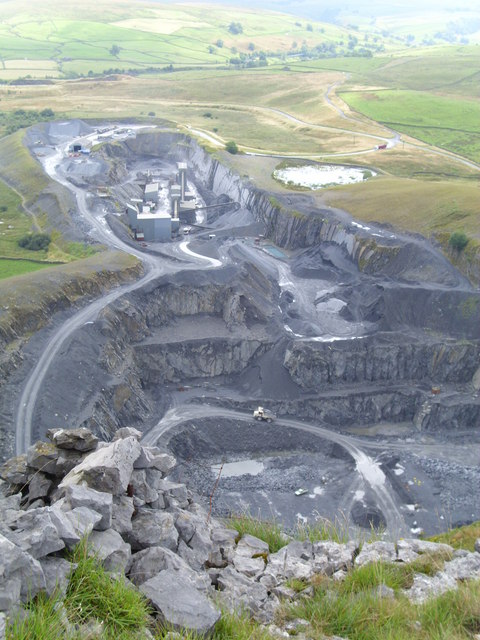
A working quarry. A 2009 view from the limestone above it looks down into what the photographer called simply the big hole. The quarry lies against Swarth Moor, a bog moorland notified as a Site of Special Scientific Interest and noted for its butterflies, sixteen species recorded including the small pearl-bordered fritillary; quarry dust altered the moor's hydrology and dried it out, and Natural England re-wetted it in 2019. Over twenty bird species use the quarry itself, among them ravens, sand martins and lapwings.
A working quarry.
Related mines
- Arcow Quarry — The two Helwith Bridge quarries are worked together by Tarmac: since 2016 about half the combined output of both has left by rail from the reopened Settle-Carlisle connection at Arcow rather than by road from Dry Rigg.
- Foredale Quarry — Both are Helwith Bridge quarries served off the same stretch of the Settle and Carlisle line, Dry Rigg working gritstone below the unconformity and Foredale limestone above it.
Nearby mines
- Arcow Quarry — 0.7 miles (1.2 km) N
- Foredale Quarry — 1.2 miles (1.9 km) NE
- Fountains Fell Colliery — 4.2 miles (6.8 km) E
- Pikedaw Calamine Mines — 5.7 miles (9.2 km) SE
- Ribblehead Quarry — 6.1 miles (9.9 km) N
Straight-line distance, within 9 miles (15 km). Show on the map.
Recorded claims
Individual factual claims, each attached to the source(s) that support it below. Where sources disagree, both are kept.
- The present Dry Rigg workings were established in 1938 by a Mr Walker of Cullingworth and absorbed the older Combs Thorn Quarry to the west; Combs Quarry itself began in the eighteenth century and had ceased by 1880. 1
- The Horton Formation greywacke worked here typically rates 65 for polished stone value, making Dry Rigg one of only fifteen sites in England and Wales that can supply stone to that specification. 1
- The quarry yields about 20,000 tonnes a year at present, well down from 320,000 tonnes in 2011 and 260,000 in 2012. 1
- Permission granted in 2021 allowed a further four million tonnes over thirteen years with restoration in 2035, but a 2023 High Court ruling left the extension undetermined, holding that the National Park Authority had not considered the effect on the park's intrinsic character. 1
- A 2009 view from the limestone edge above records the quarry as an open working pit; it lies immediately against Swarth Moor, whose hydrology was altered by quarry dust until Natural England re-wetted the site in 2019. 1,2
Photographs & further reading
The fullest general account, with the ownership sequence, the output figures and the planning history of the 2021 extension and the 2023 High Court ruling.
View sourceSources
- (secondary) Dry Rigg Quarry — Wikipedia
- (observational) Dry Rigg Quarry, looking down into the workings — Geograph Britain and Ireland
Record created: 9 September 2026 · Last researched: 9 September 2026