 MineArchive
Ribblehead Quarry
| Location | Beside Ribblehead station, Ribblesdale, North Yorkshire — 54.2030, -2.3580 (approximate) |
|---|---|
| Commodity | Limestone |
| Type | Quarry |
| Worked | Late 1800s–1998 |
| Maximum depth | Unknown. |
| Operators | Craven Lime Company (?–1907), H. Austin (1945–?), Amey Roadstone Corporation (1973–1998), Hanson (?–2000) |
Overview
A limestone quarry beside Ribblehead station on the Settle-Carlisle line, opened for building the railway, idle from about 1907, reopened in 1943 and worked by ARC for railway ballast from 1973 until 1998. Since 2000 it has been part of the Ingleborough National Nature Reserve.
History
Ribblehead Quarry, next to Ribblehead station in the Yorkshire Dales, was opened in the late nineteenth century largely as a source of stone for building the Settle to Carlisle railway. Its owner, the Craven Lime Company, let quarrying lapse around 1907; the site was far from any town and workers were hard to bring to it. It was reopened in 1943 to produce agricultural limestone; the National Park's record dates the quarry's working life from that year, when it began producing high-quality limestone for the iron industry of County Durham, while a powdering plant on site made lime for farming, toothpaste, cosmetics and scouring powders. A siding was laid in 1945 for the quarry, then worked by H. Austin, and in 1974 the station's down platform was taken away for it.
The Amey Roadstone Company (ARC) bought the quarry in 1973 to replace its Middlebarrow Quarry near Silverdale, which was near the end of its licence, and between 1976 and 1986 sent about 210,000 tonnes of railway ballast a year out over the Settle-Carlisle line. A plan in the 1980s to supply limestone for absorbing sulphur from power-station flue gases would have taken output to 1.2 million tonnes a year. In 1998 ARC gave up quarrying, leaving about 2.3 million tonnes of reserves, and in October 2000 Hanson handed the site to English Nature as part of the Ingleborough National Nature Reserve, to be left to regenerate; the National Park's record says the owners gave up their mineral rights in 1998 and handed the site over the following year. The quarry siding has since served as a railhead for timber from Cam Fell and for stone brought by road from Ingleton.
Geology
Limestone, with limestone pavement.
Workings
An open quarry with a rail siding to the Settle-Carlisle line from 1945 and an on-site powdering plant.
Closure
ARC gave up quarrying in 1998; the site went to English Nature in October 2000.
What remains
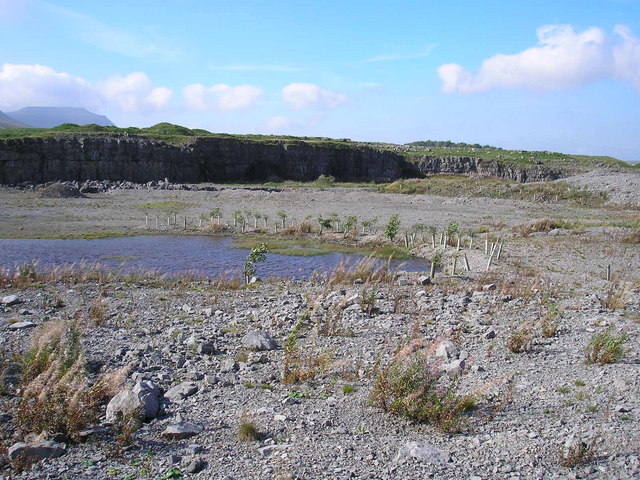
A nature reserve left to regenerate naturally, with a pond and planted trees on the quarry floor; the scarce bird's-eye primrose grows there.
The quarry faces and floor, and the former quarry siding, now reused as a railhead.
Redevelopment
Part of the Ingleborough National Nature Reserve since 2000, with a stone 'Geology Seat' recreating the Ingleborough skyline.
Related mines
- Meal Bank Quarry — Both owned by the Craven Lime Company.
Nearby mines
- Foredale Quarry — 5.4 miles (8.7 km) SE
- Meal Bank Quarry — 5.4 miles (8.7 km) SW
- Arcow Quarry — 5.5 miles (8.8 km) SE
- Wilson Wood Colliery — 5.7 miles (9.1 km) SW
- New Ingleton Colliery — 5.9 miles (9.5 km) SW
Straight-line distance, within 9 miles (15 km). Show on the map.
What's uncertain
Points where sources disagree or the record could not be settled; both accounts are kept. All open questions in the archive.
- Ribblehead Quarry began working in 1943, producing high-quality limestone for the iron industry in Durham. (disputed) 5
- The owners gave up their mineral extraction rights in 1998 and handed the site to English Nature the following year. (disputed) 5
Recorded claims
Individual factual claims, each attached to the source(s) that support it below. Where sources disagree, both are kept.
- The quarry began in the late nineteenth century to provide stone for building the Settle-Carlisle railway. 1,2
- After lapsing around 1907 under the Craven Lime Company, the quarry was reopened in 1943. 1,3
- Between 1976 and 1986 the quarry sent about 210,000 tonnes of railway ballast a year over the Settle-Carlisle line. 1
- ARC ceased quarrying at Ribblehead in 1998. 1
- In 2000 the quarry was given to English Nature as part of the Ingleborough National Nature Reserve. 1,2
- The redundant quarry siding has been reused as a railhead and transfer siding. 1,4
- Ribblehead Quarry began working in 1943, producing high-quality limestone for the iron industry in Durham. (disputed) 5
- The owners gave up their mineral extraction rights in 1998 and handed the site to English Nature the following year. (disputed) 5
Photographs & further reading
The quarry's history from the railway to ARC's ballast trade and the nature reserve.
View sourceThe former quarry siding and its reuse as a railhead.
View sourceThe Yorkshire Dales National Park's record of the quarry, its lime products and its handover to English Nature.
View sourceSources
- (secondary) Ribblehead Quarry — Wikipedia
- (secondary) Ribblehead Quarry — People and the Dales
- (observational) Ribblehead Quarry (Geograph 236594) — Wikimedia Commons (Geograph)
- (secondary) Ribblehead Railhead and Transfer Sidings (SCRCA site 247265) — Settle Carlisle Railway Conservation Area (Friends of the Settle-Carlisle Line)
- (secondary) Ribblehead Quarry (HER MYD36623) — Out of Oblivion (Yorkshire Dales National Park Authority)

Record created: 4 October 2026 · Last researched: 4 October 2026