 MineArchive
Easthouses Pit
| Also known as | Easthouses Colliery, Easthouses Extension Pit |
|---|---|
| Location | Easthouses, east of Newtongrange, Midlothian — 55.8770, -3.0630 (approximate) |
| Commodity | Coal |
| Type | Coal |
| Worked | 1909–1980s |
| Maximum depth | Unknown. |
| Operators | Lothian Coal Company (1890–?) |
Overview
A Midlothian pit east of Newtongrange, developed by the Lothian Coal Company as part of its Newbattle group. The company opened the Easthouses Extension Pit, a drift on the northern edge of Newtongrange, in 1909; when production moved there the original pit was kept as a ventilation shaft. The village of Easthouses grew in the 1920s to house the colliery's men and was extended again in the 1950s. The pits closed with the industry's decline in the 1980s.
History
The Lothian Coal Company was formed in 1890 to take over the Newbattle colliery and the other mines formerly held privately by the Marquis of Lothian. Easthouses belonged to that group. There were in fact two pits in the area: the original working, and the Easthouses Extension Pit, a drift mine on the northern edge of Newtongrange which the company opened in 1909. With the Extension developed to the north, production ceased at the original pit, which was kept on as a ventilation shaft.
The colliery made the village. Easthouses developed through the 1920s to accommodate miners working the nearby pit, and the settlement was significantly extended in the 1950s. The company also built its own tramway to serve the workings. The decline of the coal industry in the 1980s closed the collieries.
Geology
The Midlothian coalfield, the deep syncline south of Edinburgh whose measures supported the Lothian Coal Company's group of pits around Newbattle and Newtongrange. Easthouses lies on its eastern side, and the 1909 Extension was driven as a drift rather than sunk as a shaft, which suggests the company was following the coal laterally rather than going deeper for it.
Geological setting: Sedimentary Beds and Seams (well documented example)
Workings
Two workings in sequence: an original pit, and from 1909 the Easthouses Extension Pit, a drift mine on the northern edge of Newtongrange. Once the Extension was in production the original pit stopped winding coal and served as a ventilation shaft. The Lothian Coal Company built the Easthouses tramway to serve the site.
Closure
The collieries closed with the decline of the coal industry in the 1980s. No precise closure date for Easthouses is recorded.
What remains
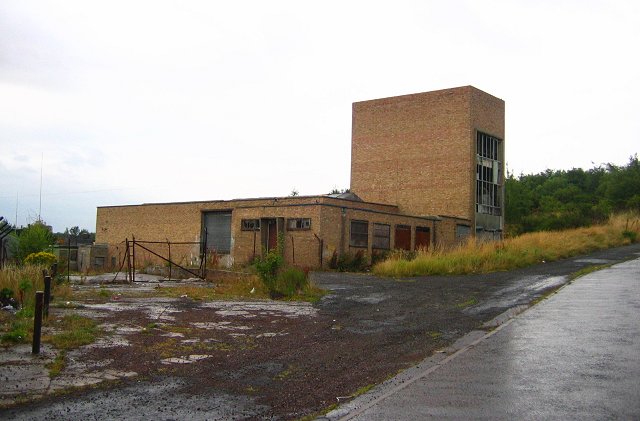
Easthouses is now a settlement in its own right east of Newtongrange, its 1920s and 1950s housing the most visible legacy of the pit. A derelict industrial building photographed in 2005 is among the little that survives of the working site.
A derelict industrial building, photographed in 2005, is among the little that survives of the working site.
Related mines
- Newbattle Collieries — Easthouses was part of the Lothian Coal Company's Newbattle group, formed in 1890 from the Marquis of Lothian's mines; Easthouses is named on the Newbattle record.
Nearby mines
- Newbattle Collieries — 1.0 miles (1.5 km) S
- Lady Victoria Colliery — 1.1 miles (1.7 km) S
- Lingerwood Colliery — 1.2 miles (1.9 km) S
- Eldin Colliery — 1.6 miles (2.5 km) W
- Fordel Mains Colliery — 1.9 miles (3.1 km) NE
Straight-line distance, within 9 miles (15 km). Show on the map.
What's uncertain
Points where sources disagree or the record could not be settled; both accounts are kept. All open questions in the archive.
- The BGS mine-plans catalogue holds a Mining Remediation Authority abandonment plan titled 'Easthouses' (catalogue S675, Great Seam, dated 1971); the catalogue gives no location and the plan's details do not clearly tie it to this working, so it may belong to another of the same name. (uncertain) 3
Recorded claims
Individual factual claims, each attached to the source(s) that support it below. Where sources disagree, both are kept.
- The Lothian Coal Company was formed in 1890 to take over the Newbattle colliery and the other mines of the Marquis of Lothian, and Easthouses was part of the Newbattle group. 1
- The Lothian Coal Company opened the Easthouses Extension Pit, a drift mine on the northern edge of Newtongrange, in 1909; with its development production ceased at the original pit, which remained as a ventilation shaft. 1
- Easthouses developed in the 1920s to accommodate miners for the nearby colliery and was significantly extended in the 1950s. 2
- The decline of the coal industry in the 1980s led to the closure of the collieries. 2
- The BGS mine-plans catalogue holds a Mining Remediation Authority abandonment plan titled 'Easthouses' (catalogue S675, Great Seam, dated 1971); the catalogue gives no location and the plan's details do not clearly tie it to this working, so it may belong to another of the same name. (uncertain) 3
Photographs & further reading
The pit's rail connections and its place in the Lothian Coal Company's Newbattle group, with the 1909 Extension and the company tramway.
View sourceSources
- (secondary) Easthouses Pit — Railscot
- (secondary) Easthouses — Wikipedia
- (primary) BGS / Mining Remediation Authority mine plans: EASTHOUSES — British Geological Survey / Mining Remediation Authority
- (observational) Derelict industrial building, Easthouses — Wikimedia Commons

Record created: 9 September 2026 · Last researched: 9 September 2026