 MineArchive
Denaby Main Colliery
| Location | Denaby Main, between Mexborough and Conisbrough, South Yorkshire — 53.4898, -1.2554 (exact) |
|---|---|
| Commodity | Coal |
| Type | Coal |
| Worked | 1863–1968 |
| Maximum depth | Unknown. The workings were on the Barnsley seam. |
| Operators | Denaby Main Colliery Company (1863–?), Amalgamated Denaby Collieries Ltd (?–1947) |
Overview
A Barnsley-seam colliery in the Dearne valley between Mexborough and Conisbrough, sunk in 1863 for the Denaby Main Colliery Company after an earlier attempt by Waring & Co. from 1856 was given up. It made a village around itself of parallel terraced streets from which almost every door looked down on the pit, and it made a reputation to match: a magazine called Denaby "the worst village in England" in 1899, and in 1902–3 the company obtained eviction orders against 750 tenant families during the Bag Muck Strike. All its coal was hand got. By the time it closed in 1968, 203 men had been killed there.
History
Sinking at Denaby Main was begun by Waring & Co. in 1856 and appears to have been given up in 1860; two shafts were sunk in 1863 for the Denaby Main Colliery Company, owned by Messrs Pope and Pearson. The village that grew round it was laid out in the manner of the industrial revolution — parallel terraced streets running back from the Mexborough to Conisbrough road, with the library and park at the centre, and the colliery visible from almost every street. Kilner Glass opened a factory beside the mine in 1863, giving the village a second employer until it closed in 1936. The mine worked the Barnsley seam and all its coal was hand got: no machinery and no conveyor belts, the coal shovelled into corves and hauled along a track by pit ponies. Denaby has a long history of disputes. A six-month strike over union recognition in 1869 was ended by negotiation. Disputes in 1877 and 1885 both led to evictions. The best known came in 1902–3: the Bag Muck Strike, fought over whether the men would be paid for removing the "bag muck", an uneven band of rock running through the Barnsley seam that had to be got out to reach the coal. The company refused, the men struck, and when the strike was twenty-six weeks old the company was granted eviction orders against 750 tenants. Families spent January 1903 in tents on open ground with sheets and blankets and soup kitchens. It was company policy to evict a dead miner’s family from company housing within weeks of the bereavement. In 1899 the magazine Christian Budget described the village as "so repulsive that many who have never been near it will probably refuse to credit the story" — a place where wages went on betting, religion was forgotten and, it alleged, wives were sold like cattle. The village’s own historians record the phrase as notoriety earned by hard and ruthless employers rather than by the people who lived there. Denaby’s Barnsley seam reserves were eventually exhausted. In 1967 it and its neighbour became "Denaby–Cadeby", and the two mines were merged on 23 March 1968.
Geology
The Barnsley seam of the South Yorkshire coalfield, the thick and prolific seam that carried most of the Doncaster-area pits. Running through it at Denaby was the "bag muck" — an uneven band of rock that had to be got down and cleared before the coal could be worked, and whose payment was the cause of the 1902–3 strike.
Workings
Two shafts of 1863. The mine was worked entirely by hand: no machinery and no conveyors, the coal shovelled into corves and drawn along a track by pit ponies. The colliery was served by two railway stations bearing the village’s name — Denaby, some distance off on the Dearne Valley Railway, and Denaby and Conisbrough, the southern terminus of the South Yorkshire Junction Railway.
Closure
Rationalisation followed the exhaustion of Denaby’s Barnsley seam reserves. In 1967 the two collieries became "Denaby–Cadeby", and the mines were merged on 23 March 1968.
What remains
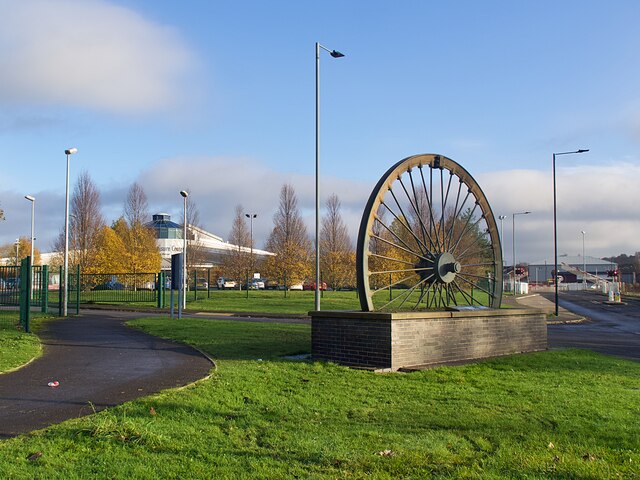
The colliery is gone and the site redeveloped. A colliery winding wheel stands outside the Dearne Valley Leisure Centre in the village as a memorial, and the terraced streets of the colliery village — Bolton Street among them — survive.
None of the colliery; a colliery wheel is preserved as a memorial in the village.
Related mines
- Cadeby Main Colliery — The two Dearne valley pits were run together and merged outright: in 1967 they became "Denaby–Cadeby" and on 23 March 1968 the two mines were combined, Denaby’s Barnsley seam reserves having been exhausted.
Nearby mines
- Cadeby Main Colliery — 1.1 miles (1.8 km) E
- Kilnhurst Colliery — 2.6 miles (4.2 km) SW
- Manvers Main Colliery — 3.0 miles (4.9 km) W
- Yorkshire Main Colliery — 3.0 miles (4.9 km) E
- Barnburgh Main Colliery — 3.3 miles (5.3 km) N
Straight-line distance, within 9 miles (15 km). Show on the map.
What's uncertain
Points where sources disagree or the record could not be settled; both accounts are kept. All open questions in the archive.
- The BGS mine-plans catalogue holds a Mining Remediation Authority abandonment plan titled 'Denaby Main' (catalogue M781, Barnsley, dated 1871); the catalogue gives no location and the plan's details do not clearly tie it to this working, so it may belong to another of the same name. (uncertain) 2
Recorded claims
Individual factual claims, each attached to the source(s) that support it below. Where sources disagree, both are kept.
- Sinking at Denaby Main was begun by Waring & Co. in 1856 and appears to have been given up in 1860; two shafts were sunk in 1863 for the Denaby Main Colliery Company, owned by Messrs Pope and Pearson. 1
- The strike of 1902–3 was caused by the company’s refusal to pay the men for removing the "bag muck", an uneven layer of rock running through the Barnsley seam that had to be got out to reach the coal; when the strike was twenty-six weeks old the company was granted eviction orders against 750 tenants, and evicted families spent January 1903 in tents on open ground. 1
- A six-month strike over union recognition in 1869 was ended by negotiation, and further disputes in 1877 and 1885 also led to evictions. 1
- All of the coal at Denaby was hand got: no machinery or conveyor belts were used, and the Barnsley seam coal was shovelled into corves for hauling along a track by pit ponies. 1
- Although there were no major accidents at Denaby, unlike its neighbour Cadeby Main, 203 miners had been killed there by the time the mine closed in 1968; it was company policy to evict a dead miner’s family from company housing within weeks of the bereavement. 1
- The village gained notoriety at the close of the nineteenth century when the magazine Christian Budget characterised it in 1899 as "the worst village in England". 1
- Rationalisation followed the exhaustion of Denaby’s Barnsley seam reserves; in 1967 the two collieries became "Denaby–Cadeby" and the mines were merged on 23 March 1968. 1
- The BGS mine-plans catalogue holds a Mining Remediation Authority abandonment plan titled 'Denaby Main' (catalogue M781, Barnsley, dated 1871); the catalogue gives no location and the plan's details do not clearly tie it to this working, so it may belong to another of the same name. (uncertain) 2
- Located at about 53.490 N, 1.255 W. 3
Photographs & further reading
The village’s own history of its two pits, with the sinking, the strikes and evictions, the hand-got Barnsley seam and the 1968 merger.
View sourceThe mine-explorer database entry for the colliery, with photographs of the site and its surviving traces.
View sourceSources
- (secondary) Denaby and Cadeby Collieries — Conisbrough and Denaby Main Local History
- (primary) BGS / Mining Remediation Authority mine plans: DENABY MAIN — British Geological Survey / Mining Remediation Authority
- (secondary) Denaby Main — Wikipedia
- (observational) Denaby Main Colliery — AditNow
Record created: 6 September 2026 · Last researched: 6 September 2026