 MineArchive
Cymmer Colliery
| Location | Cymmer, Porth, lower Rhondda Valley, Rhondda Cynon Taf — 51.6107, -3.4080 (exact) |
|---|---|
| Commodity | Coal |
| Type | Coal |
| Worked | 1847–1939 |
| Maximum depth | Unknown. |
| Operators | George Insole & Son (1844–1939) |
Overview
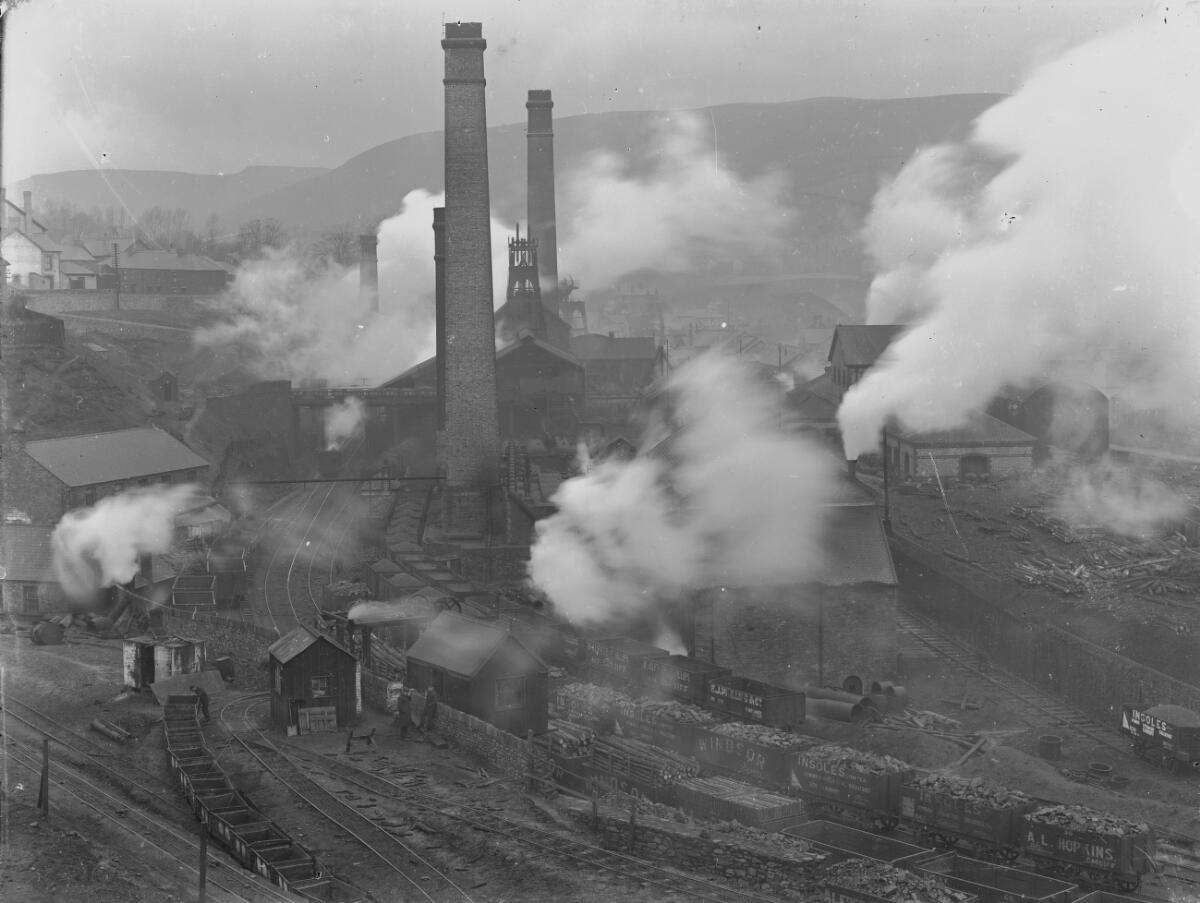
A lower Rhondda colliery near Porth, bought by George Insole and his son in 1844 and worked by the Insole company until 1939. Its Old Pit, sunk in 1847 and driven hard through the Crimean War coal boom, was the scene of the explosion of 15 July 1856 in which 114 men and boys died — at the time the worst colliery disaster recorded anywhere in the country, and one that changed the law on ventilation, safety lamps and the employment of children.
History
George Insole and his son James Harvey Insole bought Cymmer Colliery in 1844, and in 1847 sank the No. 1 Pit, known after 1853 as the Cymmer Old Pit. James took control of the business when his father died in 1851.
Between 1852 and 1855 HM Inspector of Mines Herbert Francis Mackworth inspected the colliery twice and wrote to Insole recommending improvements to the underground ventilation and the use of safety lamps. Relations underground were poor as well: in 1854 the manager Jabez Thomas dismissed two experienced firemen and brought in two others from outside, and the men's refusal to work under them — against Insole's insistence on his authority to employ whom he pleased without consulting any body of men — produced a twenty-two week strike that only financial pressure and the threat of legal action ended. Meanwhile Rhondda coal was in heavy demand as a coking coal, and the Crimean War sharpened it further; in 1855 Insole doubled the number of colliers at the Old Pit and enlarged the worked area by more than a third.
On 15 July 1856 the Old Pit exploded, killing 114 men and boys (see Disasters, below). After a second gas explosion that December, the single-shaft Old and New Pits were linked to give a safer two-shaft arrangement. Mechanical ventilators had been in use in the lower Rhondda since 1851 but were not installed at Cymmer until the mid-1870s, by which time the management had also concluded it was both safer and cheaper to give the colliers safety lamps. The Insole company worked the Old Pit until it closed in 1939.
Geology
The colliery worked the steam and coking coals of the lower Rhondda, in the Coal Measures of the South Wales Coalfield. The Rhondda variety of coal was in strong demand by the mid-nineteenth century as a coking coal, which is what drove the pace of development at the Old Pit; gas accumulating in workings extended that fast, in a single-shaft mine ventilated by the arrangement Mackworth had already criticised, is the geological and economic background to the 1856 disaster.
Workings
The No. 1 or Old Pit was sunk in 1847 and worked at first as a single-shaft mine — the arrangement that trapped the men in 1856. After a second explosion later that year the Old Pit was linked underground to the New Pit to give two shafts and better ventilation. Mechanical ventilation replaced the earlier arrangement in the mid-1870s, and safety lamps came in at about the same time.
Closure
The Cymmer Old Pit was worked by the Insole company until it closed in 1939.
What remains
The colliery site has been cleared. The Cymmer Colliery Workingmen's Institute survives in the village, and a memorial to those killed in 1856 stands at Porth. Colliery buildings of the neighbouring Lewis Merthyr pit are preserved a short distance away at the Rhondda Heritage Park.
The Cymmer Colliery Workingmen's Institute and a memorial at Porth.
Related mines
- Tynewydd Colliery, Porth — Water from Cymmer's abandoned, flooded No. 3 Rhondda workings broke into Tynewydd in 1877.
Nearby mines
- Glynfach Colliery — 0.2 miles (0.4 km) SE
- Tynewydd Colliery, Porth — 0.3 miles (0.5 km) NW
- Llwyncelyn Colliery — 0.5 miles (0.9 km) E
- Lady Lewis Colliery — 0.7 miles (1.2 km) N
- Lewis Merthyr Colliery — 0.8 miles (1.3 km) E
Straight-line distance, within 9 miles (15 km). Show on the map.
Disasters & major incidents
-
Cymmer Colliery Explosion, 1856
15 July 1856 · Explosion · 114 fatalities
On the morning of 15 July 1856, 160 men and boys went down the Old Pit at Cymmer Colliery near Porth for the six o'clock shift. A gas explosion near the mine entrance trapped those already deeper in; 114 died, most of them of afterdamp. Forty-nine were boys under sixteen, fifteen of them under twelve. The mine's manager and four officials were charged with manslaughter and all were acquitted.
What's uncertain
Points where sources disagree or the record could not be settled; both accounts are kept. All open questions in the archive.
Recorded claims
Individual factual claims, each attached to the source(s) that support it below. Where sources disagree, both are kept.
- George Insole and his son James Harvey Insole purchased Cymmer Colliery in 1844 and in 1847 sank the No. 1 Pit, known after 1853 as the Cymmer Old Pit. 1,2
- Between 1852 and 1855 HM Inspector of Mines Herbert Francis Mackworth inspected the colliery twice and wrote to Insole recommending improvements to the underground ventilation and the use of safety lamps. 1,2
- The dismissal of two experienced firemen by the manager Jabez Thomas in 1854, and Insole's insistence on his authority to employ whom he pleased, led to a twenty-two week strike. 1,2
- Crimean War demand added to the existing appetite for Rhondda coking coal, and in 1855 Insole doubled the number of colliers at the Old Pit and increased the worked area by over a third. 1,2
- After a second gas explosion in December 1856 the single-shaft Old and New Pits were linked to create a two-shaft arrangement; mechanical ventilators were installed in the mid-1870s, by which time the management had also adopted safety lamps. 1,2
- The Cymmer Old Pit was worked by the Insole company until the mine closed in 1939. (uncertain) 1,2
Photographs & further reading
A detailed, well-referenced account of the colliery under the Insoles, the 1856 explosion and the inquest and trial that followed, drawing on E. D. Lewis's 1976 study and the Inspector of Mines' own report.
View sourceSources
- (secondary) Cymmer Colliery explosion — Wikipedia
- (secondary) E. D. Lewis, 'The Cymer (Rhondda) Explosion', Transactions of the Honourable Society of Cymmrodorion (1976), 118-161 — Honourable Society of Cymmrodorion
Record created: 3 September 2026 · Last researched: 3 September 2026