 MineArchive
Coronation Pit, Walbottle
| Also known as | Throckley Coronation Colliery |
|---|---|
| Location | Throckley, Newcastle upon Tyne, Tyne and Wear — 55.0040, -1.7256 (exact) |
| Commodity | Coal |
| Type | Coal |
| Worked | 1820–20 August 1954 |
| Maximum depth | About 659 feet, to the Brockwell seam |
| Operators | Throckley Coal Co. (?–1946) — Owner in the 1940s; also reopened the neighbouring Blucher Pit in 1900. National Coal Board (1947–1954) |
A Walbottle Colliery pit at Throckley named for George IV's coronation, with a village that grew up around it, which took over from Blucher Pit in 1924-25 under the Throckley Coal Company and closed on 20 August 1954.
Location
Recorded location. The large pin is this mine; the small round markers are the nearest mines on record. Click one for its page. View on full map
History
Coronation Pit was one of the pits of Walbottle Colliery, at Throckley about five and a half miles west-north-west of Newcastle. By one account it opened in 1820 and was called Coronation Pit to mark the coronation of George IV, and a village grew up around it; by another it opened in 1800. Walbottle Colliery is recorded from before 1828 and passed through a succession of owners, from J. Lamb and Potters and Joblings' Trustees in the 1850s to the Lemington Colliery Company.
A description of Walbottle Colliery published in 1844, when Messrs. Lamb and Company were its proprietors, gives it three working pits, drawing coal with 83 horsepower of winding engines, and three pumping engines of 262 horsepower between them. Coal from the Coronation Pit travelled about two miles by waggonway to the staith at Lemington, the waggons moved by horses and inclined planes, and went on to the ships by keel. It was sold as Holywell Main, Newburn Main, Holywell Reins and Holywell Reins Splint. The colliery, the account says, had been 'remarkably fortunate in its exemption from explosions'.
The Throckley Coal Company, owners of pits at Heddon, Throckley and Newburn, which had reopened the neighbouring Blucher Pit in 1900, closed Blucher in 1924-25 in favour of workings at the reopened Coronation site. The reopened pit worked the Brockwell, Hutton and Main seams. The Hutton seam was abandoned on 8 March 1934. Employment stood at 154 in 1925, 430 in 1935 and 324 in 1940, and the colliery passed to the National Coal Board in 1947. By 1950 it was working the Hodge, Ruler and Tilley seams, and in its last year only the Ruler and Tilley. It closed on 20 August 1954, when 312 people were employed.
Geology
The Hutton seam was worked and was abandoned on 8 March 1934. The shaft, from a surface about 333 feet above sea level, passed the Grove seam at 214 feet, the Engine seam (3 feet 11 inches) at 441 feet, the Hodge at 457 feet, the Three-Quarter at 543 feet and the Main Coal (3 feet 1 inch) at 582 feet, and reached the Brockwell seam, 4 feet 6 inches thick, at about 659 feet. Two basalt or whin dykes cross the Walbottle royalty, and an account of 1844 called slip dykes and troubles 'very prevalent' there.
Geological setting: Dykes and Sills (historical documentary reference), Faults and Fractures (historical documentary reference), Sedimentary Beds and Seams (well documented example)
Workings
In the 1840s coal left the pit by a waggonway about two miles long to Lemington staith, worked by horses and inclined planes; the line joined the branch from Duke Pit and the Throckley pits' waggonway at Walbottle Road, so that all three shared the inclined plane down to Lemington. After the pit reopened in the 1920s it worked the Brockwell, Hutton and Main seams (1925), the Brockwell, Main, Stone and Tilley (1935) and the Hodge, Ruler and Tilley (1950), raising coking, gas, household, manufacturing and steam coal.
Closure
The colliery closed on 20 August 1954, when 312 people were employed, 232 of them underground. In its last year it worked only the Ruler and Tilley seams.
What remains
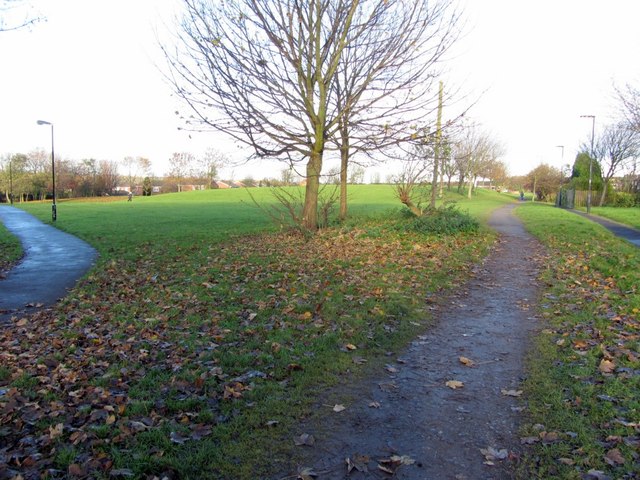
In 2013 the pit site was a grassed open space at North Walbottle, on land reclaimed from the colliery.
The line of the waggonway survived as a footpath east of Walbottle Road in 2013.
Redevelopment
The pit's land was reclaimed and is now open grassed space among the houses of North Walbottle.
Related mines
- Blucher Colliery — The Throckley Coal Company closed Blucher Pit in 1924-25 in favour of workings at the reopened Coronation site.
- Throckley Colliery — The Throckley Coal Company owned both: it sank Throckley's Isabella pit in 1867 and worked the reopened Coronation Pit from the 1920s.
- Walbottle Colliery — Physical link: the Coronation Pit was one of Walbottle Colliery's pits.
Nearby mines
- North Walbottle Colliery — 0.4 miles (0.6 km) NE
- Loughbridge Drift — 0.6 miles (1.0 km) NW
- Blucher Colliery — 0.8 miles (1.3 km) S
- Callerton Colliery — 0.9 miles (1.5 km) NW
- Dewley Pits — 1.0 miles (1.6 km) NW
Straight-line distance, within 9 miles (15 km). Show on the map.
Further reading
Owners, output, employment 1925-1954 and a short list of those killed.
View sourceThe county Historic Environment Record entry with the 1820 opening, the naming and the owners of Walbottle Colliery.
View sourceThe parent colliery's page, with the 1844 description of its pits, engines and the Coronation Pit waggonway to Lemington.
View sourceThe strata sunk through in the Coronation Pit, from the surface to the Brockwell seam.
View sourceSources
- (primary) Walbottle Colliery, Coronation Pit (HER 3984) — Tyne and Wear Historic Environment Record (Sitelines)
- (primary) Durham Mining Museum - Throckley 'Coronation' Colliery — Durham Mining Museum
- (primary) Walbottle Colliery, Blucher Pit (HER 3939) — Tyne and Wear Historic Environment Record (Sitelines)
- (primary) BGS / Mining Remediation Authority abandonment plans: THROCKLEY/BLUCHER/CORONATION — British Geological Survey
- (primary) Durham Mining Museum - Walbottle Colliery — Durham Mining Museum
- (primary) Durham Mining Museum - Walbottle Colliery, Coronation Pit shaft details — Durham Mining Museum
- (observational) Open space, North Walbottle (Geograph 3797591, 2013) — Geograph
- (observational) Open space, North Walbottle (Geograph 3797603, 2013) — Geograph
- (observational) Path east of Walbottle Road (Geograph 3796065, 2013) — Geograph
Record created: 29 September 2026 · Last researched: 30 September 2026