 MineArchive
Coldstones Quarry
| Location | Greenhow, above Pateley Bridge, Nidderdale, North Yorkshire — 54.0725, -1.8133 (exact) |
|---|---|
| Commodities | Limestone, Lead |
| Type | Stone |
| Worked | from around 1800 |
| Maximum depth | Unknown. |
| Operators | Heidelberg Materials (2023–?) |
Overview
A large limestone quarry on the moors above Greenhow, worked since around 1800 on ground first exploited for lead and barytes, and now one of the highest working quarries in Britain.
History
Coldstones Hill, on the moors above Greenhow and Pateley Bridge, was worked for lead and barytes before the limestone quarry itself began around 1800, with lime kilns already standing on the site the quarry later absorbed. Early working was by hand; ownership passed through Elisha Newbould (1892-1902) and then Henry Newbould before the quarry closed between 1926 and 1929. It reopened under Nidderdale Quarries in 1929 to supply stone for West Riding County Council's road maintenance, introducing mechanical crushing and gelignite blasting, and output rose further to help build airfields across the Vale of York during the Second World War. Ownership passed to the Yorkshire Brick Company Ltd in 1959, Pioneer in 1982, Hanson in 2000 and Heidelberg Materials in 2023. Output has ranged from around 900,000 tonnes a year in the mid-2000s to roughly 500,000 tonnes in 2022, with production expected to continue to around 2032.
Geology
Quarries a 13-metre band of Hardshaw Scar Limestone, the youngest formation in the Alston Group, laid down under tropical seas around 330 million years ago. A mineralised feature known as the Garnet Vein, up to about 2 metres wide on the quarry's southern side, has yielded aurichalcite, calcite, cinnabar, hemimorphite, cerussite and smithsonite, and the quarry is the only recorded UK locality for the minerals prosopite, doyleite and otavite.
Workings
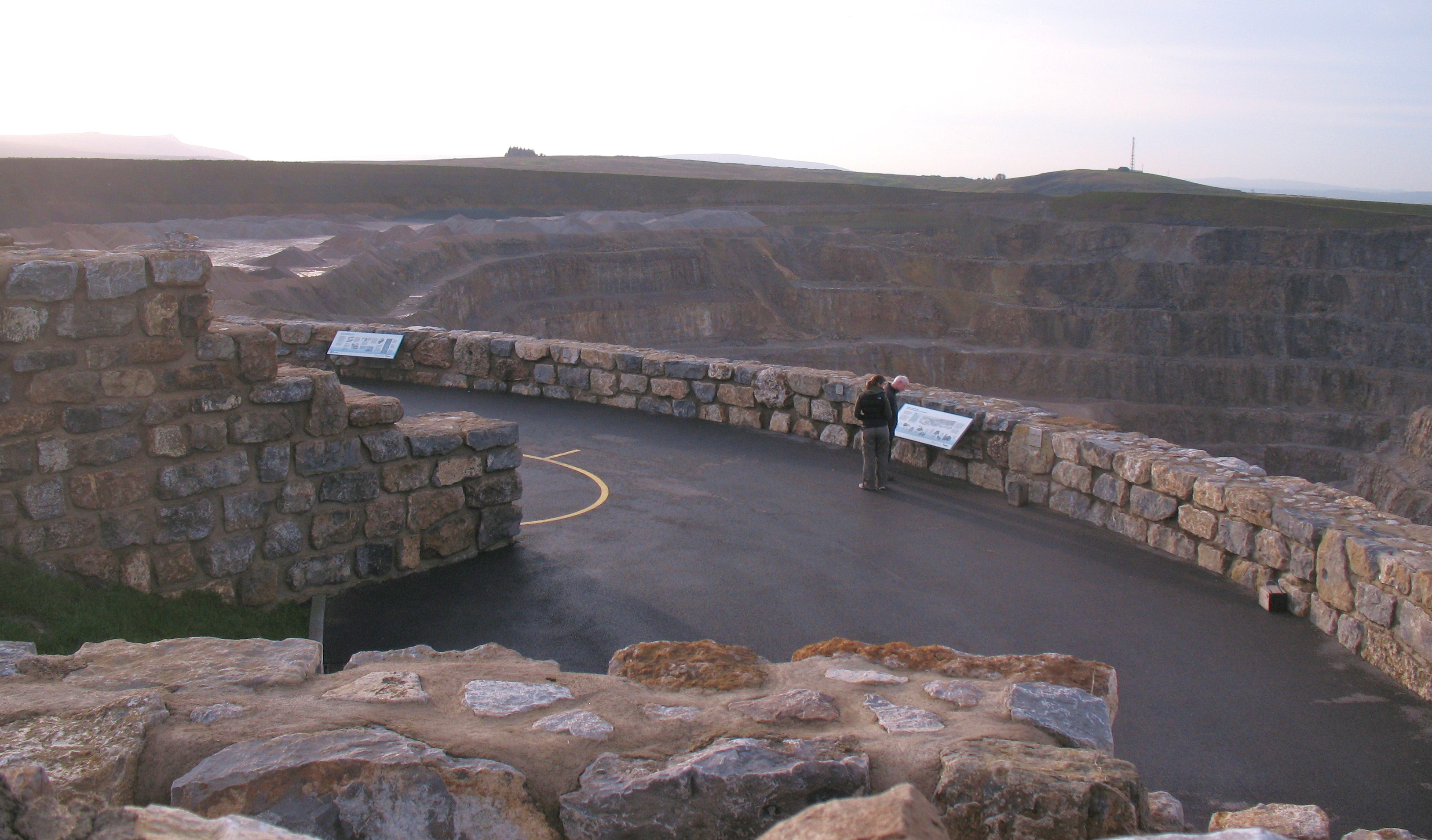
An open quarry cut into a 13-metre band of Hardshaw Scar Limestone at around 400m elevation, one of the highest working quarries in Britain. A viewing platform and walkway, the Coldstones Cut, was built into the quarry's edge in 2010 by artist Andrew Sabin using stone won from the quarry itself, funded by Arts Council England, Natural England and Yorkshire Forward with labour and stone from Hanson Aggregates; it won the Marsh Award for Excellence in Public Sculpture in 2011.
Closure
Still an active working quarry; extraction is expected to continue to around 2032.
What remains
Actively worked by Heidelberg Materials for aggregate, block stone and agricultural lime, producing around 500,000 tonnes a year (2021-22); the Coldstones Cut viewing structure is open to the public on its rim.
Nearby mines
- Greenhow Mines — 0.7 miles (1.1 km) NW
- Prosperous Lead Mine — 1.3 miles (2.0 km) N
- Stony Grooves Mine — 2.1 miles (3.4 km) NW
- Scotgate Ash Quarry — 2.8 miles (4.5 km) NE
- Red Scar Mine — 4.5 miles (7.2 km) W
Straight-line distance, within 9 miles (15 km). Show on the map.
Recorded claims
Individual factual claims, each attached to the source(s) that support it below. Where sources disagree, both are kept.
- The quarry has passed through Elisha and Henry Newbould (1892-c.1920s), Nidderdale Quarries (1929-1959), the Yorkshire Brick Company Ltd (1959-1982), Pioneer (1982-2000), Hanson (2000-2023) and Heidelberg Materials (2023-present). 1
- Coldstones Quarry is the only recorded UK locality for the minerals prosopite, doyleite and otavite. 1
- The wider Greenhow Hill mining area, of which Coldstones formed part, was surveyed and mapped by the geologist K. C. Dunham, whose plan survives in the British Geological Survey's mine-plans catalogue. 2
- Located at about 54.072 N, 1.813 W. 1
Photographs & further reading
The sculpture trust's own page on the viewing structure built into the quarry face.
View sourceA 2020s visitor account of the quarry and the Coldstones Cut, including present-day access and views.
View sourceSources
- (secondary) Coldstones Quarry — Wikipedia
- (primary) BGS Mine Plans: Greenhow Hill Mining Area — British Geological Survey / Mining Remediation Authority
Record created: 31 August 2026 · Last researched: 31 August 2026