 MineArchive
Coegnant Colliery
| Location | Nantyffyllon, Maesteg, Bridgend — 51.6264, -3.6534 (exact) |
|---|---|
| Commodities | Coal, Ironstone |
| Type | Coal |
| Worked | 1882–1981 |
| Maximum depth | Sunk to the Six Feet seam at 400 yards (366 m); one shaft deepened by a further 230 yards (210 m) in 1960. |
| Operators | Llynfi Coal and Iron Company (1882–1889), North's Navigation Collieries Company Limited (1889–1947), National Coal Board (1947–1981) |
Overview
Coegnant Colliery was a steam-coal pit at Nantyffyllon, in the Llynfi valley north of Maesteg, sunk in 1882 and worked continuously until 1981. For most of its life it belonged to North's Navigation Collieries, the company that dominated the valley, and at its peak it employed well over 1,500 men in two shafts. It survived nationalisation, a major reconstruction in 1960 and the closure of most of its neighbours before the failure of its last coalface brought it down. The site is now a community woodland.
History
The Llynfi Coal and Iron Company began sinking Coegnant in 1882 to reach the Six Feet seam at 400 yards. Two shafts were sunk, North and South, with the North shaft used for winding. North's Navigation Collieries took the colliery over in 1889 and held it until nationalisation. The Inspector of Mines lists record 747 men in 1894 and 569 in 1896, rising to 901 by 1900. By 1905 the two pits were returned separately, with 1,193 men at the North Pit and 370 at the South, and the colliery was raising steam coal throughout. Accounts of the workforce on the eve of the First World War disagree: the Lists of Mines give 1,592 men in 1915, while a secondary account puts it at 1,900. A 1923 list records 2,040 men producing coal and ironstone from the Six Feet, Seven Feet and Upper and Lower New seams, and 1,662 were employed in 1933. Three men were killed in an underground accident in 1931. Employment had fallen to 1,119 by 1940 and to 722 in 1945. At nationalisation in 1947 the colliery passed to the National Coal Board's South Western Division and raised 130,000 tons of coking, household and steam coal.
Geology
Coegnant worked the Middle and Lower Coal Measures of the South Wales Coalfield, where the coal occurs as a stacked series of bedded seams separated by mudstones and sandstones and named individually rather than numbered. The seams are relatively thin and closely spaced, so a colliery of this kind moved between named seams over its life rather than following a single horizon, and the Llynfi valley pits were sunk deep enough to reach several in turn. The Yard seam worked at the end was only about 87 cm thick in the area of the last face.
Geological setting: Sedimentary Beds and Seams (well documented example)
Workings
The colliery worked the ordinary seams of the South Wales steam-coal series, among them the Six Feet, Seven Feet, Two Feet Nine, New Seam, Upper Nine Feet, Bute and Yard. A reconstruction in 1960 deepened one of the two shafts by a further 230 yards to reach lower coal. During the 1970s a workforce of 610 men produced 163,000 tons a year from the Upper Nine Feet and Bute seams. A surface feature remarked on by photographers was the headframe, which was encased in concrete rather than left as open steel or timber lattice. In its final years the colliery worked the Yard seam on two faces, Y1 and Y2.
Closure
The Y2 face in the Yard seam failed, and with it the colliery's remaining reserves at a workable thickness. Coegnant closed in 1981 after ninety-nine years, and most of the men were transferred to St John's Colliery further down the valley, which itself lasted only until 1985. The headframe was demolished shortly afterwards and collapsed onto the winding house as it came down.
What remains
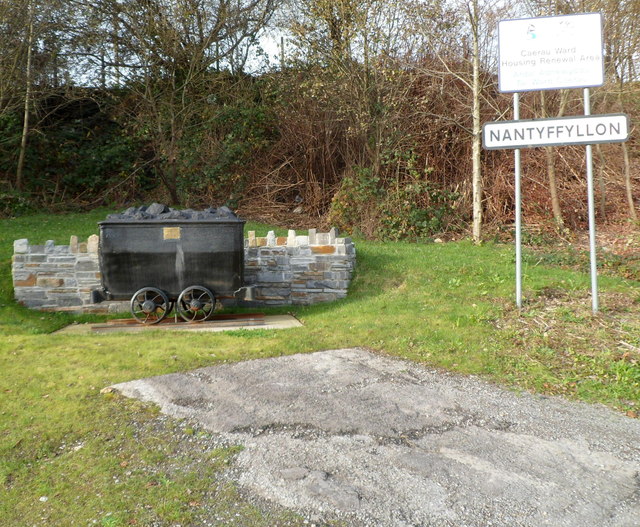
Nothing of the colliery buildings survives. The site of the colliery and the adjoining Maesteg Washery is now the Spirit of Llynfi Woodland, a community woodland created by Natural Resources Wales with Welsh Government and private funding, opened in the mid-2010s. A colliery dram recovered from the hillside above the pit by people from Nantyffyllon stands beside the A4063 at the Maesteg boundary, with a plaque recording where it was found.
No colliery structures remain; the site is planted community woodland.
Redevelopment
Reclaimed and planted as the Spirit of Llynfi Woodland by Natural Resources Wales.
Related mines
- Caerau Colliery — Both were Llynfi valley steam-coal pits owned by North's Navigation Collieries, which took Coegnant over in 1889 and sank Caerau in the same year, working the same series of seams three miles apart.
- Park Slip Colliery — Both were owned by North's Navigation Collieries, which held Park Slip from 1878 and Coegnant from 1889.
- St John's Colliery — Most of Coegnant's workforce transferred to St John's when Coegnant closed in 1981, leaving St John's as the last deep mine working in the Llynfi valley; both were latterly National Coal Board pits in the same valley and this record was itself surfaced during the Coegnant research pass.
Nearby mines
- Maesteg Deep Colliery — 0.9 miles (1.4 km) S
- Caerau Colliery — 0.9 miles (1.5 km) NE
- Caedefaid Colliery — 1.0 miles (1.6 km) SE
- Gin Pit, Maesteg — 1.2 miles (2.0 km) SW
- St John's Colliery — 1.5 miles (2.4 km) SE
Straight-line distance, within 9 miles (15 km). Show on the map.
Disasters & major incidents
-
Coegnant Colliery runaway journey, 1917
11 May 1917 · Haulage / Transport · 2 fatalities
On Friday 11 May 1917 the shackle of a tram opened while a journey was being lowered on an engine plane at Coegnant Colliery, Maesteg, and thirteen trams ran wild down the incline. The repairer Samuel Price was killed outright and his assistant John Lyons died in hospital.
What's uncertain
Points where sources disagree or the record could not be settled; both accounts are kept. All open questions in the archive.
- The Lists of Mines record 1,592 people employed in 1915 (1,422 below ground, 170 at the surface). (disputed) 2
- A secondary account states that manpower had risen to 1,900 by the outbreak of the First World War. (disputed) 1
- The colliery's headframe was encased in concrete, described by one local photographic account as an almost unique feature among Welsh collieries. (uncertain) 4
Recorded claims
Individual factual claims, each attached to the source(s) that support it below. Where sources disagree, both are kept.
- Sinking began in 1882 under the Llynfi Coal and Iron Company, to work the Six Feet seam at a depth of 400 yards, with two shafts named North and South. 1
- The Lists of Mines record 1,592 people employed in 1915 (1,422 below ground, 170 at the surface). (disputed) 2
- A secondary account states that manpower had risen to 1,900 by the outbreak of the First World War. (disputed) 1
- A reconstruction in 1960 deepened one of the two shafts by a further 230 yards. 1
- During the 1970s a workforce of 610 men produced 163,000 tons a year from the Upper Nine Feet and Bute seams. 1
- The site of the former colliery and the Maesteg Washery is now the Spirit of Llynfi Woodland, a community woodland created by Natural Resources Wales. 3
- The colliery's headframe was encased in concrete, described by one local photographic account as an almost unique feature among Welsh collieries. (uncertain) 4
- The BGS mine-plans catalogue holds a Mining Remediation Authority abandonment plan titled 'Coegnant' (catalogue SWA2470, Yard, dated 1981). 5
Photographs & further reading
Owners, output, employment and seams worked as returned to the Lists of Mines year by year, together with the names and circumstances of those killed at the colliery.
View sourceA short working history of the pit from its 1882 sinking to closure, with the seams worked in each period and two photographs of the surface.
View sourceA local photographic record of the four Llynfi valley pits, including several images of Coegnant taken in 1981 as it closed and during demolition.
View sourceA 2012 photograph of the colliery dram recovered from the hillside above Coegnant and set up beside the A4063 with a commemorative plaque.
View sourceSources
- (secondary) Coegnant Colliery, Nantyffyllon — Welsh Coal Mines
- (primary) Coegnant Colliery — Durham Mining Museum
- (primary) Ceidwad y Pyllau Glo / Keeper of the Collieries — Natural Resources Wales
- (observational) The Llynfi Valley Collieries — Digging up the Past
- (primary) BGS / Mining Remediation Authority mine plans: COEGNANT — British Geological Survey / Mining Remediation Authority
- (observational) Coal dram alongside the Nantyffyllon boundary — Geograph
Record created: 10 September 2026 · Last researched: 10 September 2026