 MineArchive
St John's Colliery
| Also known as | St Johns Colliery, Cwmdu Colliery |
|---|---|
| Location | Cwmdu, Maesteg, Bridgend — 51.6129, -3.6262 (approximate) |
| Commodity | Coal |
| Type | Coal |
| Worked | From 1908 (sinking)–22 November 1985 |
| Maximum depth | 385 yards, the depth to which the North and South shafts were sunk from 1908 to reach the middle and lower coal measures. |
| Operators | North's Navigation Collieries Company Limited (1908–1946), National Coal Board (1947–1985) |
Overview
The last deep mine in the Llynfi valley, sunk from 1908 by North's Navigation Collieries Ltd on the site of the older Cwmdu Colliery and closed on 22 November 1985. Its two shafts, North and South, went down 385 yards to the middle and lower coal measures, and first coal came in 1910. At its peak in the late 1920s it employed 1,480 people. It took most of Coegnant's workforce when that colliery closed in 1981, then went the same way four years later, after the miners' strike, as the first pit to apply to the Modified Review Procedure.
History
St John's was built on top of an earlier failure. The site is centred on two shafts put down into the deeper of the old Cwmdu Colliery, which the Tondu and Ogmore Coal and Iron Co. had worked from 1850 to 1908 in the shallow Victoria seam until that seam was exhausted. North's Navigation Collieries Ltd began sinking the North and South shafts in 1908, going for the middle and lower coal measures at 385 yards, and raised the first coal in 1910.
It grew into one of the larger pits of the valley. In 1923 there were 428 working at the North pit and 784 at the South, with 187 on the surface, producing from the Upper New, Seven Feet and Lower Six Feet seams. The late 1920s peak was 1,480 employed. In 1945 there were 1,242. By the early 1970s the workforce was down to 690, but those 690 were producing 250,000 tons a year from the Six Feet, Lower Nine Feet and Gellideg seams, working an area of about six square miles; the coal went to the Maesteg central washery and then chiefly to the steel and domestic markets.
When Coegnant closed in 1981 most of its workforce transferred to St John's, leaving it as the only deep mine still working in the Llynfi valley. That position lasted four years. Following the 1984-85 miners' strike the colliery reached only 51 per cent of expected production by the end of April 1985: the B1 face was suffering poor roof and wet conditions and there were problems with the new S12 face. By July, cumulative losses had reached £73.56 for every tonne produced, the worst figure in south Wales. On 7 May 1985 the National Coal Board's area director visited the pit and announced that redundancies would begin immediately.
The lodge of the National Union of Mineworkers agreed to a slimdown of around 300 to 350 men but opposed closure, and was the first in the country to apply to the Modified Review Procedure, the mechanism agreed after the strike for contesting a closure decision. It made no difference. St John's closed on 22 November 1985.
Geology
St John's worked the middle and lower coal measures of the western South Wales coalfield beneath the Llynfi valley. The shallow Victoria seam above had already been worked out by the old Cwmdu Colliery between 1850 and 1908, which is why the new shafts went to 385 yards. The seams named in the returns move down the sequence over the colliery's life: the Upper New, Seven Feet and Lower Six Feet in 1923, and by the 1970s the Six Feet, Lower Nine Feet and Gellideg, the last of these near the base of the productive measures. The working area in the 1970s was about six square miles.
Geological setting: Sedimentary Beds and Seams (well documented example)
Workings
Two shafts, known as North and South, sunk from 1908 into the deeper workings of the abandoned Cwmdu Colliery. The 1923 returns split the workforce between them, 428 at the North pit and 784 at the South, with 187 surface workers over both. Coal was not treated on site in the later years but sent to the Maesteg central washery. In the colliery's last year the working faces are named in the closure record: B1, troubled by poor roof and wet conditions, and the newly opened S12.
Closure
The colliery's last year is unusually well documented because it happened in public. After the 1984-85 strike, output ran at about half what was expected, the B1 face was wet with a poor roof and the new S12 face was giving trouble, and by July 1985 losses had reached £73.56 a tonne, the worst in south Wales. The area director announced redundancies on 7 May 1985. The NUM lodge accepted a reduction of 300 to 350 men but fought the closure itself, becoming the first lodge to use the Modified Review Procedure set up after the strike, and the case was debated in the Commons in April 1985. The pit closed on 22 November 1985, the last deep mine in the Llynfi valley.
What remains
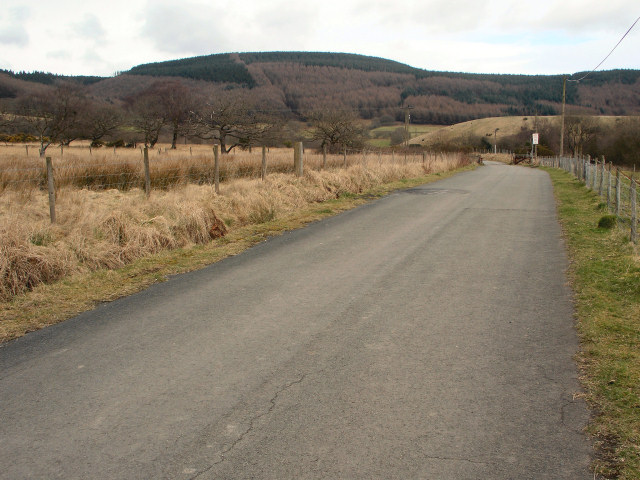
The site has been cleared. A road running up towards Cwm Du provides access to the ground where the colliery stood, with public progress along it prohibited beyond a point; a Geograph photograph of 2009 shows the approach and the valley head above it. No standing colliery structure is recorded.
None recorded on site. One substantial artefact survives elsewhere: a pit head sheave wheel used at St John's until the closure in 1985 was donated by the National Coal Board to the South Wales Miners' Museum.
Related mines
- Coegnant Colliery — Most of Coegnant's workforce transferred to St John's when Coegnant closed in 1981, leaving St John's as the last deep mine working in the Llynfi valley; both were latterly National Coal Board pits in the same valley and this record was itself surfaced during the Coegnant research pass.
- Garth Merthyr Colliery — The other large Maesteg colliery, which shares group mine plans with Garth.
- Maesteg Deep Colliery — North's Navigation worked the two together as the southern part of its Llynfi take, and sold their Two-Feet-Nine as one house coal.
Nearby mines
- Caedefaid Colliery — 0.7 miles (1.2 km) W
- Maesteg Deep Colliery — 1.1 miles (1.8 km) W
- Garth Merthyr Colliery — 1.2 miles (1.9 km) SW
- Oakwood Colliery — 1.2 miles (1.9 km) SW
- Coegnant Colliery — 1.5 miles (2.4 km) NW
Straight-line distance, within 9 miles (15 km). Show on the map.
Recorded claims
Individual factual claims, each attached to the source(s) that support it below. Where sources disagree, both are kept.
- The site is centred on two shafts put down into the deeper workings of the old Cwmdu Colliery, worked from 1850 to 1908 by the Tondu and Ogmore Coal and Iron Co. in the shallow Victoria seam until its exhaustion. North's Navigation Collieries Ltd began sinking the North and South shafts in 1908 to the middle and lower coal measures at 385 yards, and the first coal was produced in 1910. 1
- At its peak in the late 1920s 1,480 people were employed. In 1923 there were 428 at the North pit, 784 at the South and 187 on the surface; in 1945, 1,242; and by the early 1970s, 690 producing 250,000 tons a year. 1
- In 1923 coal came from the Upper New, Seven Feet and Lower Six Feet seams. By the late 1970s the pit worked about six square miles in the Lower Six-Feet, Lower Nine-Feet and Gellideg seams, the coal going to the Maesteg central washery and then chiefly to the steel and domestic markets. 1
- After the 1984-85 strike the colliery reached only 51 per cent of expected production by the end of April 1985, with poor roof and wet conditions on the B1 face and problems on the new S12 face. By July cumulative losses had reached £73.56 a tonne, the worst in south Wales. The area director announced redundancies on 7 May 1985; the NUM lodge accepted a slimdown of 300 to 350 men, opposed closure and was the first to apply to the Modified Review Procedure. The colliery closed on 22 November 1985. 1
- St John's was the last deep mine in the Llynfi valley, and took most of Coegnant's workforce when that colliery closed in 1981. 2,1
- The area director of the National Coal Board in South Wales, Philip Weekes, recommended closure in a letter and press statement of 16 April 1985, after a meeting held under the existing colliery review procedure at which the deputy director for mining and the chief mining engineer presented the results of recent years. The Commons debate of 23 April 1985 records the board having spent many millions over the years trying to make St John's viable, with a number of faces opened up and the poor geology of the area making it impossible to win a reasonable quantity of coal from any of them. 3
- The BGS mine-plans catalogue holds a Mining Remediation Authority abandonment plan titled 'St Johns' (catalogue SWA3053, Gellideg, dated 1984). 4
Photographs & further reading
The fullest account located: the old Cwmdu Colliery beneath it, the 1908 sinking to 385 yards, employment from 1923 to the 1970s, the seams worked in each period, and a close account of the colliery's last year from the post-strike production figures to the closure on 22 November 1985.
View sourceThe Commons debate on the colliery's future seven months before it closed, held while the NUM lodge was contesting the closure through the Modified Review Procedure.
View sourceA survey of the collieries of the Llynfi valley which places St John's as the last deep mine to work there, with its sinking and closure dates alongside those of its neighbours.
View sourceSources
- (secondary) St Johns Colliery, Maesteg — Welsh Coal Mines
- (observational) The Llynfi Valley Collieries — Digging up the Past
- (primary) St. John's Colliery, Maesteg, HC Deb 23 April 1985 — Hansard, UK Parliament
- (primary) BGS / Mining Remediation Authority mine plans: ST JOHNS — British Geological Survey / Mining Remediation Authority
Record created: 10 September 2026 · Last researched: 10 September 2026