 MineArchive
Climpy Colliery
| Also known as | Climpy Pit |
|---|---|
| Location | Climpy, near Wilsontown, Carnwath parish, South Lanarkshire — 55.7807, -3.7177 (exact) |
| Commodity | Coal |
| Type | Coal |
| Worked | By 1870–After 1933 |
| Maximum depth | Unknown. |
| Operators | Climpy Coal Co., Coltness Iron Company |
Overview
A colliery at Climpy, by Wilsontown in Carnwath parish, worked from several numbered pits for gas and steam coal; owned by the Climpy Coal Company and then the Coltness Iron Company, it employed 285 men in 1933.
History
Climpy lies north-west of Forth and south of Fauldhouse, in Carnwath parish, near the old Wilsontown ironworks. Its colliery was worked from a series of numbered pits. On Sunday 3 July 1870 the boiler at No. 1 Pit, Climpy, part of Wilsontown Colliery, exploded while the engineman, Walter Annan, was at church: his eldest son had gone to the engine house to pump water, and his wife and other children had walked up to the pit. Two of the children, Archibald, aged 10, and Agnes, aged 2, were killed and three of the family badly hurt. The boiler, only three years old, had been corroded by bad water until some of its plates along the water line were as thin as paper.
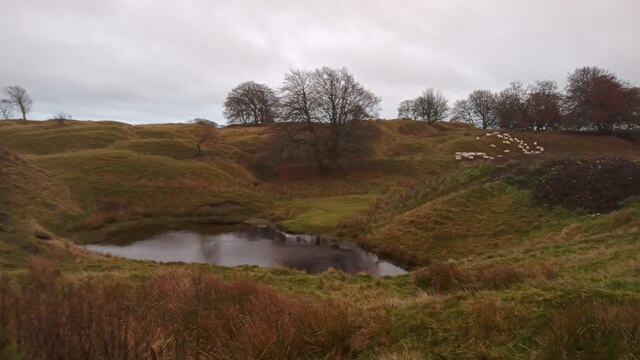
Abandonment plans record the Climpy No. 3 Pit in the Climpy Gas and Main coals (1892), the Wilsontown Main (1897 and 1900) and the gas coal of Nos 1, 2 and 3 Pits and the air pit (1898). The colliery was owned by the Climpy Coal Company and later by the Coltness Iron Company Limited. It raised gas, manufacturing and steam coal from the Wilsontown Main seam, with 125 men in 1894, 195 in 1910, 275 in 1923 and 285 in 1933. Its manager, Walter Kirkwood, was killed at the pit top in 1914 when the cage was lowered before a signal was complete. The site of No. 4 Pit is now bings and a pond.
Geology
The Wilsontown Main seam and the Climpy gas coal, with the Balbardie Gas, China, Woodmuir, Smithy, Jewel and Craw coals and the Curly ironstone on the plans.
Workings
Numbered shafts (Nos 1 to 4 and an air pit), with a level and an old level shown near No. 4 Pit on the old OS maps.
Closure
Still employing 285 men in 1933; the closure date is Unknown.
What remains
The No. 4 Pit site is a landscape of bings around a pond.
Bings and a pond at No. 4 Pit.
Redevelopment
Unknown.
Related mines
- Wilsontown Ironworks — Climpy No. 1 Pit was described in 1870 as part of Wilsontown Colliery.
Nearby mines
- Muldron Ironstone Pits — 1.5 miles (2.4 km) N, West Lothian
- Levenseat Limestone Mines — 1.9 miles (3.1 km) NE, West Lothian
- Wilsontown Ironworks — 2.0 miles (3.1 km) E
- Southfield Colliery — 2.3 miles (3.7 km) N, North Lanarkshire
- Knowes Colliery — 2.7 miles (4.3 km) N, West Lothian
Straight-line distance, within 9 miles (15 km). Show on the map.
Recorded claims
Individual factual claims, each attached to the source(s) that support it below. Where sources disagree, both are kept.
- Climpy is recorded as a nineteenth-century colliery with shafts in Carnwath parish. 1
- On 3 July 1870 the boiler at No. 1 Pit, Climpy, Wilsontown Colliery, exploded, killing two of the engineman's children; its plates had been corroded by bad water. 2
- Owned by the Climpy Coal Company and the Coltness Iron Company Limited. 3
- Employed 125 in 1894, 195 in 1910 and 285 in 1933, working the Wilsontown Main seam. 3
- Plans record Nos 1, 2 and 3 Pits and the air pit in the gas coal (1898) and Blantyre/Climpy workings in the Main, Splint, Ell and Virtuewell (1930). 4,5
- The site of Climpy Colliery No. 4 Pit is now bings and a pond. 6
Sources
- (secondary) Climpy (NRHE 88204) — Canmore / Historic Environment Scotland
- (secondary) Carnwath 1870 — Scottish Mining Website
- (primary) Climpy Colliery — Durham Mining Museum
- (primary) BGS mine plan: Climpy Mine Nos 1, 2 and 3 Pits and Air Pit, gas coal (abandoned 1898) — British Geological Survey / Mining Remediation Authority
- (primary) BGS mine plan: Blantyre/Climpy, Main, Splint, Ell, Virtuewell (abandoned 1930) — British Geological Survey / Mining Remediation Authority
- (observational) Spectacular Man-Made Scenery near Climpy (Geograph 7024738) — Geograph
Record created: 17 October 2026 · Last researched: 17 October 2026