 MineArchive
CB Mine
| Location | Arkengarthdale, near Langthwaite, North Yorkshire — 54.4180, -1.9950 (approximate) |
|---|---|
| Commodity | Lead |
| Type | Metal |
| Worked | 1654–1883 (CB Mining Company) |
| Operators | Bathurst family (1654–1740) |
Overview
CB — named for Charles Bathurst, whose family bought the mineral rights to the whole of Arkengarthdale from the Crown in the 1650s — was the company that dominated lead mining in the dale for over two centuries, building not just mines but an entire industrial yard, one of the largest smelt mills in the Dales, and its own gunpowder magazine.
History
Dr John Bathurst, physician to Oliver Cromwell, purchased the mineral rights to the whole of Arkengarthdale from the Crown in 1654; his descendants developed the CB (Charles Bathurst) mining company into the dominant lead-mining concern in the dale, and the estate remained in Bathurst family hands for four generations until 1740. In 1800 the Arkengarthdale mines were let for 21 years to a Newcastle company on a fixed rent rather than a share of the lead raised. In 1802 the company built CB Yard, providing both housing for miners and workshops, and in 1803 constructed the Octagon smelt mill nearby — one of the largest buildings anywhere in the Dales at the time — which began smelting in spring 1804 and closed in 1821. A hexagonal powder house, built in the same period a deliberate distance from the other buildings for safety, stored the gunpowder used underground. Lead had been worked in Arkengarthdale since at least medieval times, and in their Victorian heyday the CB mines were among the most productive in Yorkshire, supporting a far larger population than lives in the dale today. CB Mining closed in 1883, after which most of the dale's miners moved on in search of other work; a handful of smaller operations continued elsewhere in Swaledale and Arkengarthdale until the last of them closed in 1912.
Geology
The mine worked lead veins of the northern Pennine orefield in Arkengarthdale, a hydrothermal, non-magmatic mineralised system distinct from the granite-related lodes of Cornwall and Devon.
Geological setting: Hydrothermal Deposits (well documented example), Veins and Lodes (well documented example)
Workings
Access to the workings was originally by adits and shallow shafts; as winding and pumping technology improved, deeper shafts and lower drainage adits driven into the hillsides became possible. Ore raised from underground was smelted at the 1803 Octagon mill, with gunpowder for blasting stored and issued from a separate hexagonal powder house.
Closure
CB Mining closed in 1883, after which most of the dale's miners moved away; smaller operations continued elsewhere in Swaledale and Arkengarthdale until the last closed in 1912.
What remains
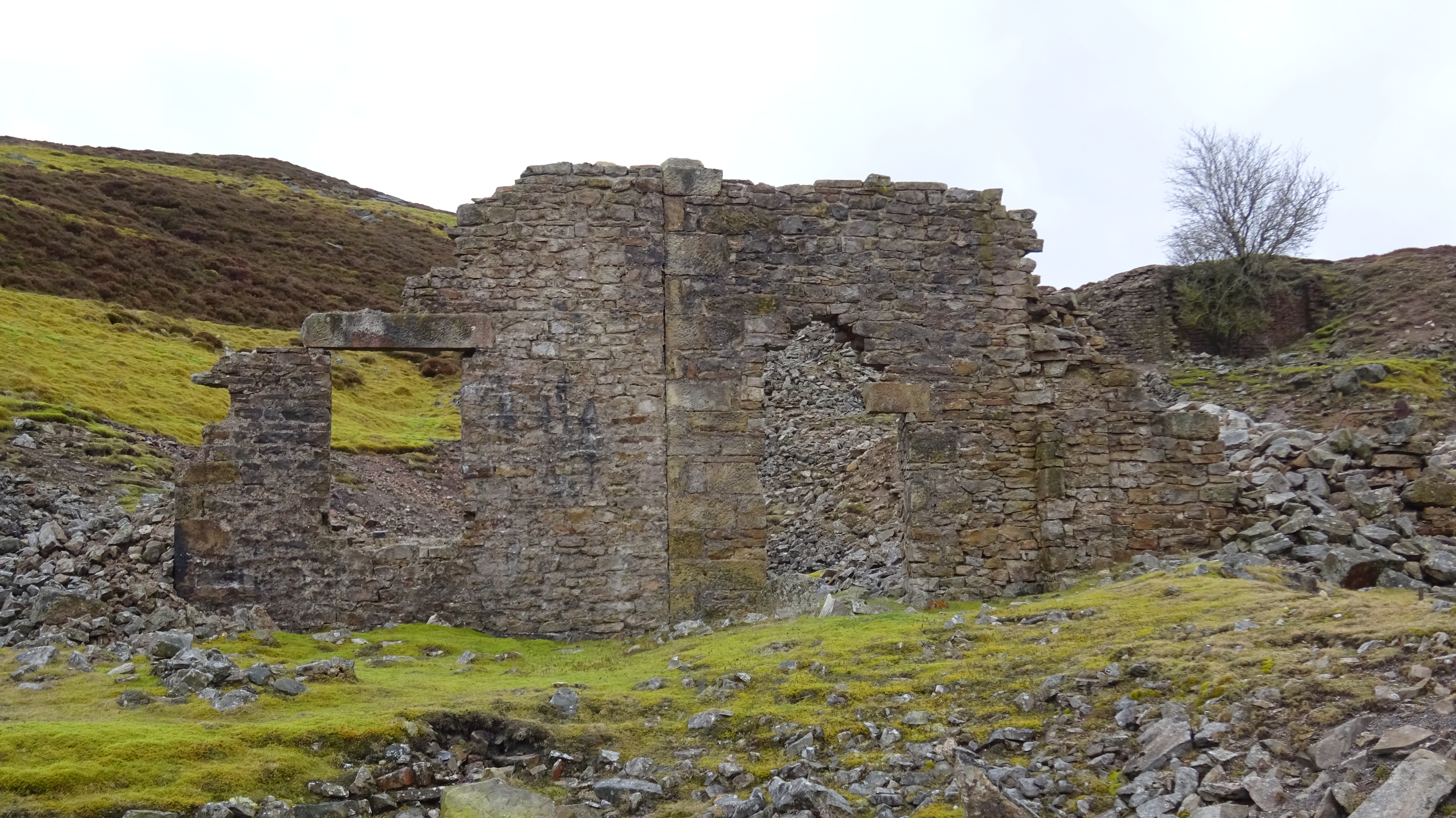
CB Yard survives and remains accessible from the road; the hexagonal powder house, Grade II* listed, stands south of the yard, and the ruins of the Octagon smelt mill also survive, though the mill building itself has been substantially demolished over time.
Nearby mines
- Arkendale Mine — 0.1 miles (0.1 km) NE
- Slei Gill Mine — 0.4 miles (0.7 km) SE
- Whaw Mine — 0.5 miles (0.8 km) S
- Cragg End Flag Stone Mine — 0.6 miles (1.0 km) NW
- Punchard Gill Mine — 0.7 miles (1.1 km) N
Straight-line distance, within 9 miles (15 km). Show on the map.
Recorded claims
Individual factual claims, each attached to the source(s) that support it below. Where sources disagree, both are kept.
- CB Yard was built in 1802 for miners' housing and workshops, with the Octagon smelt mill, one of the largest buildings in the Dales at the time, built alongside it in 1803 and smelting from spring 1804 until 1821. 1,2
- CB Mining closed in 1883; smaller operations continued elsewhere in Swaledale and Arkengarthdale until the last closed in 1912. 3
- The powder house was built about 1804 to store gunpowder for the C.B. lead mines, the mining rights having been let in 1800 to a Newcastle company; the large mill of 1803 was built with workshops that still survive. 1
Photographs & further reading
The Northern Mine Research Society's monograph on the Bathursts' manor and the CB mines.
View sourceSources
- (secondary) Old Powder Magazine — Wikipedia
- (secondary) Lead mining in Arkengarthdale — Yorkshire Dales National Park
- (secondary) A History of the Manor & Lead Mines of Arkengarthdale, Yorkshire — Northern Mine Research Society (British Mining No. 29)
Record created: 24 August 2026 · Last researched: 24 September 2026