 MineArchive
Belowda Mine
| Location | Belowda Beacon, Roche, Cornwall — 50.4240, -4.8593 (approximate) |
|---|---|
| Commodity | Tin |
| Type | Metal |
| Worked | from late 19th century |
| Maximum depth | Unknown. |
Overview
Belowda Mine worked tin on Belowda Beacon, the granite hill that rises above the village of Belowda in the parish of Roche, about seven miles west-south-west of Bodmin. Its late nineteenth-century engine house, boiler house and smithy survive together and are listed Grade II — an unusually complete small Cornish surface group, granite rubble throughout with a brick top to the chimney.
History
Belowda is a village in mid-Cornwall just north of the A30, about seven miles west-south-west of Bodmin, in the civil parish of Roche; it gives its name to the nearby Belowda Beacon. The Beacon is one of a line of small granite bosses running east from the main St Austell mass, and it was worked for tin.
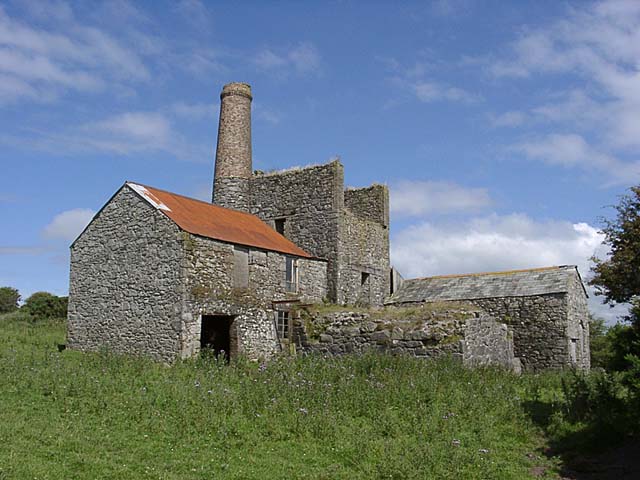
The mine's own dating rests on its buildings. The engine house, boiler house and smithy at Belowda Mine are of the late nineteenth century, and were listed Grade II on 28 August 1987 as having been part of the Belowda tin mine. Nothing on record establishes when the mine opened, who worked it, how many were employed or when it stopped — the listing describes the fabric rather than the enterprise. The buildings themselves are described in some detail. The engine house is on a rectangular plan with its chimney to the north, of granite rubble with a brick top; the chimney is circular, about three metres in diameter at the base with an inspection hole, tapered and carried up in granite as far as the height of the engine house and in brick above that. The north front has three window openings, one to each storey, the upper two with brick jambs. A two-storey lean-to of later date is attached on the left, projecting beyond the engine house at the rear with a gable end and two window openings to the side, its front partly demolished to make a cart entry. On the right is a further two-storey building with gable ends and a corrugated iron roof, with an upper door reached by a flight of granite steps. The boiler house stands about ten metres to the east, also rectangular, and the smithy about thirty metres to the south-west.
Geology
Belowda Beacon is one of a line of small granite intrusions strung out east of the main St Austell granite, and tin here occurs as cassiterite in veins associated with that granite — the standard Cornish pattern, in which the cooling granite drove the hot mineralising fluids out into fractures in itself and the rocks around it. The Beacon's own top carries lode-back workings and trial pits, and the mineralisation here is in quartz-tourmaline lodes. It is worth being careful about what this does and does not imply: the depth at which such a deposit is worked today has to do with how much rock has been stripped off the granite since, not with how deep the mineralising took place.
Geological setting: Veins and Lodes (well documented example)
Workings
The surviving group is a surface one: engine house, boiler house about ten metres east, and smithy about thirty metres to the south-west. The engine house stands on the site of a deep trial shaft. Belowda Beacon itself carries lode-back workings and trial pits over much of its top. Nothing on record describes the depth of the shaft, the number of levels, or how the mine was drained.
Closure
The closure date is not known. The buildings are late nineteenth century and the mine is long disused; nothing on record narrows it further.
What remains
The buildings survive and are listed. Photographs show the remains of a rotative beam winding engine house and its associated buildings at Beacon Mine on Belowda, and other former mine buildings west of the Beacon; some of the group has been the subject of renovation work.
The Grade II listed engine house with its granite-and-brick chimney, the boiler house ten metres east, and the smithy thirty metres south-west, together with the two-storey lean-to and the gabled building attached to either side of the engine house. Lode-back workings and trial pits survive over much of the top of the Beacon.
Nearby mines
- Castle-an-Dinas Wolfram Mine — 1.5 miles (2.4 km) W
- Gaverigan Tin Streaming — 2.8 miles (4.6 km) SW
- Wheal Remfry — 3.8 miles (6.2 km) SW
- Goonvean Pit — 4.4 miles (7.1 km) S
- Wheal Martyn China Clay Works — 4.7 miles (7.5 km) SE
Straight-line distance, within 9 miles (15 km). Show on the map.
Recorded claims
Individual factual claims, each attached to the source(s) that support it below. Where sources disagree, both are kept.
- The engine house, boiler house and smithy at Belowda Mine are of the late 19th century, of granite rubble with a brick top to the chimney, and were listed Grade II on 28 August 1987; the engine house is of rectangular plan with its chimney to the north, the boiler house about 10 metres to the east and the smithy about 30 metres to the south-west. 1
- The listed buildings at SW 969621 were part of Belowda tin mine. 1
- The chimney is of circular plan, about 3 metres in diameter at the base with an inspection hole at the base, tapered, in granite rubble to the height of the engine house and continued in brick above. 1
- Belowda is a village in Cornwall just north of the A30, about seven miles west-south-west of Bodmin, in the civil parish of Roche, and gives its name to the nearby Belowda Beacon. 2
- Remains of the rotative beam winding engine house and associated buildings survive at Beacon Mine, Belowda. 3
Photographs & further reading
The Historic England listing text, which describes the engine house, its chimney, the boiler house and the smithy in enough detail to read the group off the ground, and confirms they belonged to a tin mine.
View sourceSources
- (primary) Belowda Mine Buildings including engine house, at SW 969621 (listed building 1144194) — Historic England, via British Listed Buildings
- (secondary) Belowda — Wikipedia
- (observational) Beacon Mine, Belowda (photograph) — Geograph Britain and Ireland
Record created: 4 September 2026 · Last researched: 5 September 2026