 MineArchive
Wheal Remfry
| Location | Near Fraddon, St Enoder, Cornwall — 50.3843, -4.9199 (approximate) |
|---|---|
| Commodity | China Clay |
| Type | Clay |
| Worked | from By 1960s |
| Operators | English China Clays (1919–1999) |
Overview
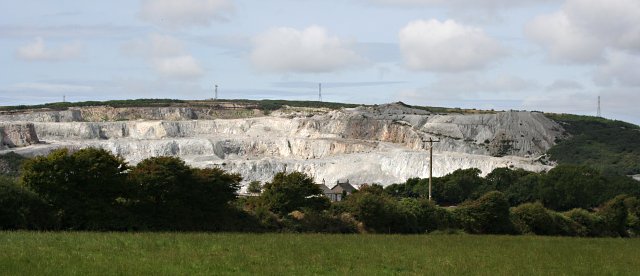
Wheal Remfry, a vast china clay pit near Fraddon, grew so large in the early 1960s that its owner, English China Clays, demolished the nearby village of Retew and rehoused its residents to allow the pit and its spoil heaps to expand.
History
Wheal Remfry is a china clay pit in the parish of St Enoder, near Fraddon in Cornwall's mid-Cornwall clay district, worked by English China Clays (ECC) -- formed in 1919 from the merger of three of the industry's largest producers, Martin Bros., West of England China Clay & Stone, and the North Cornwall China Clay Company, which together had accounted for around half the industry's output. Cornish china clay working traces back to William Cookworthy's 1746 discovery of kaolin in the area, and by the mid-20th century the district's tips and pits had come to dominate the surrounding landscape -- the neighbouring village of St Dennis was formally designated an 'island settlement' specifically to prevent the clay workings from encroaching on it. Wheal Remfry was not so fortunate: in the early 1960s, ECC expanded the pit and its waste tips to the point of demolishing the nearby village of Retew, a small settlement of 24 houses and a factory that stood on land the company owned. Residents were rehoused by ECC; only Retew Hill and a short stub of road with a sign still pointing to the vanished village survive today. ECC itself continued operating into the late 1960s at a national output of some 2.5 million tons of china clay a year, before refocusing on its core clay business in 1999 and being acquired by the French company Imetal, later renamed Imerys, which continues to operate china clay pits across the district.
Geology
Worked kaolinised granite of the St Austell granite pluton; the pit exposes a notable breccia in which silica and tourmaline crystallised around fragments of granite and killas, formed when a fault intersected a reservoir of pressurised borosilicate fluid and the resulting pressure drop drove material rapidly toward the surface.
Workings
Worked as a large open-cast china clay pit; a mineral railway branch once served the works. The pit's own breccia -- silica and tourmaline crystallised around fragments of granite and killas, formed by an ancient explosive release of pressurised borosilicate fluid along a fault line some 270 million years ago -- is a distinctive local geological feature.
Closure
Unknown.
What remains
Remains a vast, active or recently active excavation, described as occupying most of its map grid square; the site sits on private land with no public access.
A huge open pit and associated spoil tips dominate the site; the only trace of the demolished village of Retew nearby is Retew Hill and a short stub of road still signposted to the vanished settlement.
Nearby mines
- Gaverigan Tin Streaming — 1.0 miles (1.6 km) NE
- Goonvean Pit — 2.2 miles (3.6 km) SE
- Tregargus China Stone Quarries — 2.9 miles (4.6 km) SE
- Castle-an-Dinas Wolfram Mine — 3.0 miles (4.9 km) N
- South Terras Mine — 3.5 miles (5.6 km) S
Straight-line distance, within 9 miles (15 km). Show on the map.
Recorded claims
Individual factual claims, each attached to the source(s) that support it below. Where sources disagree, both are kept.
- In the early 1960s, English China Clays expanded Wheal Remfry's pit and waste tips to the point of demolishing the nearby village of Retew, a settlement of 24 houses and a factory standing on company-owned land; residents were rehoused by ECC, and only Retew Hill and a signposted stub of road survive of the village today. 1
- The wider mid-Cornwall china clay district traces its origin to William Cookworthy's 1746 discovery of kaolin in the area; by the 20th century the district's tips and pits had grown large enough that the neighbouring village of St Dennis was formally designated an 'island settlement' specifically to prevent the workings from encroaching on it. 2
- English China Clays was formed in 1919 from the merger of three of the industry's largest producers -- Martin Bros. (1837), West of England China Clay & Stone (1849) and the North Cornwall China Clay Company (1908) -- which together had accounted for around half the industry's output; by the late 1960s ECC produced some 2.5 million tons of china clay a year. 3
- The pit exposes a distinctive breccia in which silica and the boron-bearing mineral tourmaline crystallised around fragments of granite and killas, formed around 270 million years ago when a fault line intersected a reservoir of pressurised borosilicate fluid and the resulting pressure drop drove material rapidly up the newly formed conduit toward the surface. 4
Photographs & further reading
The Wheal Martyn Trust's own account of the pit's distinctive breccia geology (fetch returned HTTP 403 to both WebFetch and curl and was not read directly, but the page is a genuine, citable heritage-trust resource worth linking).
View sourceSources
- (secondary) Retew — Wikipedia
- (secondary) St Dennis, Cornwall — Wikipedia
- (secondary) English China Clays — Wikipedia
- (secondary) Wheal Remfry China Clay Works — Buddlepit Mine Database
Record created: 2 September 2026 · Last researched: 2 September 2026