 MineArchive
Barony Colliery
| Also known as | Barony A-Frame |
|---|---|
| Location | Auchinleck, East Ayrshire — 55.4674, -4.3308 (exact) |
| Commodity | Coal |
| Type | Coal |
| Worked | From 1907 (sinking)–17 February 1989 |
| Operators | William Baird & Company (1907–1947), Bairds & Dalmellington Ltd (1931–1947), National Coal Board (1947–1989) |
Overview
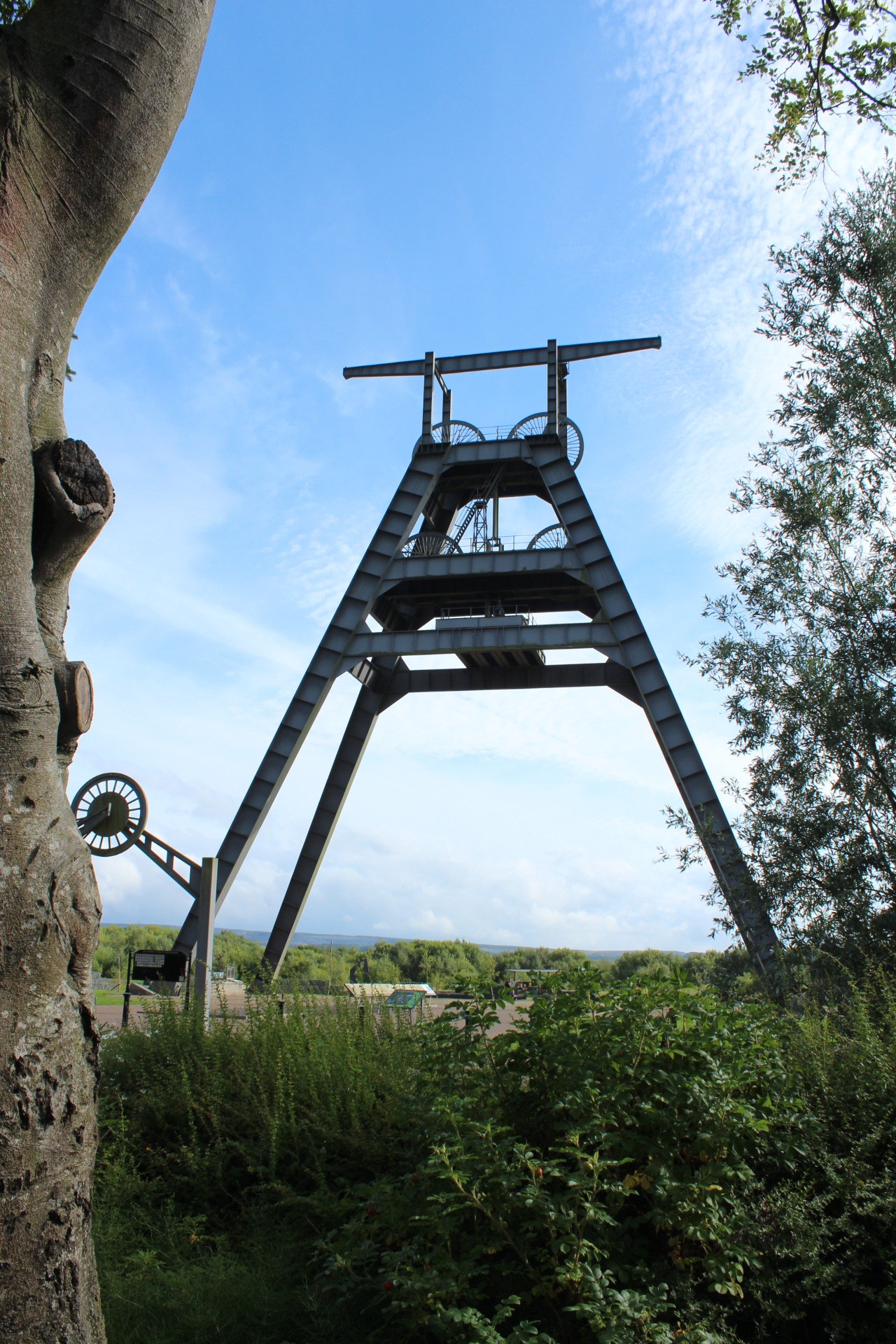
An Ayrshire colliery remembered today for one thing above all: a 180-foot steel headgear so unusual in its design that only one other was ever built, and this is the only one left.
History
William Baird & Company began sinking the first pit at Barony, near Auchinleck, in 1907, though it took until 1912 for coal to be reached and worked. The colliery passed into National Coal Board ownership at nationalisation and was substantially modernised in the 1950s, when a new headgear — No. 3 Headgear, universally known as the A-Frame — was built in 1954 to serve a new shaft. Barony worked on for a further three and a half decades before closing in 1989.
The University of Wolverhampton's Coal and Community study and the Scottish Cave and Mine Database fill out that outline. Sinking of Nos. 1 and 2 began in 1906 west of Auchinleck, and the pit was in production by 1910 on the university's account, 1912 on Wikipedia's; the eastern part of the coalfield was worked from Highhouse, which the company bought in 1931. Reconstruction and the sinking of No. 3 began in 1937, were held up by the war and finished by the National Coal Board in 1949, the new shaft carrying a German-designed steel headframe; in 1948 the colliery employed 1,264 and raised 1,520 tons a day, and from 1953 it fed the adjoining Barony power station. On 8 November 1962 No. 2 shaft collapsed and buried four men, Thomas Fyvie, Henry Green, John McNeil and George Wade (see Disasters, below); production stopped, No. 1 shaft had to be filled and the old headframes came down, and it took a campaign by the men and the management to get a new shaft sunk and the pit reopened in 1966. Geological difficulties and understaffing dogged the 1970s and 1980s, but Barony outlived Highhouse (closed 1983), Killoch (1986) and the power station (1982) before closing in 1989, by then the only colliery outside the Forth Valley.
Geology
Barony worked seams of the Ayrshire coalfield, part of the Central Belt of Scotland's Carboniferous coal measures.
Workings
No. 3 Headgear, the A-Frame, is a four-legged welded steel frame some 180 feet high carrying four pulley wheels, built in 1954. It is one of only two headgears of this specific design ever built in Britain, and the only one to survive. Four shafts in all: Nos. 1 and 2, 626 m deep, sunk 1906-12, and No. 3, 623 m, sunk in the reconstruction of 1938-50; No. 2 collapsed in 1962 and No. 1 was filled, a new shaft being sunk before the 1966 reopening.
Closure
Barony closed in 1989 along with much of the rest of the Ayrshire coalfield as deep mining contracted nationally. The last 400 men were laid off on 17 February 1989, two years after the newer Killoch closed; Archie Glover wound the last cage.
What remains
Most of the colliery has been cleared, but the A-Frame headgear, the winding engine houses, a generating station and a water-treatment works were given category B listed status in 1990. The A-Frame itself was extensively restored in 2007 at a cost of over a million pounds, with funding from Historic Scotland and the Heritage Lottery Fund, and was reopened by the Duke of Rothesay (later King Charles III) in January 2008. It now stands as a mining heritage monument, floodlit and visible for miles across the Ayrshire countryside.
The restored A-Frame headgear, winding engine houses, a former generating station and a water-treatment works, all category B listed.
Redevelopment
Preserved as the Barony A-Frame Mining Heritage Site, maintained by a dedicated trust.
Related mines
- Highhouse Colliery — Their workforces struck together in both 1972 and 1974 specifically to save the pits from closure.
- Killoch Colliery — A 1972 scheme proposed driving an underground link between the two to work reserves jointly as Killoch's own geology grew difficult.
- Knockterra Colliery — Neighbouring Cumnock-district pits; Barony was Bairds' later big sinking at Auchinleck.
Nearby mines
- Highhouse Colliery — 1.4 miles (2.2 km) E
- Ballochmyle Colliery — 1.4 miles (2.3 km) E
- Knockterra Colliery — 2.1 miles (3.4 km) SE
- Gilmilnscroft Colliery — 2.2 miles (3.5 km) NE
- Killoch Colliery — 3.1 miles (4.9 km) W
Straight-line distance, within 9 miles (15 km). Show on the map.
Disasters & major incidents
-
Barony Colliery shaft collapse, 1962
8 November 1962 · Collapse / Roof Fall · 4 fatalities
On 8 November 1962 No. 2 shaft at Barony Colliery, west of Auchinleck in Ayrshire, collapsed as the ground around it caved in, burying four men 1,300 feet down and bringing the headframe into the shaft mouth. The bodies were never recovered, the colliery stopped producing, and it took a campaign and a new shaft to reopen it four years later.
Culture
- Rab Wilson's poem on the Barony A-frame (Literature)
Rab Wilson was an NCB apprentice engineer at Barony until the 1984-85 strike; his poem in Accent o the Mind (2006) is about the colliery's preserved A-frame, quoted by Andrew Perchard in his account of the pit.
Recorded claims
Individual factual claims, each attached to the source(s) that support it below. Where sources disagree, both are kept.
- William Baird & Company began sinking Barony Colliery in 1907; coal was reached and worked from 1912. 1
- No. 3 Headgear, the A-Frame, is a four-legged welded steel frame about 180 ft high built in 1954 — one of only two of this design ever built in Britain and the only survivor. 1
- The colliery closed in 1989. 1
- The A-Frame, winding engine houses, generating station and water-treatment works were category B listed in 1990; the A-Frame was restored in 2007-08 at a cost of over £1 million and reopened by the Duke of Rothesay. 1,2
- Bairds & Dalmellington started sinking Barony Nos. 1 and 2 to the west of Auchinleck in 1906, the colliery entering production in 1910; the eastern part of the coalfield was worked from the nearby Highhouse colliery (sunk 1895-6), acquired by the company in 1931, and reconstruction with the sinking of a third shaft began in 1937, intended to be developed alongside the new Killoch colliery, which was postponed and eventually sunk by the National Coal Board. 3
- On 8 November 1962 No. 2 shaft collapsed, burying four men: Thomas Fyvie, contractor; Henry Green, oversman; John McNeil, deputy; George Wade, contractor. Production ceased, No. 1 shaft had to be filled in and the old headframes were removed; a concerted campaign by the miners and management forced the Government and Coal Board to sink a new shaft and reopen the colliery in 1966. Barony was one of the last Scottish collieries to survive the closure lists of the early 1980s: Highhouse closed in 1983, Killoch in 1986 and the adjoining Barony power station in 1982, and Barony itself in 1989. 3,4
- The colliery lies at NS 52790 21730 beside the B7036 between Auchinleck and Ochiltree, with four shafts: Nos. 1 and 2 (NS 5276 2173), both 626 m, sunk 1906-12, and No. 3 (623 m) added in the reconstruction of 1938-40 and 1945-50, completed by the NCB in 1949 and fitted with a German-designed steel headframe. In 1948 it employed 1,264 and raised 1,520 tons a day, the men coming from Auchinleck, Catrine, Cumnock, New Cumnock, Ochiltree and Sanquhar; it was one of only two Scottish collieries adjoining a power station, opened in 1953. The take lay east of the shafts, with 1988 workings to the north-west and south-west, bounded on the west by a fault that prevented links with Killoch. 4
- Barony closed on 17 February 1989, its remaining workforce of 400 laid off. 5
- The colliery stands at NS 52748 21755 in Auchinleck parish, East Ayrshire, recorded to the nearest metre. 6
- The National Record of the Historic Environment holds the colliery as site 72648, with 109 photographs of the pithead baths, winding houses, power house and headframes. 6
Photographs & further reading
The national record entry for the colliery, with its grid reference to the nearest metre and 109 photographs of the surface buildings and headgear.
View sourceSources
- (secondary) Barony A Frame — Wikipedia
- (secondary) Barony A-Frame Mining Heritage Site — Britain Express
- (secondary) Barony (1906-1989): Coal and Community case study (University of Wolverhampton) — University of Wolverhampton, Centre for Historical Research
- (secondary) Barony Colliery (Scottish Cave and Mine Database, site 8102, quoting Canmore and Coal & Community) — Grampian Speleological Group
- (secondary) Barony: A Fight for Life (Andrew Perchard) — Coal and Community, University of Wolverhampton
- (primary) Barony Colliery 1, 2, 3 and 4 (Canmore / National Record of the Historic Environment, site 72648) — Historic Environment Scotland
Record created: 24 August 2026 · Last researched: 24 September 2026