 MineArchive
Knockterra Colliery
| Location | Knockterra, between Cumnock and Skares, Ayrshire, East Ayrshire — 55.4431, -4.2994 (approximate) |
|---|---|
| Commodity | Coal |
| Type | Coal |
| Worked | By 1877–1910 |
| Operators | Eglinton Iron Company (1877–?), William Baird & Company (?–1910) |
Overview
A Bairds pit at Knockterra, on the farmland between Cumnock and Skares, worked by the Eglinton Iron Company and then William Baird and Company from about 1877 to 1910 for household coal from the Main seam. It kept about 130 men under the manager Hunter Bowie through the 1890s and dwindled to fifty in its last years; its seven recorded deaths run from a boy of fourteen run over at the screes in 1877 to a roadsman drawing props in 1902.
History
The Durham Mining Museum dates Knockterra to 1880, but its first recorded death is of David McCulloch, a boy of fourteen run over by empty wagons at the scree in April 1877, and a hillman was killed shifting a wagon in 1878. The owners were the Eglinton Iron Company, Bairds' Ayrshire concern, which the 1893 list returns from West George Street, Glasgow, and Kilwinning with David McKenna as manager; the Ayr Advertiser in November 1883 called it Knockterra coal pit belonging to the Eglinton Iron Company when the brusher John Burns of Tanyard, Cumnock, was killed by a stone from the roof on the night shift, leaving a widow and four children. The Lists of Mines then carry it under William Baird and Company, with Hunter Bowie as manager, raising household coal with 130 employed in 1894, 135 in 1896 and 136 in 1900, falling to 49 in 1905 and 52 in 1910, when the Main seam alone was worked. The museum closes the colliery in 1910.
Geology
Ayrshire coalfield, Cumnock basin; only the Main seam is named, in the 1910 list.
Geological setting: Sedimentary Beds and Seams (historical documentary reference)
Workings
Shaft colliery with screes and an incline. Employment from the Lists of Mines: 130 in 1894, 135 in 1896, 136 in 1900, 49 in 1905, 52 in 1910. Depths are not given in the sources read.
Closure
Closed in 1910 according to the museum; the reason is not given in the sources read.
What remains
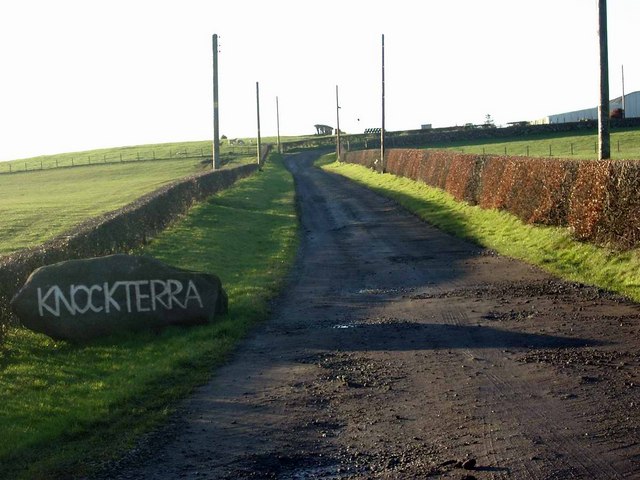
Knockterra is a working farm on the Skares road; nothing of the pit is reported, and the surrounding land was later opencast.
None reported in the sources read.
Related mines
- Barony Colliery — Neighbouring Cumnock-district pits; Barony was Bairds' later big sinking at Auchinleck.
- Highhouse Colliery — Neighbouring Bairds pits in the Cumnock and Auchinleck district.
Nearby mines
- Ballochmyle Colliery — 2.5 km N
- Highhouse Colliery — 3.2 km N
- Barony Colliery — 3.3 km NW
- Killoch Colliery — 6.9 km W
- Afton Colliery — 8.5 km SE
Straight-line distance, within 15 km. Show on the map.
Recorded claims
Individual factual claims, each attached to the source(s) that support it below. Where sources disagree, both are kept.
- The museum dates the colliery 1880 to 1910, but records deaths there from 1877. 1
- The Eglinton Iron Company in 1883 and 1893, then William Baird and Company. 2,1,3,4
- About 130 employed in the 1890s under Hunter Bowie, falling to about fifty in 1905 and 1910. 1,3
Photographs & further reading
Owners, employment and output from the 1894 to 1910 lists and seven named deaths from 1877 to 1902.
View sourceNewspaper reports of Ayrshire pit accidents including the 1883 death of John Burns at Knockterra.
View sourceSources
- (primary) Knockterra Colliery — Durham Mining Museum — Durham Mining Museum
- (primary) List of Mines in Scotland, 1893 — Scottish Mining Website
- (primary) William Baird and Co., Ltd. — Durham Mining Museum company page — Durham Mining Museum
- (primary) Ayrshire accidents 1871-1900 — Scottish Mining Website — Scottish Mining Website
Record created: 12 September 2026 · Last researched: 12 September 2026