 MineArchive
Killoch Colliery
| Location | Ochiltree, East Ayrshire — 55.4550, -4.4060 (exact) |
|---|---|
| Commodity | Coal |
| Type | Coal |
| Worked | From December 1952 (sinking)–1987 |
| Operators | National Coal Board (1952–1987) |
Overview
A National Coal Board 'superpit' at Ochiltree, designed by architect Egon Riss, which became the first Scottish colliery to raise a million tons of coal in a single year before geological problems and falling productivity brought closure in 1987.
History
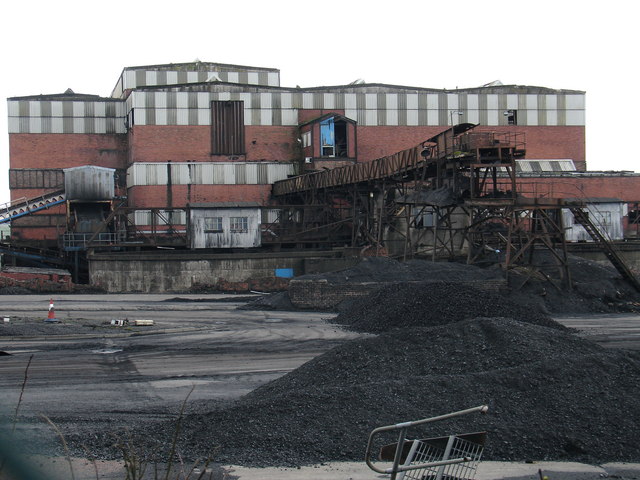
The National Coal Board began sinking Killoch Colliery's twin shafts at Ochiltree in December 1952, designed by NCB staff architect Egon Riss — the same architect responsible for the ill-fated Rothes Colliery in Fife — as one of its flagship post-war 'superpit' schemes, with a modern surface layout considered the most up-to-date in Ayrshire. Production began in 1960, and by 1965 Killoch had become the first Scottish colliery to raise a million tons of coal in a single year, much of it exported to fuel power stations in Northern Ireland; peak employment reached 2,305 that same year.
Reserves were estimated at 100 million tons in 1968, but subsequent geological problems cut productivity to roughly half the Scottish average output per man-shift, and in 1972 plans were drawn up to drive an underground link to the neighbouring Barony Colliery at Auchinleck. Despite this, Killoch's difficulties persisted, and the National Coal Board closed the colliery in 1987; its winding towers were subsequently demolished, though most of its office buildings were retained.
Geology
By 1968 Killoch's reserves were estimated at 100 million tons, but subsequent geological problems in the seams worked reduced productivity to around half the Scottish coalfield average per man-shift, a persistent difficulty that contributed directly to the colliery's eventual closure.
Workings
Killoch was built with a deliberately modern, well laid-out surface plant, part of architect Egon Riss's programme of post-war NCB 'superpit' designs; a 1972 scheme proposed driving an underground link to the neighbouring Barony Colliery at Auchinleck to work reserves jointly, reflecting the difficulties Killoch's own geology was already causing.
Closure
The National Coal Board closed Killoch in 1987, its output long since undermined by geological problems that had cut productivity to around half the Scottish average.
What remains
The colliery's winding towers were demolished after closure, though most of the office buildings survive. Part of the former site was later used as a distribution depot for the opencast operator Scottish Coal, retaining a working railhead.
Most of the colliery's office buildings survive; the winding towers were demolished after closure.
Related mines
- Barony Colliery — A 1972 scheme proposed driving an underground link between the two to work reserves jointly as Killoch's own geology grew difficult.
- Sorn Mine — Coal Board pits in Ayrshire; Sorn's coal was washed at Killoch.
Nearby mines
- Shieldmains Colliery — 2.6 miles (4.3 km) SW
- Polquhairn Colliery — 2.9 miles (4.7 km) S
- Barony Colliery — 3.1 miles (4.9 km) E
- Greenhill Colliery — 3.2 miles (5.2 km) S
- Sundrum Colliery — 3.8 miles (6.1 km) W, South Ayrshire
Straight-line distance, within 9 miles (15 km). Show on the map.
Recorded claims
Individual factual claims, each attached to the source(s) that support it below. Where sources disagree, both are kept.
- Sinking of Killoch's twin shafts at Ochiltree began in December 1952, designed by NCB architect Egon Riss as one of its flagship post-war 'superpit' schemes with a modern surface layout; production began in 1960. 1
- By 1965 Killoch had become the first Scottish colliery to raise a million tons of coal in a single year, much of it exported to Northern Ireland's power stations, with peak employment reaching 2,305 that year. 1
- Reserves were estimated at 100 million tons in 1968, but subsequent geological problems cut productivity to around half the Scottish average per man-shift, prompting a 1972 plan to drive an underground link to the neighbouring Barony Colliery at Auchinleck. 1
- The colliery was located in the parish of Ochiltree, East Ayrshire. 2,3
- The National Coal Board closed Killoch Colliery in 1987; its winding towers were subsequently demolished, though most of its office buildings were retained. 1
Sources
- (secondary) National Coal Board Coat-of-Arms from Killoch Colliery — Future Museum (East Ayrshire and South Ayrshire Museums)
- (secondary) Cumnock History Group - Mining — Cumnock History Group
- (primary) Killoch Colliery — trove.scot (National Record of the Historic Environment, Scotland)
Record created: 27 August 2026 · Last researched: 27 August 2026