 MineArchive
Polquhairn Colliery
| Location | Sinclairston, Ochiltree, East Ayrshire — 55.4136, -4.4185 (exact) |
|---|---|
| Commodity | Coal |
| Type | Coal |
| Worked | 1895–August 1962 |
| Maximum depth | About 253 feet (77 m), the deeper of the two shafts of Nos. 1 and 4 Pits |
| Operators | Polquhairn Coal Company (1894–1947), National Coal Board (1947–1962) |
Overview
A house-coal colliery near Sinclairston in the parish of Ochiltree, Ayrshire, sunk by the Polquhairn Coal Company from 1895. It grew from a handful of sinkers to over 200 people by 1915, was reconstructed in the 1950s with the neighbouring Greenhill pits merged into it, and closed in August 1962.
History
Polquhairn Colliery lay near Sinclairston in the parish of Ochiltree, some nine miles east-south-east of Ayr. The Polquhairn Coal Company began it in the mid-1890s: the Lists of Mines return eight people sinking in 1894, and production is dated from 1895. It worked house coal from two shafts, 77 and 40 metres deep, numbered 1 and 4, and with Nos. 5 and 6, by the stoop and room method.
The workforce grew quickly, from 44 in 1896 to 129 in 1910 and over 200 by 1915; the Main seam was worked, with the Ell from 1920. On 13 December 1911 gas fired in a heading of the Main coal, in a new area found beyond a whin dyke 750 yards from the shaft after the seam had been thought exhausted; a roadsman and a drawer died of their injuries. In 1948, under the National Coal Board, the colliery raised 180 tons a day, 46,500 tons a year, with 201 employees; it had two screens for dry coal and no washer, baths and a medical centre were being built, and all its electricity came from the public supply.
Polquhairn was reconstructed in the 1950s and handled and processed the coal from nearby Greenhill, which merged with it in September 1958. The workforce peaked at 460 in 1960. The last plans of the Main and Major seams date from 1961 and 1962, and the colliery closed in August 1962.
Geology
Ayrshire Coalfield: the Main and Ell coals, with the Major and the Pennyvenie Low worked later; a whin dyke crossed the Main coal about 750 yards from the shaft, with burnt coal beside it.
Workings
Nos. 1 and 4 Pits (two shafts, 77 m and 40 m) and Nos. 5 and 6 Pits, worked stoop and room; Greenhill's coal handled and processed here, and Greenhill merged with Polquhairn in 1958; a railway served the colliery.
Closure
Closed by the National Coal Board in August 1962; the abandonment plans of the Main seam (Nos. 1 and 4) and of Nos. 5 and 6 with Greenhill are dated 1962.
What remains
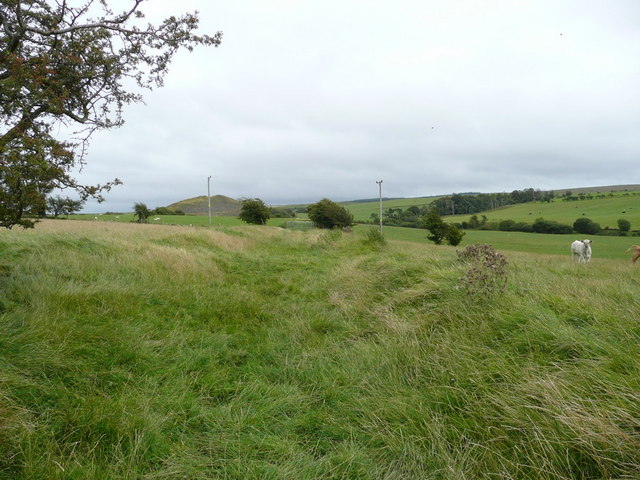
The course of the old railway that served the colliery can still be traced across farmland.
Redevelopment
Unknown.
Related mines
- Littlemill Colliery — Littlemill's 1950s coal preparation plant was designed also to serve Polquhairn.
Nearby mines
- Shieldmains Colliery — 1.5 miles (2.4 km) NW
- Littlemill Colliery — 1.9 miles (3.0 km) SW
- Rankinston Colliery — 2.0 miles (3.2 km) SW
- Killoch Colliery — 2.9 miles (4.7 km) N
- Sundrum Colliery — 4.4 miles (7.0 km) NW, South Ayrshire
Straight-line distance, within 9 miles (15 km). Show on the map.
Recorded claims
Individual factual claims, each attached to the source(s) that support it below. Where sources disagree, both are kept.
- Eight people were returned at Polquhairn in 1894, while it was being sunk. 1
- Production at Nos. 1 and 4 Pits began in 1895. 2,3
- Nos. 1 and 4 had two shafts, 77 m and 40 m deep, and worked house coal by stoop and room. 3
- In 1948 the colliery produced 180 tons a day, 46,500 tons a year, with 201 employees. 3
- On 13 December 1911 an explosion of firedamp in a heading of the Main coal fatally injured a roadsman and a drawer. 4
- Polquhairn handled and processed coal from Greenhill, which merged with it in September 1958. 2,3
- Polquhairn Nos. 1, 4, 5 and 6 closed in August 1962. 2,3,5
Photographs & further reading
The national record of the colliery, its shafts, workforce and 1948 details.
View sourceOwners, employment, output and seams from the Lists of Mines.
View sourceOpening and closing dates of the area's nationalised collieries, Polquhairn among them.
View sourceSources
- (primary) Polquhairn Colliery — Durham Mining Museum
- (secondary) Dalmellington Area — Northern Mine Research Society
- (secondary) Polquhairn (1 and 4) Colliery (NRHE 81162) — Historic Environment Scotland (trove.scot, formerly Canmore)
- (primary) Fatal Accidents in Scottish Mines & Collieries 1911 — Scottish Mining Website
- (primary) BGS mine plan: Polquhairn 1/4, Main, abandoned 1962 — BGS / Mining Remediation Authority mine plans
Record created: 4 October 2026 · Last researched: 4 October 2026