 MineArchive
Littlemill Colliery
| Also known as | Littlemill 2, 3 and 5, Knockshinnock |
|---|---|
| Location | Rankinston, East Ayrshire — 55.3989, -4.4589 (approximate) |
| Commodity | Coal |
| Type | Coal |
| Worked | 1860 (some accounts 1905)–June 1974 |
| Maximum depth | About 1,066 feet (325 m), No. 5 Shaft (1952) |
| Operators | Coylton Coal Company (?–1936), Bairds & Dalmellington Ltd (1936–1947), National Coal Board (1947–1974) |
Overview
The colliery at Rankinston, Ayrshire, that gave the village its living: begun by the Coylton Coal Company, bought by Bairds and Dalmellington in 1936, and rebuilt by the National Coal Board in the 1950s around a new 325-metre shaft. It employed 810 at its peak in 1960 and closed in June 1974.
History
Littlemill Colliery lay beside the mining village of Rankinston, in the parish of Coylton, about eight miles south-east of Ayr. Coal is recorded there from 1860, and the colliery of the twentieth century dates from 1905. The Coylton Coal Company worked it, with a brickworks built alongside about 1934, until Bairds and Dalmellington bought the colliery and brickworks in October 1936. It employed 200 people in 1933 and worked house coal from its Nos. 2 and 3 Pits.
On the night of 9 December 1938 an explosion at a face in the Ashentree main coal section, where about sixteen men were working, killed four men of Rankinston and injured five; most of the village's men turned out to help. Single deaths came from falls of roof in 1934 and 1938, and earlier a chain-runner, a bottomer and a boy drawer were killed between 1909 and 1912.
In 1948 the National Coal Board's Littlemill raised 150 tons a day, 40,000 tons a year, by longwall advancing with 158 employees. A reconstruction begun in 1952 was meant to lift output from 180 to 1,000 tons a day: a new No. 5 shaft, 4.88 metres across, concrete-lined and 325 metres deep, was sunk beneath a 23-metre steel headframe with an 805-horsepower electric winder, and the colliery gained locomotive haulage underground and a new coal preparation plant designed to serve neighbouring Polquhairn too. The workforce reached 810 in 1960. Littlemill closed in June 1974, and Rankinston, which had over 800 people in 1900, shrank to a village of about 260.
Geology
Ayrshire Coalfield: the Ell, Upper Ell and Ayr Hard seams, the Ashentree main coal, and a blackband ironstone in No. 3 Pit.
Workings
Nos. 2, 3 and 5 shafts; No. 5 (from 1952) 4.88 m across, 325 m deep, concrete-lined, with a 23 m tandem steel headframe and an 805 hp electric winder; underground locomotive haulage; a coal preparation plant; a brickworks beside the colliery from about 1934 to 1980.
Closure
Closed by the National Coal Board in June 1974; the Ell, Upper Ell and Ayr Hard workings had been abandoned in the 1950s, and the spoil tips were surveyed for abandonment in 1976 and 1988.
What remains
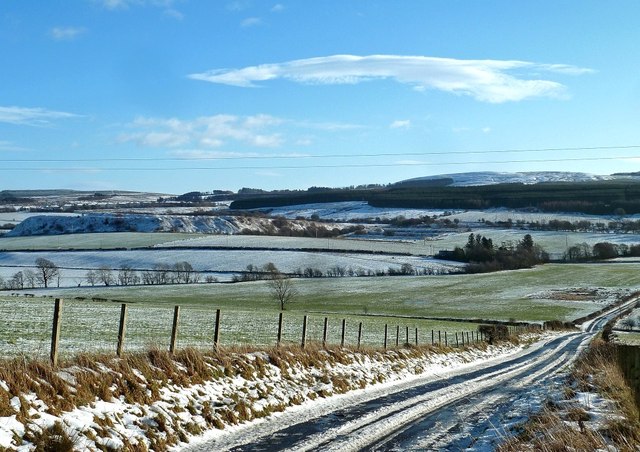
The colliery's old bing still stands in the farmland near Rankinston.
A spoil heap.
Redevelopment
Unknown.
Related mines
- Polquhairn Colliery — Littlemill's 1950s coal preparation plant was designed also to serve Polquhairn.
Nearby mines
- Rankinston Colliery — 1.0 miles (1.7 km) SE
- Polquhairn Colliery — 1.9 miles (3.0 km) NE
- Shieldmains Colliery — 1.9 miles (3.1 km) N
- Dalmellington Iron Works — 3.7 miles (6.0 km) S
- Dunaskin Ironworks — 3.7 miles (6.0 km) S, South Ayrshire
Straight-line distance, within 9 miles (15 km). Show on the map.
What's uncertain
Points where sources disagree or the record could not be settled; both accounts are kept. All open questions in the archive.
- Coal working at Littlemill is dated from 1860. (disputed) 1
- Littlemill Colliery opened in 1905. (disputed) 2
Recorded claims
Individual factual claims, each attached to the source(s) that support it below. Where sources disagree, both are kept.
- Coal working at Littlemill is dated from 1860. (disputed) 1
- Littlemill Colliery opened in 1905. (disputed) 2
- Bairds and Dalmellington bought Littlemill Colliery and Brickworks in 1936. 1,3
- An explosion in the Ashentree main coal section on the night of 9 December 1938 killed four men and injured five. 4
- No. 5 shaft, begun in the reorganisation of 1952, was 4.88 m in diameter, concrete-lined and 325 m deep. 1
- The workforce averaged 495 and peaked at 810 in 1960. 1
- Littlemill closed in June 1974. 2,1,5
- Rankinston's population fell to about 260 after the pit closed in 1974. 5
- In 1947 Littlemill raised 39,000 tons with 157 people, and in 1954 Nos. 2, 3 and 5 employed 243. 6
- The Ayr Hard workings of Littlemill Nos. 2, 3 and 5 were abandoned in 1959. 7
Photographs & further reading
The national record of the colliery, its 1950s reconstruction and workforce.
View sourceThe colliery's brickworks and its sale to Bairds and Dalmellington.
View sourceOwners, employment, seams and those killed at the colliery.
View sourceNewspaper reports of accidents at Ayrshire pits, among them the 1938 explosion at Littlemill.
View sourceSources
- (secondary) Littlemill Colliery (NRHE 124358) — Historic Environment Scotland (trove.scot, formerly Canmore)
- (secondary) Dalmellington Area — Northern Mine Research Society
- (secondary) Littlemill Colliery and Brickworks, Rankinston, East Ayrshire — Scotland's Brick and Tile Manufacturing Industry
- (secondary) Ayrshire Accidents 1915 onwards (newspaper reports) — Scottish Mining Website
- (secondary) Rankinston — Wikipedia
- (primary) Littlemill Colliery — Durham Mining Museum
- (primary) BGS mine plan: Littlemill 2/3/5, Ayr Hard, abandoned 1959 — BGS / Mining Remediation Authority mine plans
Record created: 4 October 2026 · Last researched: 4 October 2026