 MineArchive
Backworth Colliery
| Also known as | Eccles Colliery, Algernon Pit, Algernon Colliery |
|---|---|
| Location | Backworth, North Tyneside, Tyne and Wear — 55.0406, -1.5242 (approximate) |
| Commodities | Coal, Fireclay |
| Type | Coal |
| Worked | 1818–1980 |
| Maximum depth | Eccles Pit, 1,440 feet — the deepest in the Northumberland coalfield. |
| Operators | Humble, Lamb & Co. (1830–1840), Backworth Colliery Company (1840–1850), Backworth Collieries Ltd (1910–1947), National Coal Board (1947–1980) |
Overview
A Northumberland-coalfield colliery north-east of Newcastle, worked through a shifting group of shafts from 1818 until 1980. Nine or more pits were sunk on the take over that time; the last of them, Eccles, was the deepest in the Northumberland coalfield at 1,440 feet and closed in June 1980, ending 165 years of mining around the village. Coal and fireclay were both raised, and the colliery's railway was among the last places in Britain where steam locomotives worked in industrial service.
History
Sinking at the A Pit began in 1813 and it drew its first coal on 10 September 1818. Other shafts followed steadily: the B Pit, sunk from June 1820 and opened in 1821; the C Pit from May 1856; the D Pit from March 1864; the Maude Pit from July 1872; and, in the twentieth century, the Eccles Pit in July 1905 and Prosperous in 1906. The B, C, D and E pits were all given up in the 1890s and Blue Bell in 1915, so the colliery's working shafts changed several times over its life without the colliery itself ever closing.
Ownership changed as often. Humble, Lamb & Co. held it in the 1830s, the Backworth Colliery Company in the 1840s, Waldie & Co. in the 1850s, Maud, Taylor & Co. in the 1860s and J. C. Lamb & Co. in the 1880s, before it passed to the owners of Backworth and West Cramlington Collieries and then, in the 1910s, to Backworth Collieries Ltd. The National Coal Board took it over at nationalisation in 1947. Returns from the 1880s onward record fireclay raised alongside the coal, and brickmaking was carried on north of the village on the site of the former C Pit from the late nineteenth century to the mid-twentieth. By 1950 the collieries in and immediately around Backworth employed 2,905 people.
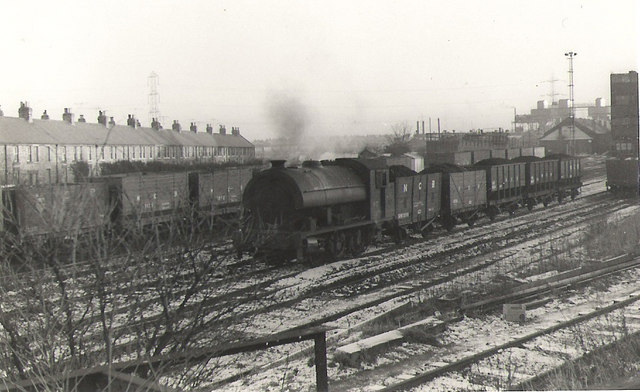
Maude and Prosperous both closed in December 1960, leaving Eccles to work on alone. In the early 1970s the colliery's own railway system was one of the very few places in Britain where steam locomotives could still be seen at work, and several of them have since been preserved on heritage railways. Eccles closed in June 1980.
The Algernon Pit at Shiremoor, west of the main group, was returned separately as Algernon Colliery for most of its life. The Durham Mining Museum dates its sinking from 30 March 1853, the High Main being reached on 3 August that year; the Tyne and Wear Historic Environment Record instead describes it as opened about 1820 as a pumping shaft of the Shiremoor Coal Company, given a beam engine in 1875 and, after the Backworth company took it over in 1896, deepened and converted to coal winding with a horizontal steam winder. It worked the Bensham seam in the early twentieth century and the Main Coal and Yard in its last years, employed 505 people in 1902 and 919 in 1921, and was one of the three pits, with Maude and Eccles, where mechanical mining began in 1927. It raised 155,000 tons of coal in 1947 and closed on 19 February 1966.
Geology
The colliery worked the Coal Measures of the Northumberland coalfield, the northern continuation of the Great Northern Coalfield. Seatearth fireclay beneath the coals was worked as a product in its own right and fed a brickworks on the site of the C Pit. The coals varied enough across the take for the annual returns to record coking, steam and gas coal from different shafts of the same colliery in the same year.
Workings
A group of shafts rather than a single pit: A, B, C, D and E, Blue Bell, Maude, Prosperous, Algernon and finally Eccles, sunk and abandoned at different dates across the take. Coal was worked with fireclay from at least the 1880s, the returns distinguishing coking, steam and gas coals from different pits in the same years. The colliery had its own railway to the staithes, worked by steam into the 1970s.
Closure
Maude and Prosperous closed in December 1960. Eccles, the last pit, closed in June 1980, ending 165 years of mining in the area.
What remains
The surface buildings were demolished apart from the colliery workshops, which back onto Station Road opposite the golf club and are in use as retail and light industrial units. The concrete caps over the backfilled A, Maude and Eccles shafts can still be seen on the colliery site. The former Miners' Welfare Hall grounds are now Backworth Golf Course.
Colliery workshops in reuse; concrete caps over the A, Maude and Eccles shafts.
Related mines
- Earsdon Colliery — Church Pit was part of Backworth Colliery, and the Backworth Collieries group owned Earsdon Colliery from the 1910s.
- Shire Moor Colliery — Backworth bought Shire Moor Colliery in 1896; its Algernon and Blue Bell pits then worked as part of Backworth.
- West Holywell Colliery — After West Holywell closed its pit heap was used for potato grounds by the Backworth men living in the former Holywell owners' houses.
Nearby mines
- Earsdon Colliery — 0.4 miles (0.6 km) E
- Shire Moor Colliery — 0.7 miles (1.1 km) SE
- East Holywell Colliery — 0.8 miles (1.4 km) NE
- West Holywell Colliery — 1.2 miles (2.0 km) N
- Seghill Colliery — 1.7 miles (2.8 km) N, Northumberland
Straight-line distance, within 9 miles (15 km). Show on the map.
Disasters & major incidents
-
Backworth Colliery explosion, 1820
29 March 1820 · Explosion · 2 fatalities
On 29 March 1820 two hewers were fatally burned by an explosion of gas fired at a candle at Backworth Colliery, in Northumberland. -
Backworth Colliery shaft accident, 1857
27 April 1857 · Winding / Shaft Accident · 3 fatalities
On 27 April 1857 three miners fell to the bottom of the shaft at Backworth Colliery, in Northumberland, when the bow of the basket they were ascending in came away from the hook. -
Algernon Pit roof fall, 1901
1901 · Collapse / Roof Fall · 2 fatalities
A fall of stone in a gateway at the Algernon Pit of the Backworth Collieries, Northumberland, in 1901 killed a shifter and a stoneman who were preparing to timber the face, in a roof full of slips that the chargeman had already examined. -
Backworth Colliery explosion, 1928
23 November 1928 · Explosion · 4 fatalities
A shot fired by a deputy in a ripping canch at Backworth's Eccles pit on 23 November 1928, after he had found gas there, ignited firedamp that burned the men on the tailgate and the face; four died. -
Eccles Pit explosion, 1933
22 April 1933 · Explosion · 3 fatalities
An explosion of firedamp at the Eccles Pit of Backworth Collieries on 22 April 1933 killed three coal-cutting machinemen. -
Eccles Pit roof fall, 1943
21 May 1943 · Collapse / Roof Fall · 3 fatalities
A fall of roof at the Eccles Pit of Backworth Collieries, Northumberland, on 21 May 1943 killed three men preparing a conveyor and injured two more.
Culture
- Backworth Colliery Band (Music)
The band was formed out of the workforce of Backworth Colliery and the surrounding pits in the 1880s, took the colliery's name, and still carries it more than forty years after the pit closed in 1980.
What's uncertain
Points where sources disagree or the record could not be settled; both accounts are kept. All open questions in the archive.
- Eccles, Backworth's last pit, was the deepest in the Northumberland coalfield at 1,440 feet, and closed in 1980 after 165 years of mining in the area. (uncertain) 2
- As late as 1950, 2,905 people were employed in the collieries in and immediately around Backworth. (uncertain) 2
- Returns from 1883 onward record fireclay raised alongside the coal, and brickmaking was carried on north of the village on the site of the former C Pit from the late nineteenth to the mid-twentieth century. (uncertain) 1,2
- In the early 1970s Backworth Colliery's railway was one of the few places in Britain where steam locomotives could still be seen at work; several have since been preserved. (uncertain) 2
- The Tyne and Wear HER describes the Algernon Pit as opened about 1820 as a pumping shaft of the Shiremoor Coal Company, with a beam engine erected in 1875; the Durham Mining Museum dates its sinking to 1853. (disputed) 4,3
Recorded claims
Individual factual claims, each attached to the source(s) that support it below. Where sources disagree, both are kept.
- Sinking at the A Pit began in 1813 and the pit drew its first coal on 10 September 1818. 1
- Eccles, Backworth's last pit, was the deepest in the Northumberland coalfield at 1,440 feet, and closed in 1980 after 165 years of mining in the area. (uncertain) 2
- As late as 1950, 2,905 people were employed in the collieries in and immediately around Backworth. (uncertain) 2
- Returns from 1883 onward record fireclay raised alongside the coal, and brickmaking was carried on north of the village on the site of the former C Pit from the late nineteenth to the mid-twentieth century. (uncertain) 1,2
- In the early 1970s Backworth Colliery's railway was one of the few places in Britain where steam locomotives could still be seen at work; several have since been preserved. (uncertain) 2
- Sinking of the Algernon Pit began on 30 March 1853 and the High Main was reached on 3 August 1853. 3
- The Tyne and Wear HER describes the Algernon Pit as opened about 1820 as a pumping shaft of the Shiremoor Coal Company, with a beam engine erected in 1875; the Durham Mining Museum dates its sinking to 1853. (disputed) 4,3
- When the Backworth company took over the Algernon Pit in 1896 it deepened the shaft and converted it to coal winding with a horizontal steam winder. 4
- Algernon Colliery closed on 19 February 1966, having raised 155,000 tons in 1947 and employed 645 people in 1960. 4,3
Photographs & further reading
Sinking and closing dates for each of the colliery's shafts, the succession of owners from the 1830s to nationalisation, and the annual output returns distinguishing coking, steam and gas coal and fireclay.
View sourceSources
- (primary) Durham Mining Museum: Backworth Colliery — Durham Mining Museum
- (secondary) Backworth — Wikipedia
- (primary) Durham Mining Museum: Algernon Colliery — Durham Mining Museum
- (primary) Backworth Colliery, Algernon Pit (HER 2177) — Tyne and Wear Historic Environment Record
Record created: 3 September 2026 · Last researched: 3 September 2026