 MineArchive
Ardenrigg Colliery
| Also known as | Ardenrigg No. 6, Watch Moss, Earlshill |
|---|---|
| Location | Plains, near Airdrie, North Lanarkshire — 55.8701, -3.8765 (exact) |
| Commodity | Coal |
| Type | Coal |
| Worked | 1908–June 1963 |
| Maximum depth | Unknown. |
| Operators | Ardenrigg Coal Company (1908–1947), Coltness Iron Company (?–1947), National Coal Board (1947–1963) |
Overview
The Ardenrigg Coal Company's anthracite colliery on the high ground above the Lily Loch, between Plains and Salsburgh, worked from about 1908 through a run of numbered pits to No. 6. Its coal went down an aerial ropeway to Stepends, where the dross made bricks, and it closed in June 1963.
History
Ardenrigg lies in the hills above the Lily Loch, north of Plains and towards Salsburgh, in the parish of Shotts, near Airdrie. The Ardenrigg Coal Company was established by John Gardner and John Gemmell, and the colliery is dated from 1908. It employed 112 people in 1910 working the Lower Drumgray, and over the next dozen years worked a series of small pits, Nos. 1 to 4, in the Upper and Lower Drumgray seams, for household, manufacturing and steam coal.
The company was incorporated as the Ardenrigg Coal Co. Ltd in 1925, and the Coltness Iron Company later bought 95 per cent of it as part of a policy of acquiring small pockets of undeveloped coal. No. 6 Pit, dating from the 1920s, became the colliery's mainstay, employing 130 people in 1933 and 250 by 1940, and the colliery produced anthracite from the two Drumgray seams. Its output, 77,000 tons a year, was carried by an overhead ropeway down to the company's Stepends pit beside the railway at Plains, whose washer served both; from about 1938 the dross went into bricks stamped "Stepends" at a brickworks built there.
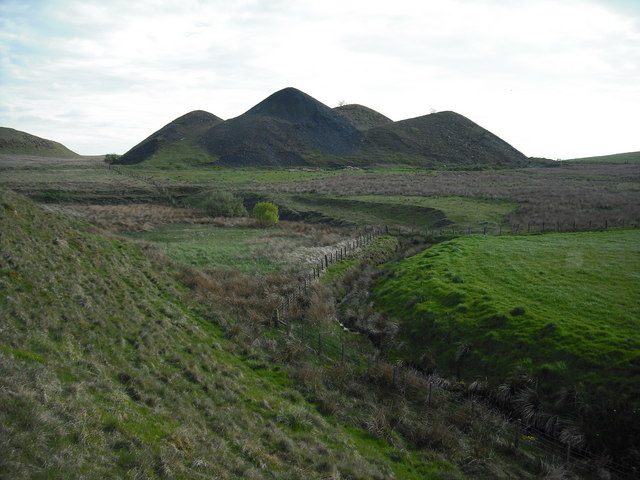
The National Coal Board took Ardenrigg over in 1947, when it raised 65,000 tons of anthracite with 194 people. No. 6 employed 275 in 1954. The colliery closed in June 1963, when the last plans of No. 6's Upper and Lower Drumgray workings were lodged; its conical bings still stand on the moor.
Geology
Lanarkshire coalfield: the Upper and Lower Drumgray seams, worked as anthracite, with the Virtuewell.
Workings
Numbered pits, Nos. 1 to 4 and No. 6 (from the 1920s); an aerial ropeway to Stepends pit, where a washer served both and a brickworks used the dross.
Closure
Closed by the National Coal Board in June 1963; No. 6 Pit's Upper and Lower Drumgray plans are dated 1963.
What remains
Several tall conical bings of No. 6 Pit stand on the moor among rough grazing.
Spoil heaps (bings).
Redevelopment
Unknown.
Nearby mines
- Fortissat Colliery — 2.5 miles (4.1 km) SE
- Hassockrigg Colliery — 3.3 miles (5.4 km) SE
- Hillhouserigg Colliery — 3.9 miles (6.3 km) SE
- Blairmuckhill Colliery — 4.1 miles (6.6 km) E
- Calderhead Colliery — 4.1 miles (6.6 km) SE
Straight-line distance, within 9 miles (15 km). Show on the map.
Recorded claims
Individual factual claims, each attached to the source(s) that support it below. Where sources disagree, both are kept.
- The Ardenrigg Coal Company was founded by John Gardner and John Gemmell and incorporated as a limited company in 1925; the Coltness Iron Company acquired 95 per cent of it. 1
- Ardenrigg colliery is dated 1908 to June 1963. 2,3
- In 1910 Ardenrigg employed 112 people working the Lower Drumgray. 3
- Ardenrigg's output of 77,000 tons a year of anthracite went by overhead ropeway to Stepends, where a washer served both pits and the dross was made into bricks. 1
- In 1947 Ardenrigg raised 65,000 tons of anthracite with 194 people. 3
- Ardenrigg No. 6 is recorded as a twentieth-century colliery, also known as Watch Moss and Earlshill. 4,5
- The Upper Drumgray workings of Ardenrigg No. 6 were abandoned in 1963. 6
Photographs & further reading
The brickworks fed by Ardenrigg's dross, with the history of the Ardenrigg Coal Company.
View sourceThe national record of the colliery, with an elevated photograph of the site.
View sourceOwners, employment, output and seams pit by pit.
View sourceSources
- (secondary) Stepends Brickworks, Nr Plains, Airdrie, North Lanarkshire — Scotland's Brick and Tile Manufacturing Industry
- (secondary) NCB Collieries - Scotland (Northern Mine Research Society) — Northern Mine Research Society
- (primary) Ardenrigg Colliery — Durham Mining Museum
- (secondary) Ardenrigg Colliery (NRHE 83281) — Historic Environment Scotland (trove.scot, formerly Canmore)
- (observational) Ardenrigg Pit No. 6 (Commons, from Geograph 1307698) — Wikimedia Commons
- (primary) BGS mine plan: Ardenrigg No 6, Upper Drumgray, abandoned 1963 — BGS / Mining Remediation Authority mine plans

Record created: 4 October 2026 · Last researched: 4 October 2026