 MineArchive
Whatley Quarry
| Also known as | New Frome Quarry |
|---|---|
| Location | Whatley, near Frome, on the East Mendips, Somerset — 51.2297, -2.3856 (exact) |
| Commodity | Limestone |
| Type | Quarry |
| Worked | 1939–Still active |
| Maximum depth | Surface quarrying cut deep into the Mendip plateau; no depth figure applies. |
| Operators | Roads Reconstruction (1934) Ltd. (1937–?), Heidelberg Materials UK |
Overview
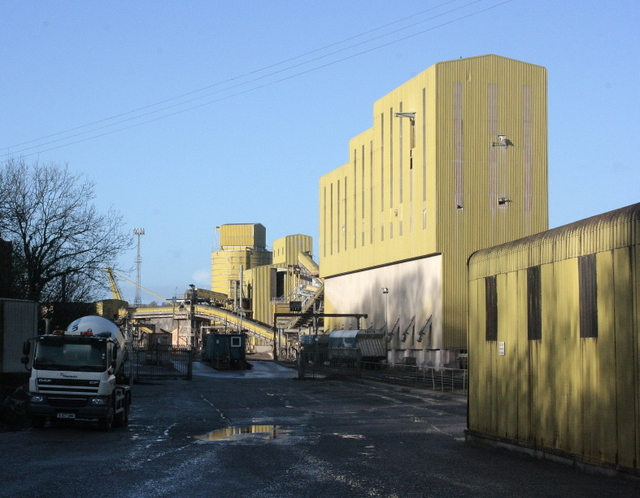
One of the great East Mendip limestone quarries, begun as New Frome Quarry in 1937 and worked since on a scale few sites in Britain match. It is the northern counterpart of Torr Works, cutting the opposite flank of the Beacon Hill Pericline, and like Torr it is deliberately hidden — planned so that the working area is invisible from any public road. Its stone leaves by rail for London and the south east, where there is no limestone of their own.
History
There were small quarries here in the 1880s at Murder Combe and Whatley Bridge, beside the roads crossing the Fordbury Water valley, and Frome Rural District Council worked both from at least 1895 — Murder Combe until about 1919 and Whatley until about 1930, presumably relinquished when the county took over rural highway responsibility. These were very small operations and not really the quarry as it is now.
The uncertain markets between 1926 and 1933 prompted the amalgamation of many local companies into Roads Reconstruction (1934) Ltd, and a rationalisation of the twelve sites they then held. Work at Whatley, originally New Frome Quarry, began in 1937 with first production in 1939.
Stone at first went by a 2 ft gauge railway along a tortuous four-kilometre route, partly following the old Vallis Vale tramway, to be crushed at Hapsford Mill. Demand had grown so much by 1943 that the unmanageable narrow-gauge system was rapidly upgraded to standard gauge, trains of up to seven Hudson side-tipping wagons hauled by Sentinel locomotives being filled by electric 100 RB face shovels. By 1948 a team of sixty was producing 6,000 tons a week from a face 270 m wide and 10 to 20 m high; annual production between 1940 and 1951 ran at 150,000 to 160,000 tons. Road aggregate was the main product, but stone also went for rail ballast, agricultural limestone, coal mine safety dust and steel flux.
A primary crusher was installed at the quarry in the early 1950s, though the rest of the processing stayed at Hapsford. The line was improved with additional tunnels in 1963, and in 1964 the first comprehensive processing plant was built at the quarry itself, capable of 500 tons an hour — taking annual output to a million tonnes, about 0.4 million of it rail ballast, and turning the old Hapsford plant site in Vallis Vale into a marshalling yard. Ten years later the most difficult sections of railway were realigned and a new section put in to join the British Rail line more directly, allowing much larger trains. New plant in 1970 met the growing motorway programme. By the early 1980s production had reached 2.5 million tonnes a year with the plant at full capacity, and a new £25 million plant was opened in 1987. By 1987 the company had concentrated virtually all its Mendip production on Whatley in the east and Batts Coombe in the west.
Geology
Whatley is the northern counterpart of Torr Works, taking stone from the opposite flank of the Beacon Hill Pericline, and almost all the formations within the Carboniferous Limestone are represented in it. The stone ranges from fairly chemically pure oolites to mudstone-rich and cherty limestones. The dips are much steeper than at Torr — typically 60 to 70 degrees, and in places the beds are overturned — and minor faulting is significant. The eastern part of the site, now worked out, carried a cover of Inferior Oolite.
Geological setting: Faults and Fractures (well documented example), Sedimentary Beds and Seams (well documented example)
Workings
A very large open quarry cut deep into the East Mendip plateau, planned like its neighbour Torr Works so that the working area is hidden from any public road, bordered by landscaped screen banks and natural woodland slopes. Internal haulage began as a 2 ft gauge line to Hapsford Mill four kilometres away, was converted to standard gauge in 1943, and was progressively realigned to give a more direct connection to the main line for larger trains. Processing moved on site in stages: a primary crusher in the early 1950s, a full plant of 500 tons an hour in 1964, and a new £25 million plant in 1987.
Closure
Still working. Whatley and the neighbouring Westdown quarry are operated today by Heidelberg Materials, formerly Hanson and before that ARC.
What remains
An active rail-connected quarry, worked with Westdown alongside it. Its rail link, part of the Mendip Rail operation, lets it supply construction materials to London and the south east, where there are no natural supplies of limestone; stone from the East Mendip quarries has gone into projects from Georgian Bath to Hinkley Point C and HS2. The Hanson East Mendip Study Centre occupies the site of the old Whatley Bridge quarry.
Not applicable — the quarry, its plant and its rail connection are in active use.
Related mines
- Torr Works — The two are counterparts on the same fold: BGS describes Torr Works and Whatley as working opposite flanks of the Beacon Hill Pericline, Torr from the south with consistent southward dips and Whatley from the north where the beds stand at 60 to 70 degrees and are locally overturned. Both are rail-connected and served by the Mendip Rail joint venture.
- Tytherington Quarry — Both worked by Roads Reconstruction (1934) Ltd and now by Heidelberg Materials UK.
Nearby mines
- Mells Colliery — 1.8 miles (2.9 km) NW
- Vobster Breach Colliery — 2.2 miles (3.5 km) W
- Newbury Colliery — 2.8 miles (4.5 km) NW
- Torr Works — 3.1 miles (4.9 km) SW
- Charmborough Colliery — 3.5 miles (5.7 km) NW
Straight-line distance, within 9 miles (15 km). Show on the map.
Recorded claims
Individual factual claims, each attached to the source(s) that support it below. Where sources disagree, both are kept.
- Small quarries existed at Murder Combe and Whatley Bridge in the 1880s, worked by Frome Rural District Council from at least 1895 until about 1919 and about 1930 respectively; they were very small and did not coincide with the quarry as it is now. 1
- Work at Whatley, originally known as New Frome Quarry, began in 1937 with first production in 1939, under Roads Reconstruction (1934) Ltd. 1
- Whatley is the northern counterpart of Torr Works, extracting stone from the opposite flank of the Beacon Hill Pericline; almost all formations within the Carboniferous Limestone are represented, dips are typically 60 to 70 degrees and beds are in some cases overturned. 1
- Stone was first taken by a 2 ft gauge railway along a tortuous 4 km route partly following the Vallis Vale tramway to Hapsford Mill; by 1943 demand had grown so much that the system was rapidly upgraded to standard gauge. 1
- By 1948 a team of sixty was producing 6,000 tons a week from a face 270 m wide and 10 to 20 m high, annual production between 1940 and 1951 running at 150,000 to 160,000 tons. 1
- The first comprehensive processing plant at the quarry itself was erected in 1964, capable of 500 tons an hour, taking annual output to a million tonnes of which about 0.4 million was rail ballast; a new £25 million plant followed in 1987. 1
- As at Torr Works, operations were planned so that the working area is hidden when viewed from any public road or anywhere outside the quarry, bordered by landscaped screen banks and natural woodland slopes. 1
- Road aggregate was the main product, with stone also sold for rail ballast, agricultural limestone, coal mine safety dust and steel flux; the rail connection allows the quarry to supply London and the south east, which have no natural limestone of their own. 1,2
Photographs & further reading
The Survey's detailed history of the East Mendip quarrying industry, following Whatley from the small council quarries of the 1890s through its narrow-gauge beginnings to the £25 million plant of 1987.
View sourceThe current operator's own pages for the quarry and its neighbour, covering present working and community liaison.
View sourceSources
- (primary) History of the East Mendip quarries (Foundations of the Mendips) — British Geological Survey
- (secondary) Quarries of the Mendip Hills — Wikipedia
- (primary) Whatley and Westdown quarries community page — Heidelberg Materials UK
Record created: 3 September 2026 · Last researched: 3 September 2026