 MineArchive
Torr Works
| Also known as | Merehead Quarry |
|---|---|
| Location | East Cranmore, near Shepton Mallet, Somerset — 51.1998, -2.4379 (exact) |
| Commodity | Limestone |
| Type | Quarry |
| Worked | 1930s–Still active |
| Maximum depth | Surface quarrying; no depth figure applies. |
| Operators | Limmer and Trinidad (1938–1958), Foster Yeoman Ltd. (1958–2006), Aggregate Industries (2006–?) |
Overview
A very large Mendip limestone quarry at East Cranmore, opened as Merehead and renamed in 1970 after the engineer who rebuilt it. It works the southern flank of the same Beacon Hill Pericline that Whatley cuts from the north, produces 7.5 million tonnes a year, and ships nearly all of it by rail from a terminal that still carries the quarry's old name.
History
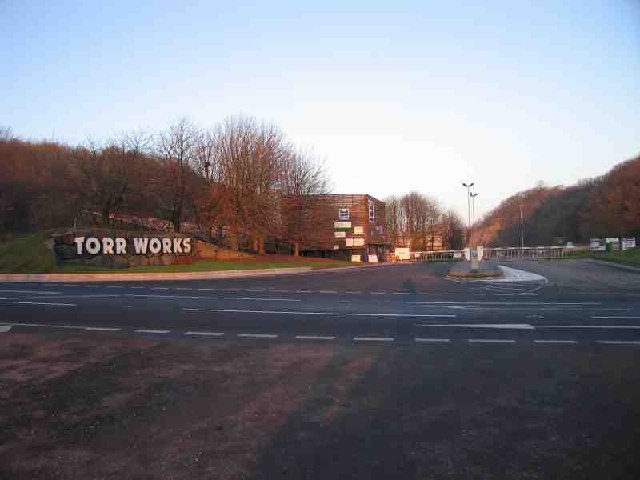
Merehead Quarry had only recently opened when Limmer and Trinidad took it over in 1938, employing twenty-five men. In 1958 it was sold to Foster Yeoman, who were already working Dulcote Quarry near Wells. Foster Yeoman brought in Ron Torr as chief engineer to redevelop the plant, and within four years the company had returned to profit; on 19 August 1970 the quarry was renamed Torr Works in his honour.
The same day saw the first train run. The quarry had been connected to the East Somerset branch, which joins the main line at Witham, and the rail terminal built to serve it kept the older name — Merehead — which it still uses, on the opposite side of the A361 from the quarry itself.
Foster Yeoman was taken over by Aggregate Industries in 2006, which has operated Torr Works since. The site employs over 250 people and produces 7.5 million tonnes of limestone a year, carried directly from the quarry by Mendip Rail — the joint venture between the rail operations of Aggregate Industries and Hanson that also serves Whatley.
Geology
A 2004 geodiversity audit recorded pale to dark grey, well-bedded Carboniferous Limestone dipping consistently southwards, with a small area of overlying horizontally bedded buff Jurassic oolitic limestone forming an angular unconformity — younger flat beds resting on the tilted edges of older ones. Torr works the southern flank of the Beacon Hill Pericline; Whatley, its counterpart, takes stone from the opposite flank of the same fold, where the dips are far steeper.
Geological setting: Faults and Fractures (well documented example), Sedimentary Beds and Seams (well documented example)
Workings
An open quarry covering some 205 hectares, of which 60 have been landscaped to blend into the surrounding countryside — the same concealment principle applied at Whatley, where the working area was planned to be invisible from any public road. Output leaves almost entirely by rail: the Merehead terminal across the A361 has been the railhead since August 1970, and Mendip Rail runs the trains.
Closure
Still working, and among the largest limestone quarries in Britain at 7.5 million tonnes a year. The precise opening date is not recorded: Merehead is described only as 'recently opened' when Limmer and Trinidad took it over in 1938.
What remains
An active rail-connected quarry employing over 250 people, operated by Aggregate Industries. Sixty of its 205 hectares have been landscaped. The Merehead rail terminal on the far side of the A361 remains the despatch point and is a well-known location among railway photographers.
Not applicable — the quarry, its plant and its rail terminal are in active use.
Related mines
- Dulcote Quarry — Both are Mendip limestone quarries built around rail-borne aggregate traffic, and both passed into the Foster Yeoman business that began at Dulcote in 1923.
- Whatley Quarry — The two are counterparts on the same fold: BGS describes Torr Works and Whatley as working opposite flanks of the Beacon Hill Pericline, Torr from the south with consistent southward dips and Whatley from the north where the beds stand at 60 to 70 degrees and are locally overturned. Both are rail-connected and served by the Mendip Rail joint venture.
Nearby mines
- Vobster Breach Colliery — 2.7 miles (4.3 km) N
- Doulting Quarry — 2.8 miles (4.6 km) W
- Fairy Cave Quarry — 3.0 miles (4.8 km) NW
- Whatley Quarry — 3.1 miles (4.9 km) NE
- Mells Colliery — 3.6 miles (5.7 km) N
Straight-line distance, within 9 miles (15 km). Show on the map.
Recorded claims
Individual factual claims, each attached to the source(s) that support it below. Where sources disagree, both are kept.
- Limmer and Trinidad took over the recently opened Merehead Quarry in 1938, when twenty-five men were employed; Foster Yeoman bought it in 1958. 1,2
- The quarry was renamed Torr Works on 19 August 1970 after Ron Torr, the chief engineer brought in to redevelop the plant, under whom the company returned to profit within four years. 1,2
- The quarry was connected to the East Somerset branch in 1970 and the first train ran on 19 August 1970; the rail terminal kept the older name, Merehead. 1
- The site employs over 250 people and produces 7.5 million tonnes of limestone a year, carried directly from the quarry by Mendip Rail. 1
- The quarry covers some 205 hectares, including 60 hectares landscaped to blend with the surrounding countryside. 1
- A 2004 geodiversity audit recorded pale to dark grey well-bedded Carboniferous Limestone dipping consistently southwards, with a small area of horizontally bedded Jurassic oolitic limestone above it forming an angular unconformity. 1
Photographs & further reading
How ownership of the Mendip quarries consolidated, including Merehead's passage from Limmer and Trinidad to Foster Yeoman and the redevelopment that led to the renaming.
View sourceSources
- (secondary) Torr Works — Wikipedia
- (primary) History of the main Mendip quarry companies (Foundations of the Mendips) — British Geological Survey
Record created: 3 September 2026 · Last researched: 3 September 2026