 MineArchive
Tytherington Quarry
| Location | Tytherington, near Thornbury, South Gloucestershire — 51.5970, -2.4894 (approximate) |
|---|---|
| Commodity | Limestone |
| Type | Quarry |
| Worked | 1872–Still active |
| Maximum depth | Unknown. |
| Operators | John Hawkins Tyler (?–1877), Tytherington Stone Company (1880–?), Roads Reconstruction (1934) Ltd. (1934–?), Hanson (1988–2023), Heidelberg Materials UK (2023–?), Teign Valley Granite Co. |
Overview
A limestone quarry near Thornbury, begun as a small working in 1872 when the railway arrived and owned by the Tytherington Stone Company by 1880. Through a chain of mergers it passed to Hanson in 1988 and Heidelberg Materials; mothballed in 2008, it reopened in 2019 and produces about 2.25 million tonnes a year.
History
Quarrying at Tytherington, near Thornbury, began on a small scale in 1872 with the arrival of the Yate to Thornbury railway, on West Street and behind the church on Tytherington Hill, closer to the village than the present workings; at least fourteen older small quarries for building stone and lime burning can still be traced. John Hawkins Tyler of West End Farm, already working a small quarry across West Street from his farmhouse, brought the railway into it and sent stone out by train; after his death in 1877 his widow Mary ran the quarry with the farm. Squire Hardwicke, who came to the village in 1882, opened Church quarry on the limestone hill behind the church by about 1890, its sidings crossing Stow Hill Road; both quarries ate into the earthworks of an Iron Age camp. By 1880 the site belonged to the Tytherington Stone Company, which Howell Lloyd Hardwicke built up from these quarries. A rail link of 1888 took 60 to 65 trucks of stone, each of 8 tonnes, every weekend, for stone could be loaded only on Sundays, when no passenger trains ran; the restriction lifted when the line became freight-only in 1944. Grovesend quarry was opened in 1902 to supply stone for the Royal Edward Dock at Avonmouth, sending some 850 to 895 tonnes a week by rail; steam drills followed two years later. Main Quarry, up West Street, closed in 1910 and Church Quarry in 1920. From 1906 the company also made pennant cement slabs, in sheds along Stow Hill Road until about 1935, and from 1914 tar-macadam. Its shunting engines included the 'Iron Duke' of about 1897 and 'Daphne', named after the squire's eldest daughter.
The Tytherington Stone Company was bought by the Teign Valley Granite Company, which became Roads Reconstruction Ltd and, after liquidation in the 1930s, Roads Reconstruction (1934) Ltd, merged with several Somerset quarries. It was then absorbed into Amey Roadstone, ARC and Consolidated Gold Fields, and in 1988 Hanson, which became Heidelberg Materials UK in 2023. Between 1934 and 1958 the company bought up neighbouring land, Woodleaze Farm among it in 1940; a scheme of 1972 restored the rail track and built a loading terminal at Grovesend, and in 1984 quarrying was extended south of the railway into Woodleaze. In 1990 Grovesend was producing some 30,000 tons a week. The quarry was mothballed in 2008 in the economic downturn and reopened in 2019. It covers about 57 hectares in three pits: Woodleaze and Grovesend, which are worked and linked by a tunnel under the railway, and North Face, north of Tytherington Road, which is exhausted, partly flooded and owned by FCC Environment. Part of North Face was notified in 1989 as a geological SSSI for late Triassic fissure fills that have yielded seven reptile species, among them the genus Diphydontosaurus. The quarry produces about 2.25 million tonnes of limestone aggregate a year, sent by rail across the south and south-east.
Geology
Carboniferous limestone, with late Triassic (Rhaetian) fissure fills in the North Face pit.
Workings
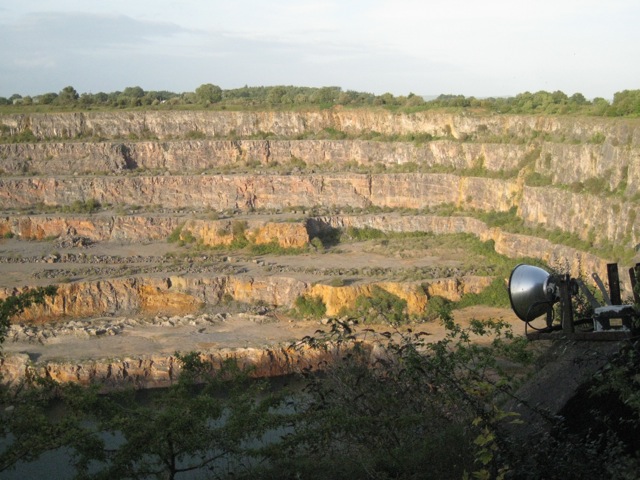
Three open pits, Woodleaze, Grovesend and North Face, joined by tunnels; rail-connected by the Thornbury branch; an asphalt plant.
Closure
Working; mothballed from 2008 to 2019. An extension deepening Woodleaze was permitted in 2025.
What remains
Woodleaze and Grovesend are worked; North Face is exhausted and partly flooded.
The worked-out North Face pit, partly flooded, north of Tytherington Road.
Redevelopment
Part of North Face has been a geological Site of Special Scientific Interest since 1989.
Related mines
- Whatley Quarry — Both worked by Roads Reconstruction (1934) Ltd and now by Heidelberg Materials UK.
Nearby mines
- Nibley Colliery — 4.4 miles (7.0 km) SE, Gloucestershire
- Mayshill Colliery — 4.6 miles (7.5 km) SE, Gloucestershire
- Yate Celestine Mines — 4.8 miles (7.8 km) SE
- Coalpit Heath Colliery — 5.0 miles (8.0 km) S
- Ram Hill Colliery — 5.4 miles (8.7 km) S, Gloucestershire
Straight-line distance, within 9 miles (15 km). Show on the map.
Recorded claims
Individual factual claims, each attached to the source(s) that support it below. Where sources disagree, both are kept.
- Quarrying at Tytherington began in 1872, with the coming of the railway. 1,2
- A rail link of 1888 took 60 to 65 trucks of 8 tonnes every weekend. 2,3
- Grovesend quarry opened in 1902 to supply stone for Avonmouth Docks. 1,2
- The company passed through Roads Reconstruction (1934) Ltd, Amey Roadstone, ARC and Consolidated Gold Fields to Hanson in 1988. 1,2
- The quarry was mothballed in 2008 and reopened in 2019. 2
- John Hawkins Tyler of West End Farm brought the railway into his small quarry and sent stone out by train; he died in 1877. 4
- Main Quarry, up West Street, closed in 1910 and Church Quarry in 1920. 4
- In 1984 quarrying was extended south of the railway into Woodleaze Farm land. 4
Photographs & further reading
The operator's history of the quarry, its pits and its output.
View sourceHistory, the three pits and the Triassic fossil SSSI.
View sourceThe village history of the quarries: Tyler, Squire Hardwicke, the slab works, the engines and the company's land.
View sourceSources
- (secondary) Tytherington Quarry — Wikipedia
- (primary) Tytherington quarry: about the site — Heidelberg Materials UK
- (observational) Tytherington Quarry, South Gloucestershire - 2014 - 2019 — 28DaysLater
- (secondary) Tytherington Quarries — Tytherington Roots (village history)
Record created: 4 October 2026 · Last researched: 4 October 2026