 MineArchive
Yate Celestine Mines
| Also known as | Yate Celestine Workings, Celestite Mines, Yate, Yate Quarry |
|---|---|
| Location | Yate, Chipping Sodbury and Goose Green, South Gloucestershire — 51.5406, -2.4224 (approximate) |
| Commodity | Celestine |
| Type | Mineral |
| Worked | 1880s–1994 |
| Maximum depth | Shallow surface workings rather than deep mines |
| Operators | Bristol Mineral and Land Company (1910–1994), Albright & Wilson (1941–1969), English China Clays (1969–1975) |
Overview
For most of a century, somewhere around ninety-five per cent of the world's celestine came out of the fields around Yate — dug at first by farm labourers with picks in the slack season, and ending up in German sugar refineries, fireworks and tracer bullets.
History
Celestine was being taken from the Yate area from early in the 19th century, but the trade that mattered began in the 1880s, when a German sugar refinery found the local mineral purer than anything else available. Strontium salts were used to recover sugar from beet molasses, and Yate had the deposit. A note in Nature in 1887 reported the 'large and valuable layer' lately found at Yate, lying just below the subsoil on red Triassic marl. Landowners such as the Reverend Pontifex and Robert Drew worked it themselves before brokers took over, and the Bristol Mineral and Land Company, set up as a brokerage in 1910 (or 1912, in the group's later history), came to dominate the industry; one of its directors, Mr Pauli, was connected with the German sugar-beet refineries, and his family stayed with the firm for three generations. The ore went by horse and cart to stations such as Wickwar until the company invested in plant at Yate to crush, wash, grind, grade and bag it. The industry outlived the loss of its German customers in two world wars by finding American buyers, and by the 1930s pyrotechnics had become a market. The company was acquired by Albright & Wilson in 1941 and by English China Clays in 1969, and after a temporary closure it was revived independently in 1975 under Roger Pauley, grandson of the founder Carl Pauli. At its height Yate supplied something like ninety-five per cent of world production. Output peaked in the 1960s at about 10,000 tons a year, and so valuable was the mineral that in 1949 the planning committee blocked housing on the former Yate aerodrome on the mere chance of finding it. The work was done at first with picks and shovels by agricultural labourers taking it on part-time; after the Second World War, with labour short, the company brought in mechanical excavators, bulldozers and pneumatic drills. Extraction ended in 1994 and the processing plant closed the following year, the workable deposits exhausted.
Geology
Celestine — strontium sulphate — occurs here in the Triassic rocks around Yate and Chipping Sodbury as nodules and veins, and the Yate concentration was both the largest and the highest quality known anywhere, better than the deposits in Australia, Germany or Mexico. The celestine formed as an ancient inland lake in a desert dried out, leaving the mineral in the Keuper Marl in irregular beds up to three feet thick along a belt about seven miles long, from Westerleigh through Yate and Wickwar to Charfield; the marl rests unconformably on the Coal Measures at the eastern edge of the Bristol coalfield. The other Avon occurrences, at Leigh Court in Bristol and Aust Cliff, never approached it. Because the mineral lay near the surface it was worked from shallow diggings and quarries rather than from shafts, which is why an industry supplying most of the world left so little visible behind it.
Geological setting: Evaporite Deposits (well documented example)
Workings
Shallow surface workings: pits and quarries following the nodules, dug by hand for the first sixty years and by machine afterwards. There were no deep shafts and no underground development of the kind the word 'mine' usually implies — the local name for the trade stuck all the same.
Closure
Quarrying ended in 1994 and the processing works closed in 1995. The cause was exhaustion of the workable Yate deposits rather than loss of the market; world strontium supply moved to celestine and strontianite from Mexico, Germany and elsewhere. The last significant extraction here is associated with demand during the Vietnam War, for flares and tracer.
What remains
Built over. The principal workings lie beneath modern Yate, including the shopping centre, and there is essentially nothing to see. Celestine specimens from Yate Quarry are prized by collectors precisely because the source is long gone.
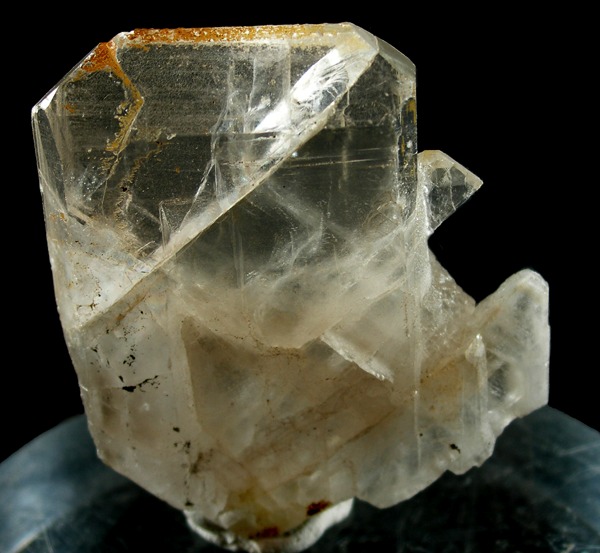
Little to nothing in the ground. The mineral itself is the memorial: water-clear tabular celestine from Yate Quarry sits in museum and private collections around the world.
Redevelopment
Yate grew over its own mineral field; the main site is now under the shopping centre and its surroundings.
Nearby mines
- Nibley Colliery — 1.0 miles (1.6 km) W, Gloucestershire
- Mayshill Colliery — 1.2 miles (1.9 km) W, Gloucestershire
- Serridge Pit — 1.5 miles (2.4 km) SW, Gloucestershire
- Ram Hill Colliery — 2.3 miles (3.6 km) SW, Gloucestershire
- Coalpit Heath Colliery — 2.3 miles (3.7 km) SW
Straight-line distance, within 9 miles (15 km). Show on the map.
What's uncertain
Points where sources disagree or the record could not be settled; both accounts are kept. All open questions in the archive.
- The Bristol Mineral and Land Company Limited was established in 1910 as a brokerage. (disputed) 1
- The Bristol Mineral & Land Company was formed in 1912. (disputed) 3
Recorded claims
Individual factual claims, each attached to the source(s) that support it below. Where sources disagree, both are kept.
- The celestine trade at Yate began in earnest in the 1880s, when a German sugar refinery found the local mineral purer than any other source; strontium salts were used in recovering sugar from beet. 1,2
- At its peak Yate supplied about 95 per cent of world celestine production. 2
- The Yate deposits were the largest and highest-quality concentration of celestine known, better than those in Australia, Germany or Mexico. 1
- The mineral was worked by picks and shovels, largely by agricultural labourers working part-time, until the Bristol Mineral and Land Company introduced mechanical excavators, bulldozers and pneumatic drills after the Second World War. 1
- Celestine's uses ran from sugar-beet refining in the 1890s to pyrotechnics, military and signal flares and tracer ammunition — strontium colouring flame red — and later to television components, paint, medicines, plastics and fertilisers. 1,2
- Extraction ended in 1994 and the processing plant closed in 1995, the local deposits exhausted; the main site now lies beneath Yate shopping centre. 1,2
- Landowners such as the Reverend Mr Pontifex, Rector of Yate, and Robert Drew at Wickwar quarried celestine piecemeal in the late nineteenth century before brokers took over the trade. 1
- The Bristol Mineral and Land Company Limited was established in 1910 as a brokerage. (disputed) 1
- The Bristol Mineral & Land Company was formed in 1912. (disputed) 3
- The company was acquired by Albright & Wilson in 1941 and English China Clays in 1969, and revived independently under Roger Pauley, grandson of the founder Carl Pauli, in 1975 after a temporary closure. 3
- Output peaked in the 1960s at about 10,000 tons a year, approximately 90 per cent of world production; at its peak Yate provided over 80 per cent of the global supply of strontium. 3
- A large and valuable layer of celestine was reported in 1887 as lately found at Yate, just below the subsoil on red Triassic marl resting unconformably on the Coal Measures at the eastern edge of the Bristol coalfield. 4
- In 1949 the chance of finding celestine was reason enough for the Planning Committee to block Sodbury Rural Council's proposal to build housing on the former Yate aerodrome. 1
- The deposit stretches about seven miles from Westerleigh through Yate and Wickwar to Charfield, in irregular beds in the Keuper Marl up to three feet thick. 3
- Areas of Yate between the 1920s and 1950s estates could not be built on until the celestine had been extracted; the Stanshawes area was exhausted in the 1960s. 2
Photographs & further reading
The group's book-length treatment of the industry.
View sourceContemporary scientific note on the newly found Yate celestine layer and its geological setting.
View sourceSources
- (primary) Minerals — South Gloucestershire Mines Research Group — South Gloucestershire Mines Research Group
- (secondary) Yate, Gloucestershire — Wikipedia
- (secondary) Celestine — synopsis (David Hardwick, South Gloucestershire Mines Research Group) — South Gloucestershire Mines Research Group
- (primary) A Recently-Discovered Deposit of Celestine — Nature (1887)
- (secondary) Yate Quarry, Yate, South Gloucestershire — Mindat
Record created: 24 August 2026 · Last researched: 21 September 2026