 MineArchive
Celestine
| Also known as | Celestite (The more common name in modern mineralogical and industrial usage), Strontium Sulphate (The chemical name) |
|---|---|
| Category | Commodities |
| Commodity page | Celestine → |
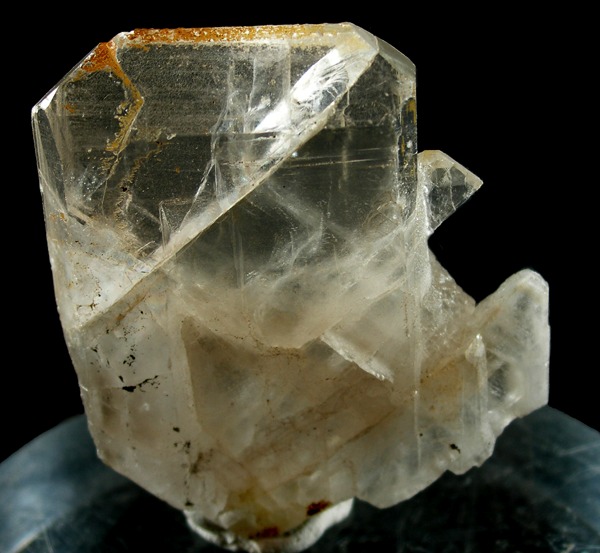
Strontium sulphate, a soft, often glassy-blue mineral whose only real importance is as the world's principal source of the element strontium — and which, for the better part of a century, came overwhelmingly from one small stretch of Gloucestershire.
Historical usage
Celestine had been dug in small quantities around Yate from early in the 19th century, but the industry that mattered began in the 1880s, when a German sugar refinery found the local mineral purer than any other source available. Strontium salts were used to recover sugar from beet molasses, and Yate's deposit was exactly what that process needed. Local landowners worked it themselves at first before brokers and larger firms took over, and from 1910 the Bristol Mineral and Land Company came to dominate the district; at its peak Yate supplied something like 95 per cent of the world's celestine. Extraction, done at first by agricultural labourers with picks and shovels in the farming off-season, switched to mechanical excavators, bulldozers and pneumatic drills after the Second World War as labour grew scarce, before finally ending in 1994. The Board of Trade was recording celestine exports in the 1880s. The Bristol Mineral and Land Company, formed in 1912, put the digging on an organised footing; when the German sugar refiners were lost in the First World War the company found American buyers instead, and by the 1930s a new market had opened in pyrotechnics, since powdered celestine burns a bright red. Albright & Wilson bought the company in 1941 and English China Clays in 1969; after a temporary closure it was reborn as an independent concern in 1975 under Roger Pauley, grandson of the founder Carl Pauli. Post-war mechanisation replaced the pick with bulldozers and excavators, and output peaked in the 1960s at about 10,000 tons a year, roughly nine-tenths of the world's supply. Commercial quarrying ended in 1994, the Tanhouse Lane processing plant closed in 1995, and the main quarry now lies under Yate shopping centre.
How it worked
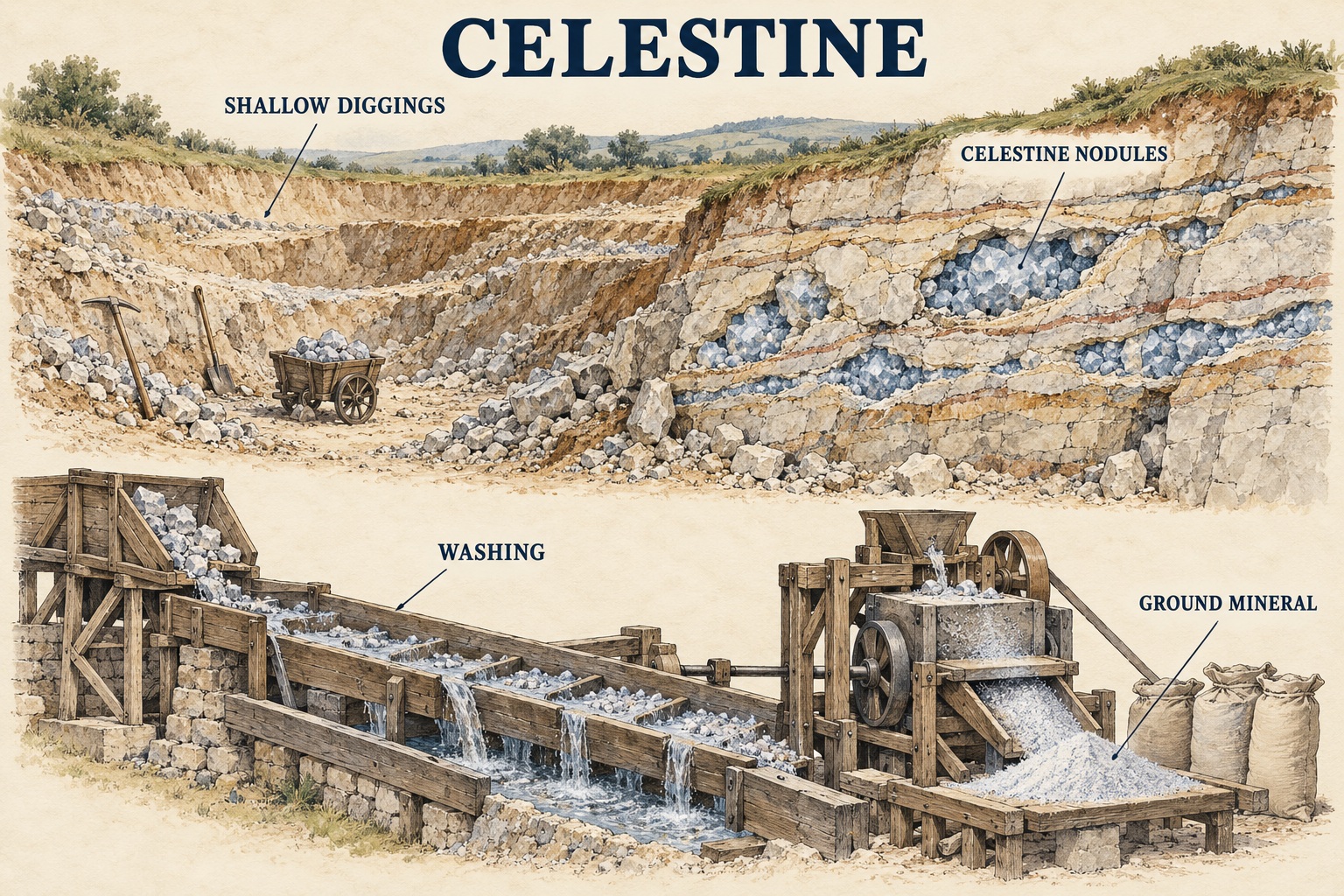
Celestine at Yate occurred as nodules and veins near the surface within Triassic rocks, which meant it could be worked from shallow open pits and diggings rather than from proper shafts — a large industry that, precisely because it never had to go underground, has left remarkably little visible trace on the ground today. Before mechanisation the ore went by horse and cart to the railway at Wickwar; after the 1912 company's investment it was crushed, washed, ground, graded and bagged at Yate itself.
Why it was used
Its chief historic use was industrial rather than decorative: strontium salts extracted from celestine helped recover sugar that would otherwise be lost in beet molasses, a process German refiners pioneered and depended on Yate's unusually pure ore to supply cheaply and reliably. Strontium compounds derived from celestine also colour fireworks and military and signal flares a distinctive crimson red, a use that has long outlasted the sugar trade.
Value over time
Celestine went from a mineral almost nobody wanted to one of the most concentrated single-source mining industries in Britain within a few decades of the 1880s discovery, purely because German sugar refiners needed exactly what Yate could supply cheaply and in bulk. That sugar-beet market eventually declined, but strontium's later uses in pyrotechnics, flares and specialist chemicals kept demand alive long enough for Yate to keep working until 1994, when the workable deposit was finally exhausted rather than the market disappearing. The later markets were as particular as the first: red fireworks and signal flares from the 1930s, and after the war the glass of colour television tubes, where strontium carbonate blocked the X-rays — at the peak three-quarters of American strontium went into cathode-ray glass. Yate's deposits were worked out by the 1990s just as flat screens began to kill that market, and cheaper foreign celestine of lower quality became competitive; world strontium production peaked in 2005 and fell by more than half in five years.
Hazards & challenges
Celestine itself is chemically stable and not associated with any specific toxic or poisoning hazard; the risks at Yate were the ordinary ones of shallow open-pit digging — falls of ground and dust — rather than anything peculiar to the mineral. The one chemical particularity is in processing rather than digging: celestine occurs with barium and calcium minerals of similar properties, which makes separation difficult, so producers want ore of at least 90 per cent strontium sulphate — the purity that made Yate's worth digging.
Risks & limitations
Because Yate's celestine lay close to the surface as scattered nodules rather than a single predictable bed, individual diggings could be exhausted quickly even while the wider district remained rich, which is part of why so many small operators worked the area before it consolidated under one dominant company from 1910.
Regional variation
Smaller celestine occurrences exist elsewhere in the Bristol area, at Leigh Court and Aust Cliff, but neither ever approached Yate's combination of scale and purity, and Yate's was recognised as superior even to the deposits worked in Australia, Germany and Mexico.
Mines associated with this term
Included only where MineArchive's own research gives a reasonable evidential basis — not every mine where this might plausibly apply.
- Yate Celestine Mines — South Gloucestershire (well documented example)
Yate is the single dominant British source, documented in detail on the mine's own record, and supplied around 95 per cent of world production at its peak.
See every mine that worked celestine →
Sources
- (primary) Celestine, One of the Old Mineral Industries of Yate — Moore Books / Kingswood Historical Society
- (primary) Minerals — South Gloucestershire Mines Research Group — South Gloucestershire Mines Research Group
- (secondary) Celestine — synopsis (David Hardwick, South Gloucestershire Mines Research Group) — South Gloucestershire Mines Research Group
- (secondary) Celestite (celestine) — Ohio Department of Natural Resources
- (secondary) Mineral Resource of the Month: Strontium — Earth Magazine (American Geosciences Institute)
Record created: 24 August 2026 · Last researched: 8 September 2026