 MineArchive
Cromhall Quarry
| Also known as | Slickstones Quarry |
|---|---|
| Location | Cromhall, near Leyhill, South Gloucestershire — 51.6229, -2.4282 (exact) |
| Commodity | Limestone |
| Type | Quarry |
| Worked | 1840–1998 |
| Maximum depth | The flooded quarry is 17 metres deep at its deepest. |
Overview
A flooded limestone quarry at Cromhall, South Gloucestershire, also called Slickstones Quarry, whose faces cut Triassic fissure fillings that have yielded one of Britain's richest collections of small fossil reptiles. Quarrying ended in 1998 and the water is now used for diver and maritime training.
History
Quarrying at Cromhall is said to have begun in 1840, at first for the red and yellow quartzitic sandstone known as the Upper Cromhall Sandstone, and later for the Carboniferous limestone beneath. The quarry is also known as Slickstones Quarry.
Its fame is geological. The limestone is cut by fissures, the remains of a cave system, which filled in the Triassic with red sediment and the bones of the small animals living on the limestone surface. The first fossils were identified in 1938 and finds have continued since: more than thirty species of reptile, dinosaur and early mammal, most of them so small that they are studied under a microscope. The commonest are sphenodontids, Clevosaurus above all; there is the gliding reptile Kuehneosaurus, a terrestrial crocodile, the oldest pterosaur remains in Britain, and a small carnivorous dinosaur named for the village, Agnosphitys cromhallensis. N. C. Fraser described rare jaw bones and a vertebra from the fissure deposits in 1988. The quarry was notified as a Site of Special Scientific Interest in 1966.
Quarrying is said to have stopped in 1998, and the workings filled with water. A dive centre opened on the lake in 2006 and was run for fourteen years by Simon Chen and Maggie Alger. After the storms of February 2020 and the closures of that spring they announced in May that it would not reopen; in July the South West Maritime Academy, which had already held courses there, took the water into its lease and reopened it to swimmers and divers.
Geology
Carboniferous limestone, named in one account as the Friars Point Limestone and in another as the Gully Oolite and Black Rock Limestone, about 350 million years old, overlain by the Upper Cromhall Sandstone. Fissures in the limestone are filled with red Triassic sediment of the Magnesian Conglomerate, laid down about 210 million years ago, which carries the fossil bones.
Workings
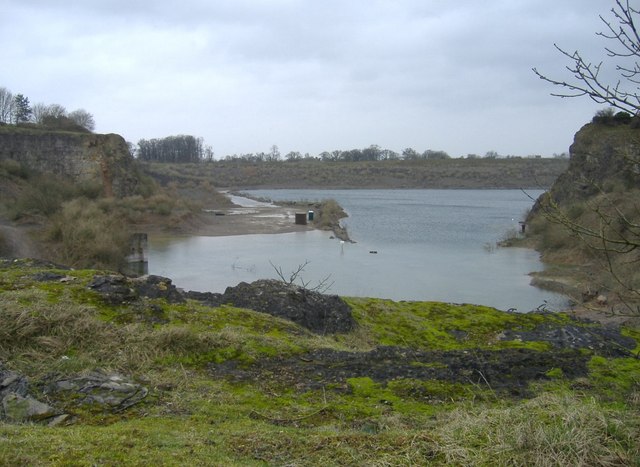
An open quarry, roughly triangular in plan, worked in benches into the limestone; a former quarry road slopes down into what is now the lake.
Closure
Quarrying is said to have ended in 1998, after which the workings flooded naturally.
What remains
A lake of about four hectares, up to 17 metres deep, fills the quarry. It is leased by the South West Maritime Academy for maritime training, with open water swimming, diving and paddleboarding. The site is a Site of Special Scientific Interest for its geology and for great crested newts.
The quarry faces and benches above the water, and the old quarry road running down into the lake.
Redevelopment
A dive centre from 2006; since July 2020 a maritime training site and open water swimming and diving lake.
Nearby mines
- Tytherington Quarry — 3.2 miles (5.1 km) SW
- Yate Celestine Mines — 5.7 miles (9.2 km) S
- Nibley Colliery — 5.8 miles (9.3 km) S, Gloucestershire
- Mayshill Colliery — 6.1 miles (9.9 km) S, Gloucestershire
- Coalpit Heath Colliery — 6.9 miles (11.2 km) S
Straight-line distance, within 9 miles (15 km). Show on the map.
What's uncertain
Points where sources disagree or the record could not be settled; both accounts are kept. All open questions in the archive.
- Quarrying began in 1840, for the quartzitic Upper Cromhall Sandstone. (uncertain) 1
- Quarrying ceased in 1998 and the quarry flooded naturally. (uncertain) 1
- The limestone is the Gully Oolite and Black Rock Limestone, around 350 million years old. (disputed) 2
- The fissures of red Triassic Magnesian Conglomerate lie in the Friars Point Limestone. (disputed) 1
Recorded claims
Individual factual claims, each attached to the source(s) that support it below. Where sources disagree, both are kept.
- Quarrying began in 1840, for the quartzitic Upper Cromhall Sandstone. (uncertain) 1
- Quarrying ceased in 1998 and the quarry flooded naturally. (uncertain) 1
- The quarry, also known as Slickstones Quarry, was notified as a Site of Special Scientific Interest in 1966. 1,2
- The first fossils were identified in 1938 and more than thirty species have been found, including Clevosaurus, Kuehneosaurus, the oldest pterosaur remains in Britain and the dinosaur Agnosphitys cromhallensis. 1,2
- Triassic fissure deposits at the quarry have yielded abundant reptile remains, with some rare jaw bones and a procoelous vertebra described in 1988. 3
- The limestone is the Gully Oolite and Black Rock Limestone, around 350 million years old. (disputed) 2
- The fissures of red Triassic Magnesian Conglomerate lie in the Friars Point Limestone. (disputed) 1
- The flooded quarry is triangular, covers about four hectares and is 17 metres deep at most. 1,4
- A dive centre ran at the quarry from 2006; its operators announced its closure in May 2020, and in July 2020 the South West Maritime Academy took the water into its lease and reopened it. 1,4
- The workings were abandoned and partly flooded when photographed in February 2007. 5
Photographs & further reading
The village's own account of the quarry's Triassic fossils, with an aerial photograph.
View sourceAbstract and paper on rare reptile remains from the quarry's Triassic fissures.
View sourceSources
- (secondary) Cromhall Quarry — Wikipedia
- (secondary) The Cromhall dinosaur — Cromhall.com
- (primary) Fraser, N. C. (1988), Rare tetrapod remains from the late Triassic fissure infillings of Cromhall Quarry, Avon. Palaeontology 31(3), 567-576 — The Palaeontological Association
- (observational) Cromhall Quarry: back from the brink — British Sub-Aqua Club
- (observational) Cromhall quarry (ST7091), 2007 — Geograph (Roger Cornfoot)
Record created: 4 October 2026 · Last researched: 5 October 2026