 MineArchive
Wharncliffe Wood Ganister Mines
| Also known as | Gannister Mines |
|---|---|
| Location | Wharncliffe Wood, near Oughtibridge, South Yorkshire — 53.4508, -1.5121 (approximate) |
| Commodity | Ganister |
| Type | Mineral |
| Worked | 1860s–c. 1945 |
| Operators | Oughtibridge Silica Fire Brick Company (1860–1945), Steetley (1947–?) |
Overview
A cluster of small mines and quarries on the outcrops of Wharncliffe Wood above the River Don, worked from the 1860s to the 1940s for ganister — a hard, silica-rich sandstone that gave the local Sheffield fire-brick industry its name.
History
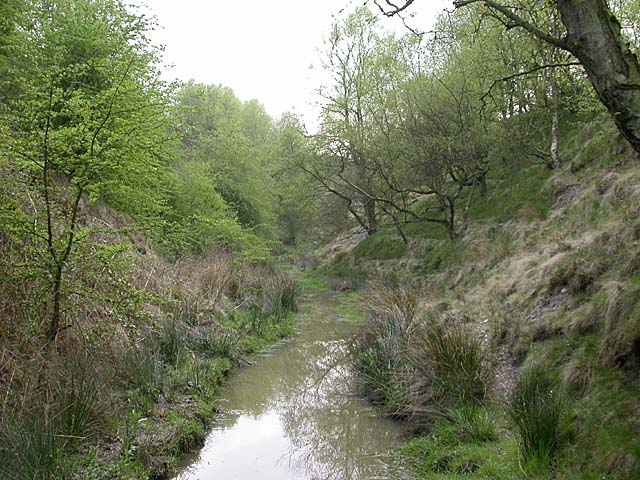
Ganister mining developed at Wharncliffe Wood, north of Oughtibridge, as a local industry supplying the Oughtibridge Silica Fire Brick Company, established in 1856 (and originally reliant on other refractory materials, before ganister became the standard) before being incorporated in 1918 and taken over by Steetley in 1947. The earliest mines opened in the 1860s on the outcrops nearest the works; as those were worked out, mining moved progressively further north across the wood, with the last mines closing around the end of the Second World War. One of the mines explorers have recorded lies beside Waterfall Clough, a little over half a kilometre above the works, its stone run down by gravity tramway to the main line and then up a short incline into the brickworks.
Geology
Ganister is a close-grained quartzose sandstone of the Coal Measures, running over 90 per cent silica with only traces of alumina and lime — a bed within the ordinary Coal Measures sequence rather than a vein, which is why it was worked along its outcrop around the sides of the Don valley. That silica content is what made it valuable: crushed and fired, it produced refractory bricks able to line the furnaces of the Sheffield steel industry.
Geological setting: Sedimentary Beds and Seams (well documented example)
Workings
Ganister was worked both by quarrying and by mining the outcrop into the hillside on the western-facing slopes above the River Don, in roughly horizontal passages of characteristic horse-shoe section following the bed. Stone-lined tramways contoured the hillside between the mine mouths, and a gravity-worked incline carried the stone downhill to the Great Central main line between Manchester and Sheffield, opened in 1845, for onward transport to the fire-brick works. Output from the valley as a whole was recorded at around 40,000 tons in 1908.
Closure
Explorers recording the workings between 2017 and 2023 found most entrances along the tramway sealed or blasted shut.
What remains
Overgrown mine entrances, quarried faces and stretches of the tramway survive across Wharncliffe Wood. Explorers recording the workings between 2017 and 2023 found most entrances along the tramway sealed or blasted shut, with the surviving openings running only a short distance before ending, and the lower workings standing in water for much of the year — an October 2020 visit found one mine badly flooded and largely silted with mud. The site of the fire-brick works below the wood is now occupied by Sheffield Refractories Ltd.
Nearby mines
- Thorncliffe Colliery — 2.2 miles (3.6 km) NE
- Smithy Wood Colliery — 2.3 miles (3.7 km) E
- Norfolk Colliery — 2.4 miles (3.8 km) NE
- Tankersley Colliery — 2.6 miles (4.2 km) N
- Wharncliffe Silkstone Colliery — 3.0 miles (4.9 km) N
Straight-line distance, within 9 miles (15 km). Show on the map.
What's uncertain
Points where sources disagree or the record could not be settled; both accounts are kept. All open questions in the archive.
- A gravity tramline carried crushed ganister down from the mines to the Great Central main line, opened in 1845, for transport to the fire-brick works. (uncertain) 1
- Total ganister output from the valley was recorded at around 40,000 tons in 1908. (uncertain) 2
- The mines were driven as roughly horizontal passages of horse-shoe section, linked by stone-lined tramways contouring the hillside to a gravity incline down to the railway. (uncertain) 3,2
- Recording work between 2017 and 2023 found most entrances along the tramway sealed or blasted shut and the lower workings seasonally flooded. (uncertain) 2
- Steetley took over the Oughtibridge works in 1947; by the 1980s Sheffield Refractories Ltd held the northern part of the site, the southern half having been given over to housing. (uncertain) 2
Recorded claims
Individual factual claims, each attached to the source(s) that support it below. Where sources disagree, both are kept.
- The mines supplied the Oughtibridge Silica Fire Brick Company, established in 1856, incorporated in 1918 and taken over by Steetley in 1947. 1
- A gravity tramline carried crushed ganister down from the mines to the Great Central main line, opened in 1845, for transport to the fire-brick works. (uncertain) 1
- Total ganister output from the valley was recorded at around 40,000 tons in 1908. (uncertain) 2
- The mines were driven as roughly horizontal passages of horse-shoe section, linked by stone-lined tramways contouring the hillside to a gravity incline down to the railway. (uncertain) 3,2
- Recording work between 2017 and 2023 found most entrances along the tramway sealed or blasted shut and the lower workings seasonally flooded. (uncertain) 2
- Steetley took over the Oughtibridge works in 1947; by the 1980s Sheffield Refractories Ltd held the northern part of the site, the southern half having been given over to housing. (uncertain) 2
- One of the small mines lies high in the wood north of Oughtibridge, its entrance beside Waterfall Clough, a stream running south-west down the slope to the Don, 0.6 km north of the Oughtibridge Silica Fire Brick works; the ganister ran by gravity tramline down the slope to the Great Central line, then north a short way to an incline that delivered it to the works west of the railway. 4
Photographs & further reading
Dated photographic report on two of the Wharncliffe Wood workings.
View sourceOngoing survey of the Sheffield ganister mines, with the Wharncliffe workings covered in detail.
View sourceSources
- (secondary) Oughtibridge Silica Firebrick Co — Grace's Guide
- (observational) The Lost Ganister and Clay Mines of Sheffield project, Part 2: Oughtibridge and Beeley Wood — 28DaysLater
- (observational) Ganister mines, Wharncliffe Wood, Sheffield, South Yorks, October 2020 — 28DaysLater
- (observational) Gannister Mine, Oughtibridge, Sheffield, August 2020 (Derelict Places, HughieD) — Derelict Places
- (observational) The Lost Ganister and Clay Mines of Sheffield project: 2017 - to date — 28DaysLater.co.uk
- (primary) Mine plan search: WHARNCLIFFE / OUGHTIBRIDGE / GANISTER — BGS / Mining Remediation Authority mine plans catalogue
- (secondary) Ganister — Wikipedia
Record created: 25 August 2026 · Last researched: 24 September 2026