 MineArchive
Westoe Colliery
| Location | Westoe, South Shields, Tyne and Wear, County Durham — 54.9881, -1.4212 (exact) |
|---|---|
| Commodity | Coal |
| Type | Coal |
| Worked | 1909 (producing colliery from 1940)–May 1993 |
| Operators | Harton Coal Company (1909–1947), National Coal Board (1947–1993) |
Overview
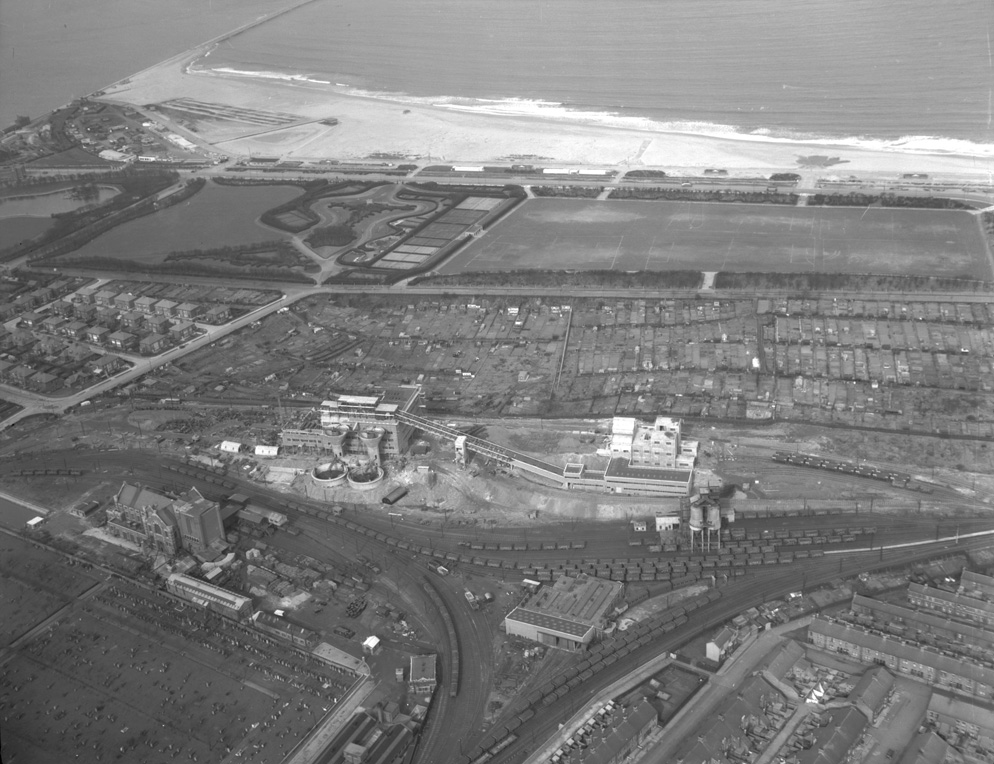
Westoe Colliery in South Shields, sunk in 1909 as a man-riding shaft for the neighbouring St Hilda's Colliery, became a producing mine in its own right in 1940 and closed in 1993 as the last working pit on Tyneside.
History
Westoe Colliery's shaft was sunk in 1909 at Westoe, South Shields, originally as a man-riding shaft serving the older St Hilda's Colliery. It became a producing colliery of its own after St Hilda's closed in 1940, and underwent major reconstruction from 1957, when a modern coal preparation plant and two tower-mounted friction winders were installed; the Crown Shaft's tall enclosed winding tower dates from the early 1960s. Coal was moved by an electrically operated railway to staiths at Harton, a line originally installed by the German-owned Harton Coal Company. Westoe closed in May 1993, the last pit of its kind on Tyneside to close, ending 84 years of coal mining at the site; the colliery was cleared by 2001 and the site redeveloped as the Westoe Crown Village housing estate.
Geology
Coal of the Durham field, won from under the sea: the Bensham, Hutton and Yard seams before the war, the Brass Thill, Main and Maudlin after it.
Workings
Originally a man-riding shaft for St Hilda's Colliery; became a full producing mine from 1940, reconstructed from 1957 with two tower-mounted friction winders and a modern coal preparation plant, coal moved via an electric railway to staiths at Harton. Seams worked shifted over time from the Bensham, Hutton and Yard seams before the war to the Brass Thill, Main and Maudlin seams by the 1970s-80s, tracking a corresponding shift in coal product from household/gas coal to coking and finally steam coal.
Closure
Worked on as a colliery of its own after St Hilda's closed in 1940, and reconstructed from 1957.
What remains
The colliery has been fully cleared and the site redeveloped as the Westoe Crown Village housing estate.
Related mines
- Harton Colliery — Both Harton Coal Company collieries, linked by the company's electric railway from 1908.
- St Hilda’s Colliery — Interlinked underground and outlived by its neighbour: St Hilda’s closed in 1940, but its shaft and surface buildings were maintained for Westoe, and only when Westoe closed in 1993 did the need to keep them end.
Nearby mines
- St Hilda’s Colliery — 0.7 miles (1.1 km) NW, Tyne and Wear
- Burdon Main Colliery — 1.3 miles (2.0 km) NW, Tyne and Wear
- Harton Colliery — 1.4 miles (2.2 km) SW, Tyne and Wear
- Whitburn Colliery — 1.9 miles (3.1 km) E, Tyne and Wear
- Percy Main Colliery — 2.2 miles (3.5 km) W, Tyne and Wear
Straight-line distance, within 9 miles (15 km). Show on the map.
Recorded claims
Individual factual claims, each attached to the source(s) that support it below. Where sources disagree, both are kept.
- The shaft was sunk in 1909 as a man-riding shaft for the neighbouring St Hilda's Colliery, and became a producing mine in its own right only after St Hilda's closed in 1940. 1
- Major reconstruction from 1957 installed two tower-mounted friction winders and a modern coal preparation plant; the Crown Shaft's tall enclosed winding tower dates from the early 1960s. Coal was carried to staiths at Harton by an electric railway originally built by the German-owned Harton Coal Company. 1
- Westoe closed in May 1993, the last pit of its kind on Tyneside to close, ending coal mining on Tyneside after 84 years at this site. 2
- Employment grew enormously over the colliery's life: 427 in 1915, 899 by the early 1920s, dipping to 646 in 1955 as St Hilda's workings were absorbed, then rising sharply through modernisation to a peak of 2,509 (2,146 underground, 363 surface) in 1980, before declining to 1,798 by 1990, three years before closure. 3
- The colliery worked a changing succession of seams over its life -- the Bensham, Hutton and Yard seams before the Second World War, then the Five Quarter and Yard through the 1950s, and finally the Brass Thill, Main and Maudlin seams from 1970 to closure -- and its coal product shifted correspondingly from household and gas coal in its early decades to coking coal by the 1960s and purely steam coal by 1980. 3
- In January 1961, a miner named W. Cameron was killed instantly when a 'hurricane stemmer' -- a device used to pack limestone grit into shotholes before firing -- caused a premature explosion; the Divisional Coal Board withdrew the device from use across the whole coalfield pending investigation. 3
- Located at about 54.988 N, 1.421 W. 2
Photographs & further reading
The official Historic Environment Record entry, with the mine's technical and engineering history.
View sourceSources
- (primary) Westoe Colliery (SMR 5110) — Sitelines (Tyne and Wear Historic Environment Record)
- (secondary) Westoe Colliery — Wikipedia
- (primary) Westoe Colliery — Durham Mining Museum
Record created: 2 September 2026 · Last researched: 2 September 2026