 MineArchive
St Hilda’s Colliery
| Also known as | Chapter Main Colliery, St Hilda Pit |
|---|---|
| Location | South Shields, on the south bank of the Tyne, Tyne and Wear — 54.9942, -1.4342 (exact) |
| Commodity | Coal |
| Type | Coal |
| Worked | 1810–1940 |
| Maximum depth | About 143 fathoms (858 feet) to the Bensham Seam |
| Operators | Brandling Brothers (1822–1850), Harton Coal Company (1880–1940) |
Overview
A colliery in the heart of South Shields, first won by Simon Temple on the Dean and Chapter of Durham’s ground — from which it was originally called Chapter Main — with the first coals drawn in April 1810. Under the Brandlings the Church Pit was bottomed in the Bensham Seam in July 1825 at about 143 fathoms. On 28 June 1839 an explosion killed 51 men and boys, and the inquest that followed recommended abandoning candles underground in favour of lamps — the beginning of a national argument about mine lighting. The colliery worked until 1940, and its shaft and pumping engine house were kept alive by neighbouring Westoe until 1993.
History
Simon Temple first won a colliery here on the ground of the Dean and Chapter of Durham, which is why it was called Chapter Main; the first coals reached the spout amid great rejoicing on 23 April 1810. The expense broke him, and the concern passed to the Messrs Brown of London, owners of Jarrow Colliery, who sold the lease on to Messrs Devey; by the 1820s it belonged to the Brandlings. The shaft was first sunk in 1822 and the pit bottomed at the Bensham Seam in July 1825, the shaft about 143 fathoms deep and divided into upcast and downcast by a brattice. There was a 90 horsepower pumping engine, two 30 horsepower drawing engines and a 20 horsepower engine underground.
On 28 June 1839 fifty-one men and boys were killed by an explosion in the western workings (see Disasters, below). Eighteen months later, on the night of 14 January 1841, fire broke out — thought to have started at the furnace — and set alight the brattice dividing the shaft, with more than twenty men and boys at work below. The water poured down by the fire engines carried enough air with it to keep the ventilation going, and every one of them came up safely.
The colliery passed from the Brandlings to W. Blackett, N. Wood, Anderson and Philipson in the 1850s, to Wood, Blackett and Co. in the 1860s, and to the Harton Coal Company from the 1880s, working gas, household and steam coal. New surface structures went up in the late nineteenth and early twentieth centuries, including the pumping engine house that still stands. The colliery closed in 1940, but the shaft and its buildings were maintained for the interlinked Westoe Colliery until Westoe itself closed in 1993.
Geology
The Durham coalfield at the mouth of the Tyne. The Bensham Seam, reached at about 143 fathoms, averaged some 6 feet thick; the workings ran south of the shaft and the strata rise towards the sea. The coal needed blasting with gunpowder, which is why candles rather than safety lamps were used through much of the pit — the fact at the centre of the 1839 disaster.
Workings
A single shaft divided into upcast and downcast by a brattice — the arrangement that made the 1841 fire so dangerous — with the Church Pit, also called the New Engine Pit, opened in June 1825. Ventilation was by furnace. The colliery was served by St Hilda’s Waggonway and by a ballast railway, and by 1933 it was one of a group of pits linked by rail under the Harton Coal Company. In its later years it was connected underground to Westoe Colliery.
Closure
The colliery closed in 1940. The shaft and the surface buildings were not abandoned with it: they were maintained for the interlinked Westoe Colliery, and only when Westoe closed in 1993 did the need to keep them end.
What remains
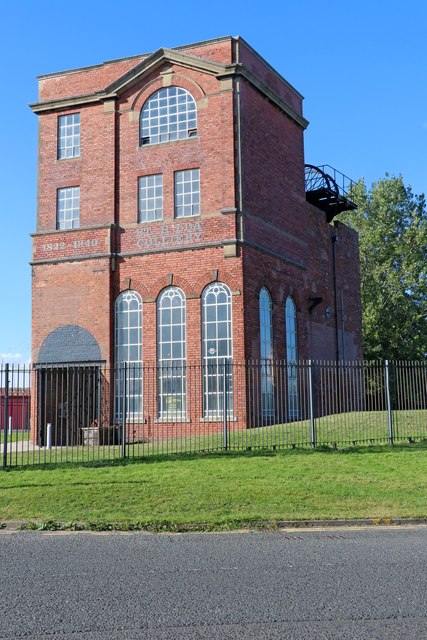
The pumping engine house survives, partially renovated in 1989 to mark the 150th anniversary of the disaster. It and the remaining colliery head stocks were listed Grade II in 1990.
The pumping engine house and the colliery head stocks, both Grade II listed since 1990.
Related mines
- Harton Colliery — Both held in the 1860s by the Harton and Hilda Coal Company, and later by the Harton Coal Company.
- Westoe Colliery — Interlinked underground and outlived by its neighbour: St Hilda’s closed in 1940, but its shaft and surface buildings were maintained for Westoe, and only when Westoe closed in 1993 did the need to keep them end.
Nearby mines
- Burdon Main Colliery — 0.6 miles (1.0 km) NW
- Westoe Colliery — 0.7 miles (1.1 km) SE, County Durham
- Harton Colliery — 1.6 miles (2.6 km) S
- Percy Main Colliery — 1.6 miles (2.6 km) W
- Preston Colliery — 1.9 miles (3.0 km) NW
Straight-line distance, within 9 miles (15 km). Show on the map.
Disasters & major incidents
-
St Hilda’s Colliery Explosion
28 June 1839 · Explosion · 51 fatalities
On the morning of 28 June 1839 an explosion tore through the western workings of St Hilda’s pit in the middle of South Shields, killing 51 men and boys. Most died not in the blast but of afterdamp. The inquest returned accidental death with a recommendation that working coal mines by candlelight be abandoned in favour of lamps, and a Committee for the Investigation of Accidents in Mines was formed in the town shortly afterwards — its report weighed the merits of the various safety lamps and did much to improve mine safety nationally.
Recorded claims
Individual factual claims, each attached to the source(s) that support it below. Where sources disagree, both are kept.
- Simon Temple first won a colliery here on the ground of the Dean and Chapter of Durham, from which it was called Chapter Main Colliery; the first coals were conveyed to the spout on 23 April 1810. 1
- The pit was bottomed at the Bensham Seam in July 1825, the shaft being about 143 fathoms deep and divided into upcast and downcast by a brattice. The seam averaged about 6 feet thick. 1
- The coal required blasting with gunpowder, so it had been found necessary to use candles in many parts of the pit, the Davy lamp being used only where the coal was softer than usual. 1
- On the night of 14 January 1841 a fire, thought to have started at the furnace, set alight the brattice dividing the shaft while more than twenty men and boys were at work below. The water poured down by the fire engines carried enough air with it to maintain ventilation, and all were brought up safely. 1
- The colliery belonged to the Brandlings from the 1820s, to W. Blackett, N. Wood, Anderson and Philipson in the 1850s, to Wood, Blackett and Co. in the 1860s and to the Harton Coal Company from the 1880s. 2
- The colliery closed in 1940, but its shaft and buildings were maintained for the interlinked Westoe Colliery; only when Westoe closed in 1993 did the need to maintain them end. 3
- The pumping engine house was partially renovated in 1989 to commemorate the 150th anniversary of the disaster, and it and the remaining colliery head stocks became Grade II listed buildings in 1990. 3
Photographs & further reading
The colliery record: opening and closure, the Church Pit, the succession of owners from the Brandlings to the Harton Coal Company, and the output and employment returns.
View sourceThe county archaeological record, covering the sinking, the colliery’s place in the history of mine ventilation and safety, the surviving pumping engine house and the Grade II listing.
View sourceSources
- (primary) The St. Hilda Colliery, South Shields — View of the Collieries — Durham Mining Museum, reproducing the contemporary account
- (primary) St. Hilda's Colliery — Durham Mining Museum
- (primary) St. Hilda's Colliery (Tyne and Wear HER 2355) — Tyne and Wear Historic Environment Record
- (primary) Colliery Disaster 1839 — St. Hilda — Durham Mining Museum, reproducing M. A. Richardson’s Local Historian’s Table Book (1844)
Record created: 8 September 2026 · Last researched: 8 September 2026