 MineArchive
Wellingborough Ironstone Quarries
| Also known as | Rixon’s Quarries, Wellingborough Iron Co. Quarries, Finedon Ironstone Quarries |
|---|---|
| Location | Between Wellingborough and Finedon, Northamptonshire — 52.3198, -0.6421 (exact) |
| Commodities | Ironstone, Limestone |
| Type | Ironstone |
| Worked | 1874–1966 |
| Maximum depth | Unknown. Shallow quarrying with some underground mining. |
| Operators | James Rixon (1874–1889), Wellingborough Iron Co. Ltd (1889–1962), Midland Brick Co. (Wellingborough) Ltd (1910–1937), Stewarts & Lloyds (1962–1966) |
Overview
A group of ironstone quarries and mines running north from Wellingborough towards Finedon, begun in 1874 by the brickmaker James Rixon and worked under a succession of owners until 1966. The ore went at first for resale, then to the company’s own blast furnaces from 1884, carried on a metre-gauge tramway that grew to over four miles. Two limestone quarries and a small mine were worked within the same ground. Quarrying ended in 1966, three years after the last of the pits closed.
History
In 1870 the Wellingborough businessman James Rixon opened a brickworks on the west side of the Midland Railway line, and in 1874 expanded into iron ore, leasing land for a quarry south of Finedon village. A metre-gauge horse tramway was laid along the side of the Finedon road to bring the ore down to sidings north of the brickworks; the road still has the wide grass verge the tramway ran on. The sideline overtook the main business. By 1884 the ironstone was doing better than the bricks, and the firm installed a blast furnace at the western end of the tramway, extended its leases south and west of Finedon, lengthened the tramway to over four miles and bought steam locomotives in 1884 and 1887. The ownership followed the money: Rixon & Co. from 1874, Rixon’s Iron & Brick Co. Ltd from 18 June 1883, the Wellingborough Iron Co. Ltd from 12 February 1889, and Stewarts & Lloyds Minerals Ltd from 29 October 1962 until closure. Several separately named quarries were opened across the one area — Harrows in 1896, Finedon in 1897, Ditchford 9 and Ditchford 10 in 1898, Carrol Spring 5a in 1905, Thingdon in 1911 and Glebe in 1922 — along with two limestone quarries and, at one time, a small mine near Carol Spring Farm. A separate quarry on the Finedon Road, worked in the 1880s, was redeveloped from 1910 by the Midland Brick Co. (Wellingborough) Ltd, which sold on the ironstone it recovered from the brick clay as a separate product; it worked intermittently from 1901 to 1925 and was hand-operated in 1924, some ore going to the Wellingborough furnaces and some to Middlesbrough. The depression closed the mines and quarries in 1932. They reopened, and new machinery meant the work came back as quarrying while the underground mining was shut down. Wellingborough No. 5 closed in August 1964 and the remainder of the quarry in October 1966.
Geology
The Northampton Sand Formation — the Jurassic ironstone that runs in a belt through Northamptonshire and made the county an ore field rather than a coal one. The ore lies shallow, under limited overburden, which is why it was quarried rather than mined for most of its history and why mechanical excavation displaced underground working so decisively in the twentieth century. Oolitic limestone occurs in the same ground and was quarried here too, and ironstone was recovered as a by-product from the clay dug for brickmaking.
Workings
Open quarries worked along the ore belt, with some underground mining that did not survive mechanisation. Transport was the making of the operation: a metre-gauge tramway, horse-drawn at first and worked by steam locomotives from 1884, extended to over four miles as the leases spread south and west of Finedon, running down to sidings on the Midland Railway and, from 1884, to the company’s own blast furnace at the western end. Tub bodies from the closing quarries went on to the nearby Cranford quarries for use on the calcining clamp.
Closure
The mines and quarries closed in the depression of 1932. When they reopened, new machinery meant the work was done by quarrying and the underground mining was not restarted. Wellingborough No. 5 closed in August 1964 and the rest in October 1966 — a decade before the East Midlands ironstone industry ended altogether with the deep quarries around Corby in 1980.
What remains
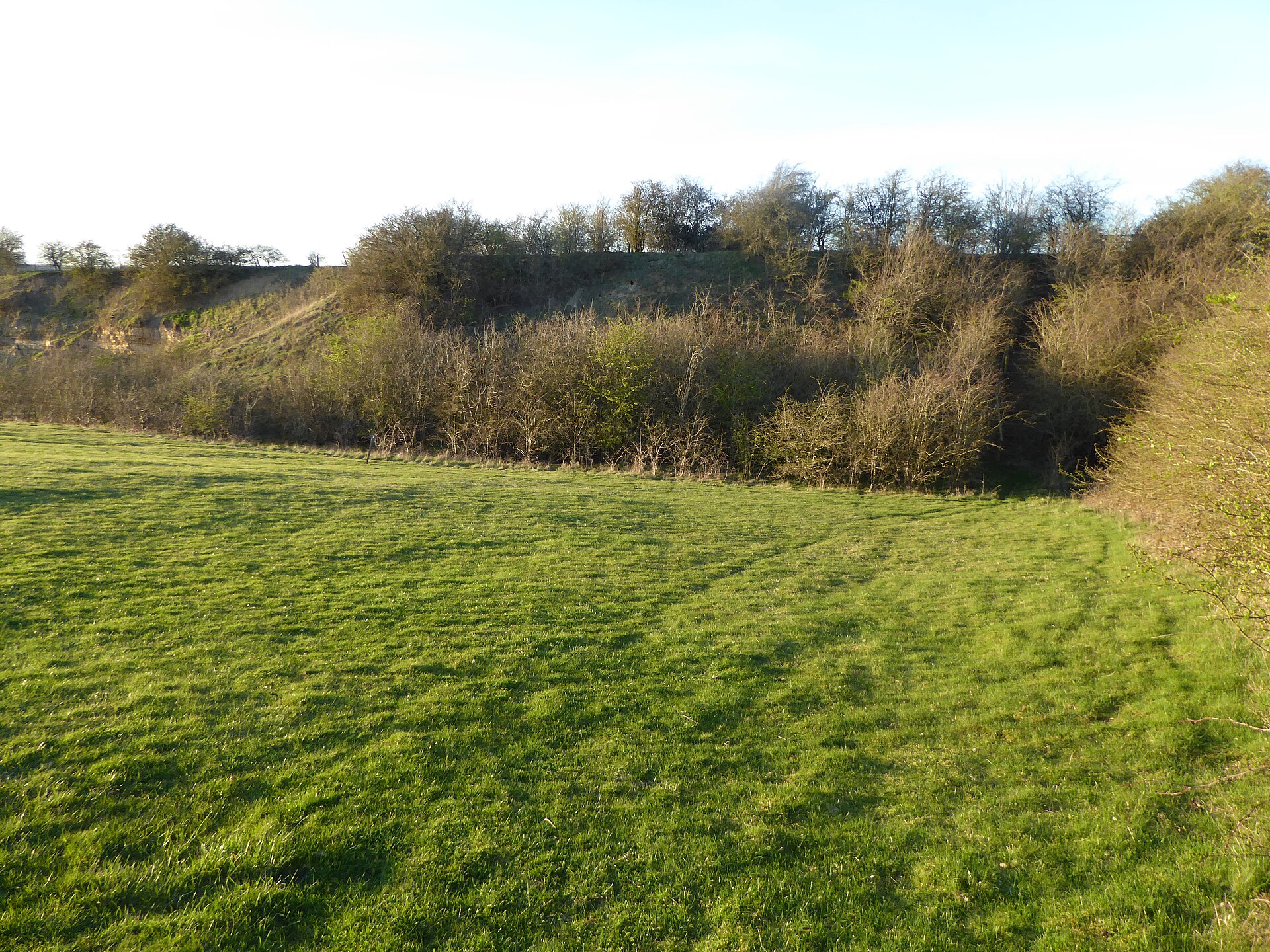
The quarry ground has largely been built over or returned to farmland; the Finedon Road brickworks area in particular has since been developed. Finedon Top Lodge Quarry, within the same ironstone field east of Wellingborough, survives as a geological Site of Special Scientific Interest.
The wide grass verge along the Finedon road, which is the formation of the original metre-gauge tramway, and the exposures preserved at Finedon Top Lodge Quarry.
Related mines
- Glendon Ironstone Quarries — Neighbouring Northamptonshire ironstone quarries working the same Northampton Sand belt, both eventually under Stewarts & Lloyds as the industry consolidated on Corby.
- Irthlingborough Ironstone Mine — Both worked the Northampton Sand ironstone in the Nene valley within a few miles of each other, and their ends bracket the industry’s: Irthlingborough was the last underground ironstone mine in the East Midlands when it closed in 1966, the same year the Wellingborough quarries finished.
Nearby mines
- Irthlingborough Ironstone Mine — 0.8 miles (1.3 km) E
- Irchester Ironstone Quarries — 2.6 miles (4.2 km) SW
- Wembley Ironstone Quarry — 2.6 miles (4.2 km) S
- Islip Ironstone Quarry — 3.0 miles (4.8 km) N
- Newbridge Ironstone Quarry — 5.7 miles (9.2 km) N
Straight-line distance, within 9 miles (15 km). Show on the map.
Recorded claims
Individual factual claims, each attached to the source(s) that support it below. Where sources disagree, both are kept.
- Owners were Rixon & Co. from 1874, Rixon’s Iron & Brick Co. Ltd from 18 June 1883, the Wellingborough Iron Co. Ltd from 12 February 1889, and Stewarts & Lloyds Minerals Ltd from 29 October 1962 until closure in 1966. 1
- This series of quarries and mines started alongside the Finedon to Wellingborough road just south of Finedon, the road still maintaining its wide grass verge. At the start the iron ore was for resale only, but in 1883 the owners decided to go into the ironmaking business. 1
- There were several quarries in the one area, all of which had names: Harrows (1896), Finedon (1897), Ditchford 9 (1898), Ditchford 10 (1898), Carrol Spring 5a (1905), Thingdon (1911) and Glebe (1922). There were also two limestone quarries within the site and at one time a small mine in operation in the area of Carol Spring Farm. 1
- The Midland Brick quarry on the Finedon Road was a redevelopment of an area worked in the 1880s; when ironstone was recovered from the clay needed for brickmaking it was sold on as a separate item. The quarry was used intermittently from 1901 to 1925 and was hand operated in 1924, some ore going to the Wellingborough furnaces and some to Middlesbrough. 2
- In 1937 two and a half acres of unworked stone on the Finedon Road site were leased to the Wellingborough Iron Co. and working began in 1940, but the stone proved poor quality and not worth extracting, and the quarry closed. 2
- Wellingborough No. 5 finally closed in August 1964, with the remainder of the quarry closing in October 1966. 1
Photographs & further reading
The county record for the main group: the full ownership succession from 1874 to closure in 1966, the seven named quarries with their opening dates, and the limestone quarries and small mine worked in the same ground.
View sourceSources
- (primary) Monument record 8430 — Wellingborough Quarries, Rixons — Northamptonshire Historic Environment Record
- (primary) Monument record 8416/3 — Midland Brick Quarries, Wellingborough — Northamptonshire Historic Environment Record
- (secondary) Geology — Nene Valley Mines Study Group
Record created: 8 September 2026 · Last researched: 8 September 2026