 MineArchive
Irchester Ironstone Quarries
| Location | Irchester, near Wellingborough, Northamptonshire — 52.2890, -0.6767 (exact) |
|---|---|
| Commodity | Iron |
| Type | Ironstone |
| Worked | c. 1872–1969 |
Overview
A Northampton Sand ironstone opencast district southeast of Wellingborough, worked in phases from around 1872 to 1969 across several linked pits, the best-documented being the 'Wembley' quarry worked 1924-41. Ore was calcined on site and moved by internal tramway to the main line, from where it was mainly sent by rail to the Cargo-Fleet blast furnaces on Teesside. Since 1971 the core of the workings has been preserved as Irchester Country Park, home since 1987 to a narrow-gauge heritage railway running on part of the original ironstone line's trackbed.
History
A quarry was opened at Irchester around 1872, extracting iron ore initially processed at local ironworks. The district was worked as several distinct, overlapping pits over the following century rather than one continuous quarry, with Butler Bevan's Irchester Ironstone Company Ltd recorded among the operators. The best-documented working, the 'Wembley' pit — the ground now preserved as the Country Park — was worked from 1924 to 1941. A separate, short-lived standard-gauge tramway was built in 1926-27 to serve a smaller quarry east of the Chester House Roman site nearby, cutting through the old Roman rampart; that satellite working opened in 1927 and closed within a year, an unsuccessful venture distinct from the main workings. District output rose through the 1930s with the opening of the new Corby furnaces, and ironstone quarrying at Irchester continued until the quarries closed in 1969.
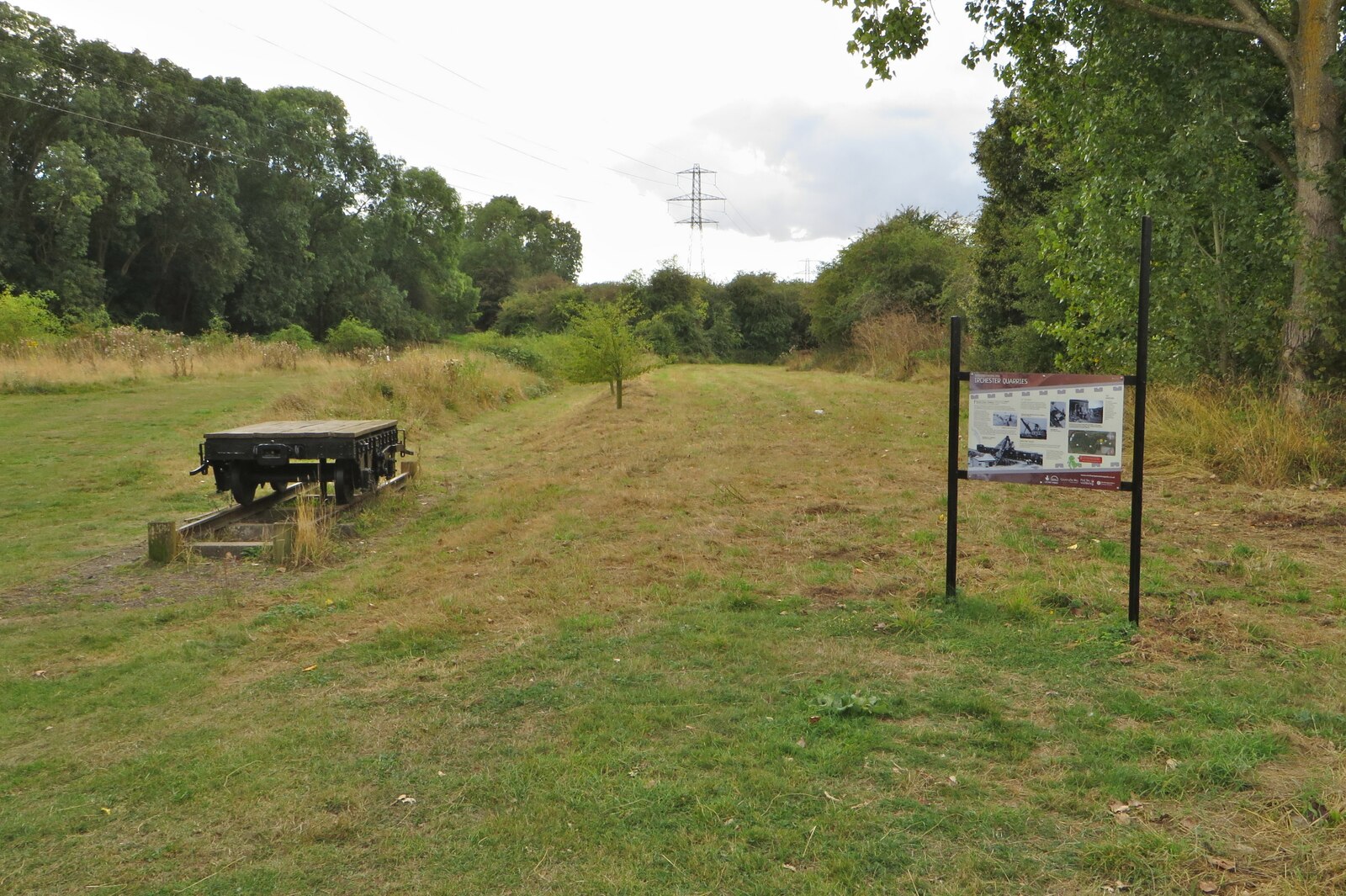
The former Wembley pit was opened by Northamptonshire County Council as Irchester Country Park in 1971, and the Irchester Narrow Gauge Railway Museum opened within it in 1987, building a 250-metre, 1,000mm-gauge demonstration line to the west of the original ironstone railway's maintenance yard; the park's footpaths follow the line of the original trackbed.
Geology
Northampton Sand ironstone, worked opencast south-east of Wellingborough and calcined on site.
Workings
Worked by open-cast methods: at the Wembley pit a steam-powered 300-ton Ruston face shovel removed up to 10 metres of overburden (Blisworth Limestone and Rutland Formation clay and silt), with a smaller face shovel loading the ironstone itself, only 3-5 metres thick, into railway wagons; both limestone and ironstone required blasting. The ore is the Northampton Sand Ironstone, at the base of the Inferior Oolite Group, Middle Jurassic in age. Internal tramways moved ore to a calcining bank, where it was mixed with coal slack at a ratio of 40 parts ore to one of coal, piled onto a layer of coal and burned for months to reduce water content and upgrade the iron content before being sent mainly by rail to the Cargo-Fleet blast furnaces on Teesside, beside the Dorman-Long steelworks.
Closure
A satellite working opened in 1927 and closed within a year; quarrying at Irchester itself continued until 1969.
What remains
The former Wembley pit face, over a kilometre long, is now largely vegetation-covered within Irchester Country Park, a roughly 200-acre former ironstone quarry whose 'hill and dale' topography of ridges and furrows up to 10 metres high survives from spoil dumped behind the advancing working face. The Irchester Narrow Gauge Railway Museum, opened 1987, runs a 250-metre, 1,000mm-gauge demonstration railway with over 40 items of rolling stock, including four steam and six diesel locomotives, on part of the original ironstone railway's route; an Ironstone Heritage Trail leads past the former calcining bank and quarry face.
Nearby mines
- Wembley Ironstone Quarry — 0.6 miles (0.9 km) SE
- Wellingborough Ironstone Quarries — 2.6 miles (4.2 km) NE
- Irthlingborough Ironstone Mine — 3.1 miles (5.0 km) NE
- Bury St Edmunds Chalk Mines — 3.8 miles (6.1 km) SW, Suffolk
- Islip Ironstone Quarry — 5.2 miles (8.3 km) N
Straight-line distance, within 9 miles (15 km). Show on the map.
Recorded claims
Individual factual claims, each attached to the source(s) that support it below. Where sources disagree, both are kept.
- A quarry was opened at Irchester around 1872, extracting iron ore initially processed at local ironworks. 1
- The Wembley pit, the ground now preserved as Irchester Country Park, was worked from 1924 to 1941. 2
- A short-lived standard-gauge tramway was built in 1926-27 to serve a smaller quarry east of the Chester House Roman site, cutting through the Roman rampart; the associated quarry opened in 1927 and closed within a year. 3
- Ironstone quarrying at Irchester continued until 1969; ore was mainly sent by rail to the Cargo-Fleet blast furnaces on Teesside, beside the Dorman-Long steelworks. 1,2
- Irchester Country Park opened on the former Wembley pit site in 1971; the Irchester Narrow Gauge Railway Museum opened within it in 1987, running a 250-metre, 1,000mm-gauge demonstration railway on part of the original ironstone railway's route. 1,4
- The Wembley pit was worked with a steam-powered 300-ton Ruston face shovel removing up to 10 metres of overburden, with the ironstone seam itself only 3-5 metres thick, calcined on site with coal slack before being sent for smelting. 2
- The BGS/Coal Authority mine plans catalogue holds no record for Irchester, unsurprising for a surface-worked ironstone district rather than a deep mine. 1
Sources
- (secondary) Irchester Narrow Gauge Railway Museum — Wikipedia
- (primary) Irchester and Twywell (Mercian Geologist, 2018, 19(3), p.181) — Ian Clarke, East Midlands Geological Society
- (primary) Ironstone tramway route (MNN13361) — Northamptonshire Historic Environment Record
- (primary) Irchester Country Park — North Northamptonshire Council
Record created: 26 August 2026 · Last researched: 26 August 2026