 MineArchive
Virtuous Lady Mine
| Location | Peninsula of the River Tavy below Double Waters, near Buckland Monachorum, Devon — 50.5089, -4.1537 (approximate) |
|---|---|
| Commodities | Copper, Arsenic, Tin |
| Type | Metal |
| Worked | Late 16th century–1873-1879 |
| Maximum depth | About 120 feet (1870). |
Overview
A copper mine on a peninsula of the River Tavy just below Double Waters, near Buckland Monachorum, by tradition worked since Elizabethan times and named after Elizabeth I; reopened in the early nineteenth century, it had its best years in the 1850s and closed in the 1870s, its caverns later shown to visitors.
History
Virtuous Lady Mine lies on a small peninsula of the River Tavy just downstream from Double Waters, where the Walkham joins the Tavy, on the western edge of Dartmoor near Buckland Monachorum. It is famously said to have been worked from 1588 and named in honour of Elizabeth I, though the earliest known documents date only from the early eighteenth century. Accounts of its later dates differ: Helen Harris has it worked until 1807, reopened in the 1830s and closed in 1879; Paul Rendell has it reopened as a copper mine in 1816 and in liquidation in 1873.
The mine combined openworks with several shafts, some of whose workings ran under the river. Waterwheels fed by a leat from the Walkham near Grenofen Bridge powered it, and at the height of its profitability in the 1850s steam was added, just as copper prices fell; tin and arsenic were also taken from older workings. In 1856 its purser was Henry Wells of Plymouth and its captain Goss, with London offices at 76 Cornhill. By one account copper output reached about 4,000 tons a year in the mid-nineteenth century, and in 1870 the workings went down about 120 feet with up to 43 people employed. There was no smelting on site: the ore was crushed, carried by packhorse over a bridge to Orestocks, and taken on to Morwellham for shipment to South Wales. After closure the underground caverns, rich in crystallised minerals, were a popular attraction, and visitors could be taken round them until the early 1970s.
Geology
Copper ore with some tin and arsenic, in the metamorphosed killas beside the Tavy on the western edge of the Dartmoor granite.
Workings
Openworks at the western end and several shafts, including a capped Eastern Engine shaft with a capstan pit; workings beneath the river; a crusher house with its wheelpit, fed from the Lady Bertha leat.
Closure
Sources differ: in liquidation in 1873 (Rendell) or finally closed in 1879 (Harris).
What remains
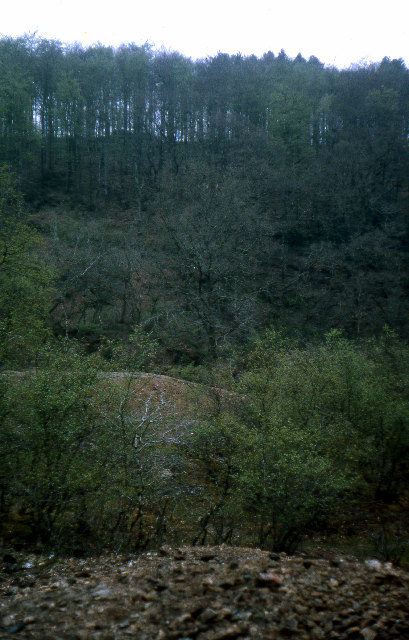
The site lies in woodland beside the river; spoil heaps are largely overgrown, and the crusher house survives in part.
Three corners of the crusher house, the tallest about 3 m high, with its backfilled wheelpit, capped shafts, a capstan pit, a stone-arched leat tunnel and spoil heaps.
Nearby mines
- Westdown Mine — 1.0 miles (1.5 km) NE
- Gem Mine — 1.4 miles (2.2 km) E
- Gawton Mine — 1.5 miles (2.3 km) SW
- Wheal Crebor — 1.7 miles (2.7 km) NW
- George and Charlotte Copper Mine — 1.7 miles (2.8 km) W
Straight-line distance, within 9 miles (15 km). Show on the map.
What's uncertain
Points where sources disagree or the record could not be settled; both accounts are kept. All open questions in the archive.
- The mine is traditionally said to have been worked from 1588 and named after Elizabeth I. (uncertain) 1,2,3
- Helen Harris dates the mine's working to 1588-1807, a reopening in the 1830s and closure in 1879. (disputed) 1,2
- Paul Rendell dates its reopening as a copper mine to 1816 and its liquidation to 1873. (disputed) 1,2,3
Recorded claims
Individual factual claims, each attached to the source(s) that support it below. Where sources disagree, both are kept.
- The mine is traditionally said to have been worked from 1588 and named after Elizabeth I. (uncertain) 1,2,3
- Helen Harris dates the mine's working to 1588-1807, a reopening in the 1830s and closure in 1879. (disputed) 1,2
- Paul Rendell dates its reopening as a copper mine to 1816 and its liquidation to 1873. (disputed) 1,2,3
- In 1856 the Virtuous Lady Copper Mine's purser was Henry Wells of Plymouth and its captain Goss. 4
- In 1870 the workings reached about 120 feet and up to 43 people were employed. 1
- The ore was carried by packhorse to Orestocks and on to Morwellham for shipment to South Wales for smelting. 1,3
- Until the early 1970s visitors could be taken round the mine's underground caverns. 3
Photographs & further reading
A field survey of the mine's surviving features, with grid references and photographs.
View sourceSources
- (secondary) Virtuous Lady Mine (Dartmoor Explorations) — Dartmoor Explorations
- (secondary) Virtuous Lady Mine (Dartefacts) — Dartefacts
- (secondary) The East Bank of the Tavy: Grenofen to Denham Bridge (A Walk in English Weather) — A Walk in English Weather
- (secondary) 1856 Mines in Devon and Cornwall — Grace's Guide
Record created: 24 October 2026 · Last researched: 24 October 2026