 MineArchive
Wheal Crebor
| Location | Lumburn valley, Tavistock, Devon — 50.5303, -4.1725 (approximate) |
|---|---|
| Commodities | Copper, Iron, Tin |
| Type | Metal |
| Worked | About 1803–1902 |
| Maximum depth | 110 fathoms (660 feet) at the deepest shaft; about 80 fathoms in 1822 |
| Operators | Tavistock Canal Company (1803–1828) |
Overview
A copper mine found in the Tavistock Canal's Morwell Down tunnel cutting, worked beside the tunnel's Tavistock end with water power from the canal, rich from about 1811 to 1819 and run with the canal until 1828.
History
Wheal Crebor was a copper mine at the Tavistock end of the Morwell Down tunnel of the Tavistock Canal, in the Lumburn valley north of Shillamill. The canal, authorised by an Act of Parliament in 1803 with John Taylor as engineer, was opened from Tavistock to the tunnel mouth in 1805; when cutting of the tunnel began, copper ore was discovered close to the Tavistock end, and the ground became Wheal Crebor. It was managed as a separate project from the canal, with its own entrance beside the tunnel entrance, and it was worked with water-powered machinery driven by water flowing along the canal. The canal company ran it in conjunction with the canal until 1828, with moderate success.
Lysons' Magna Britannia, published in 1822, lists Wheal Crebor, near the tunnel on the Tavistock canal, among the principal copper mines then worked in Devon, and records it as very rich from about 1811 to 1819, when it became unproductive, although new discoveries promised to make it productive again; it was about 80 fathoms deep. It lay on the same east-west lode as Wheal Crowndale, East Liscombe and Wheal Tamar, which together spread over about four miles. The mine produced copper, tin, iron and arsenic in various periods between 1803 and 1902.
Moses Bawden, reading a paper to the Devonshire Association at Tavistock in 1914, called Wheal Crebor one of the earliest mines at work in the district, its very productive copper lode found in cutting the tunnel of the Tavistock Canal, which he dated to about 1810 and said began at Crebor. The mining company had its own canal boats and loaded the ore into them at the mine. He found records of about 70,000 tons of copper ore sold from the mine, to a value of about £500,000, and thought the true figure much higher. The deepest shaft was 110 fathoms, but the chief production of copper ore and arsenical pyrites came from above the 80 fathom level.
Geology
Copper lode running east to west, the same lode as Wheal Crowndale, East Liscombe and Wheal Tamar, found in cutting the Morwell Down tunnel; the mine also yielded tin, iron and arsenic. Arsenical pyrites was worked with the copper.
Workings
Workings beside the Tavistock end of the Morwell Down tunnel, with its own entrance by the tunnel mouth, water-powered machinery driven from the canal and a drainage adit in the Lumburn valley.
Closure
The canal company ran the mine until 1828; it was worked again in later periods up to 1902.
What remains
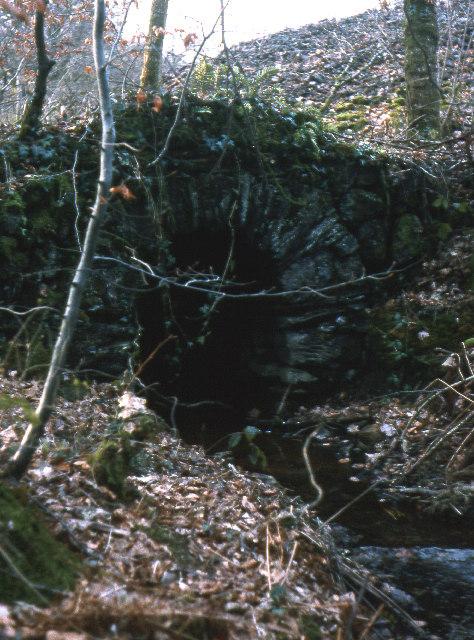
A drainage adit portal stands at the foot of a mine tip in the Lumburn valley just north of Shillamill, where it was photographed in 1978.
Redevelopment
Unknown.
Related mines
- Wheal Friendship — Lysons lists both among the principal copper mines of the Tavistock district, and John Taylor, engineer of the Tavistock Canal, also managed Wheal Friendship.
Nearby mines
- George and Charlotte Copper Mine — 1.9 miles (3.0 km) SW
- Gawton Mine — 2.2 miles (3.6 km) S
- Devon Great Consols — 2.3 miles (3.7 km) W
- Okeltor Mine — 2.3 miles (3.7 km) SW, Cornwall
- Drakewalls Mine — 2.4 miles (3.9 km) SW, Cornwall
Straight-line distance, within 9 miles (15 km). Show on the map.
What's uncertain
Points where sources disagree or the record could not be settled; both accounts are kept. All open questions in the archive.
- A mine drainage adit portal stands at the foot of a mine tip in the Lumburn valley just north of Shillamill; it was photographed in winter 1978. (uncertain) 5
- The Tavistock Canal tunnel, in cutting which the lode was found, is dated about 1810 and said to begin at Crebor. (disputed) 7
Recorded claims
Individual factual claims, each attached to the source(s) that support it below. Where sources disagree, both are kept.
- Copper ore was discovered close to the Tavistock end of the Morwell Down tunnel when its cutting began for the Tavistock Canal, and the ground became Wheal Crebor. 1,2
- Wheal Crebor was managed as a separate project, with its own entrance by the tunnel entrance, and used water-powered machinery driven by water flowing along the canal. 1
- The canal company ran Wheal Crebor in conjunction with the canal until 1828, and it was a moderate success over that time. 2
- Wheal Crebor was very rich from about 1811 to 1819, when it became unproductive, and was about 80 fathoms deep in 1822. 3
- Wheal Crebor lay on the same east-west lode as Wheal Crowndale, East Liscombe and Wheal Tamar, within a space of about four miles. 3
- The mine produced copper, tin, iron and arsenic in various periods between 1803 and 1902. 4
- A mine drainage adit portal stands at the foot of a mine tip in the Lumburn valley just north of Shillamill; it was photographed in winter 1978. (uncertain) 5
- The British Geological Survey catalogues abandonment plans for Wheal Crebor, Wheal Crebor South, Wheal Crebor East and Crebor New. 6
- About 70,000 tons of copper ore, worth about £500,000, are recorded as sold from Wheal Crebor, and the true figure was probably higher. 7
- The deepest shaft was 110 fathoms, but the chief production of copper ore and arsenical pyrites came from above the 80 fathom level. 7
- The mining company had its own canal boats and loaded the ore into them at the mine. 7
- The Tavistock Canal tunnel, in cutting which the lode was found, is dated about 1810 and said to begin at Crebor. (disputed) 7
- The Tavistock Canal's two-mile tunnel intersected copper lodes in Morwell Down which were worked by Wheal Crebor. 8
Photographs & further reading
The canal's construction, the Morwell Down tunnel and the copper found in it.
View sourceThe canal's history, including Wheal Crebor and its working with the canal until 1828.
View sourceLysons' 1822 account of Devon's principal copper mines, with Wheal Crebor's rich years and depth.
View sourceMoses Bawden's paper on the district's mines, with Wheal Crebor's discovery, output, depth and ore.
View sourceSources
- (secondary) Tavistock Canal (Wikipedia) — Wikipedia
- (secondary) Tavistock Canal (Canal Routes) — Canal Routes
- (secondary) Magna Britannia, Volume 6: Devonshire - Mines and Produce (British History Online) — British History Online (Lysons, 1822)
- (secondary) Tavistock Key Centre Area Statement of Significance (Tavistock Town Council, Guildhall Interpretation Plan Appendices) — Tavistock Town Council
- (observational) Mine drainage adit portal, Wheal Crebor (Geograph 64083) — Geograph
- (primary) BGS / Mining Remediation Authority abandonment plans: WHEAL CREBOR — British Geological Survey
- (secondary) Mines and Mining in the Tavistock District (1914) (Devonshire Association, Moses Bawden) — The Devonshire Association
- (secondary) Tavistock. Report from the Industrial Archaeology Section (Devonshire Association, Mick Atkinson) — The Devonshire Association
Record created: 30 September 2026 · Last researched: 30 September 2026