 MineArchive
Union Colliery, Coalway
| Also known as | Royal Union Steam Navigation Colliery |
|---|---|
| Location | Bixslade valley, between Coalway and Cannop, Forest of Dean — 51.7877, -2.5777 (approximate) |
| Commodity | Coal |
| Type | Coal |
| Worked | By 1838–1902 |
| Maximum depth | About 252 feet. |
| Operators | Parkend Deep Navigation Collieries Ltd (1892–1902) |
Overview
The Royal Union Steam Navigation Colliery in the Bixslade valley of the Forest of Dean, opened in 1892 by the Parkend Deep Navigation Collieries Company on an old gale; dogged by water and tender coal, it was flooded from old workings on 4 September 1902, when four men drowned and three were rescued after five days, and it never worked again.
History
Union Colliery, formally the Royal Union Steam Navigation Colliery, stood among the trees of the Bixslade valley, between Coalway and Cannop in the Forest of Dean. The Union gale was first granted around 1824 to George Powell, a free miner, who leased it to the Oxford bankers James and Robert Morrell; a prospectus of about 1838 described a Union Pit on Miles' New Level able to raise twenty tons a day. Work had stopped by 1877, when the gale was forfeited to the Crown. Re-granted in 1881, it was bought in January 1892 by the Parkend Deep Navigation Collieries Company, which reopened the old Slade Pit to work the Coleford High Delf.
The coal proved tender, only about a fifth of it sound, and water was the great problem: pumps lifting 600 gallons a minute were overpowered and the pit drowned for six weeks early in 1899. Winding engines and boilers were added that year, and some 100 tons a day went down the Bixslade tramroad to the railway. The shaft was about 252 feet deep, and two steep parallel levels ran a mile south towards Fetter Hill; about 100 men worked there by 1902.
On 4 September 1902 a face driven too close to the flooded old workings of Miles' Level, shown in the wrong place on a Crown plan, gave way. Most of the 67 men below escaped; seven were trapped. Pumping went on for five days while crowds waited in the valley, and on 9 September rescuers found James Gwilliam, James Hawkins and Thomas Cooper alive; Herbert Gwatkin, Amos and Thomas James and William Martin had drowned. The manager was fined a nominal shilling. Thomas Deakin closed the colliery that autumn, and in 1904 the gale passed to the Princess Royal company, which worked the remaining coal from its own pits.
Geology
The Coleford High Delf seam of the Forest of Dean Pennant group, here tender ('slippy') coal with only about a fifth sound, close to the flooded old workings of Miles' Level and Hopewell.
Workings
The reopened Slade Pit shaft, about 252 feet deep, under a wooden headframe, with two parallel levels rising south for about a mile towards Fetter Hill, a windroad adit for ventilation, shaft pumps and a tramroad to Bixslade Wharf.
Closure
Closed in the autumn of 1902 after the inundation of 4 September; plant was removed by November and the gale was sold to the Princess Royal company by January 1904.
What remains
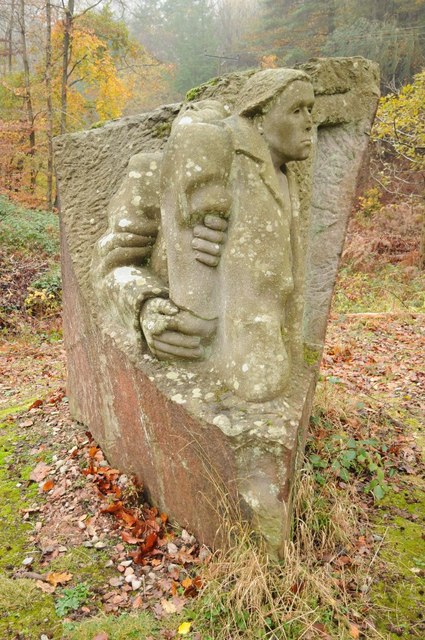
The colliery site lies in woodland in the Bixslade valley, marked by a memorial to the 1902 disaster.
A carved sandstone memorial of two trapped miners embracing, by the sculptor Matt Baker, with a commemorative plaque.
Related mines
- Parkend Colliery — Shared owner: both were worked by Parkend Deep Navigation Collieries Ltd.
- Princess Royal Colliery — Shared take: the Princess Royal company bought the Union gale by 1904 and worked its remaining coal from its own pits.
Nearby mines
- Hopewell Colliery — 0.6 miles (1.0 km) NE, Gloucestershire
- Cannop Colliery — 1.0 miles (1.6 km) NE, Gloucestershire
- Dark Hill Colliery — 1.0 miles (1.6 km) SW, Gloucestershire
- Brookall Ditches Colliery — 1.2 miles (1.9 km) SE, Gloucestershire
- Gentlemen Colliers — 1.2 miles (1.9 km) NW, Gloucestershire
Straight-line distance, within 9 miles (15 km). Show on the map.
Recorded claims
Individual factual claims, each attached to the source(s) that support it below. Where sources disagree, both are kept.
- The Union gale was first granted around 1824 to George Powell, a free miner, who leased it to James and Robert Morrell. 1
- The Parkend Deep Navigation Collieries Company bought the Union gale in January 1892 and reopened the old Slade Pit. 1,2
- By 1902 about 100 men worked at Union Colliery, raising about 100 tons a day. 1,2
- On 4 September 1902 Union was flooded from old workings; seven men were trapped, three were found alive on 9 September and four had drowned. 1,2,3
- Union was closed after the 1902 inundation and its gale passed to the Princess Royal company by January 1904. 1
Photographs & further reading
A full history of the Union gale and a detailed account of the 1902 inundation and rescue.
View sourceSources
- (secondary) Forest of Dean Coal Mining — Lightmoor Press
- (secondary) Union Colliery Disaster Memorial (Forest of Dean Local History Society) — Forest of Dean Local History Society
- (primary) NMRS deaths and accidents database: Herbert Gwatkin, Union, Coalway, 4 Sep 1902 — Northern Mine Research Society
Record created: 23 October 2026 · Last researched: 23 October 2026