 MineArchive
Tynehead Mine
| Also known as | Sir John's Mine, Tynehead Lead Mine |
|---|---|
| Location | Tyne Head Fell, near Garrigill, Alston Moor, Cumbria — 54.7520, -2.3500 (approximate) |
| Commodities | Lead, Copper |
| Type | Metal |
| Worked | 1854–1873 |
| Operators | Tynehead Lead Mining Company (1854–1873) |
Overview
The Sir John lead mine at Tyne Head Fell near Alston -- a decade-long, thousands-of-pounds trial by the Tynehead Lead Mining Company (1854-1873) on Sir John's Vein and the Great Sulphur Vein that never quite found payable ore before the company was liquidated.
History
Tynehead Mine, on the north-east slope of Tyne Head Fell at the head of the South Tyne near Alston, was begun by a group of local businessmen who secured a sett in the Manor of Tynehead in 1854-55 and formed the Tynehead Lead Mining Company. They set out to work Sir John's Vein, located in the riverbed, and the much larger Great Sulphur Vein (also called the Backbone), which ran for some nine miles across the district but was already known to carry little galena despite its width -- up to 365 metres in places -- and its rich iron ore and pyrites. Two consulting engineers, Evan Hopkins and John Calvert, recommended pressing on regardless, and the company negotiated its royalty down from a seventh to a twelfth of output. Surface works -- a mine shop, smithy, waterwheel, leat and crushing stamps -- were built through 1856-57, and the Low Level was driven steadily eastwards for over a decade, with lead ore raised from Kindred's Working and, at 60 fathoms' depth in 1864, an unexpected showing of copper (assayed at 34.5% sulphur, 4.9% copper) that a few tons were sold to test the market. The Low Level flooded in late 1865 and was pumped dry again by April 1866. A visiting survey in 1869 still had not proved the Great Sulphur Vein, and by 1873, after nearly two decades and many thousands of pounds spent without ever cutting a payable lode, the company was liquidated and its mine and plant sold at auction in Newcastle on 26 February 1873.
Geology
Sir John's Vein, in the bed of the South Tyne at Tyne Head Fell, and the much larger Great Sulphur Vein, also called the Backbone.
Workings
Worked via the Low Level, driven eastwards from the valley side for over 100 fathoms in total, with rises connecting to Sir John's Vein for ventilation and stoping; a 30-foot diameter waterwheel (maker's plate 'Deans & Co. No.27') powered ore-crushing stamps, made necessary by the veins' unusually high quartz and iron-ore content.
Closure
The Tynehead Lead Mining Company was liquidated in 1873 after failing to cut a payable lode; the mine and plant were sold at auction in Newcastle on 26 February 1873.
What remains
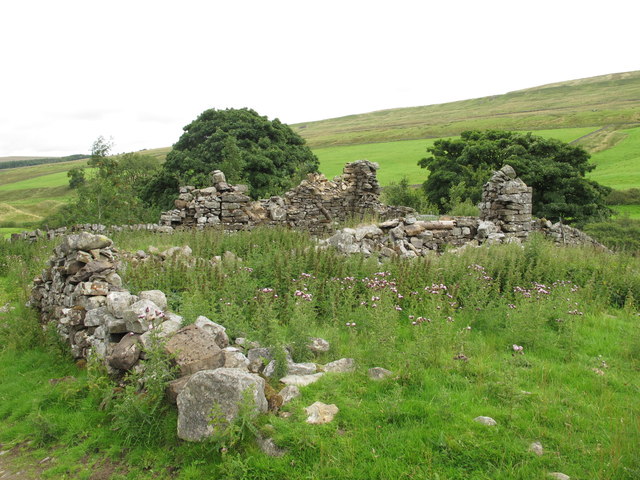
The mine shop had collapsed and the waterwheel pit was crumbling by a 1991 visit; the shaft survives to about 10 metres deep to water, covered by concrete sleepers, with water still issuing from the Low Level drift. Enough pieces of the waterwheel were recovered during a 1971 survey by Eston Grammar School pupils to allow its original 30-foot diameter to be reconstructed, but no ironwork remained on a 1991 visit.
The ruins of the mine shop and the waterwheel pit by the South Tyne, and the shaft, covered with concrete sleepers.
Nearby mines
- Flinty Fell Lead Rakes — 1.8 miles (2.9 km) NW
- Middlecleugh Mine — 2.0 miles (3.2 km) NE
- Caplecleugh Mine — 2.1 miles (3.4 km) N
- Bentyfield Mine — 2.2 miles (3.5 km) NW
- Carrs Mine — 2.2 miles (3.5 km) N
Straight-line distance, within 9 miles (15 km). Show on the map.
Recorded claims
Individual factual claims, each attached to the source(s) that support it below. Where sources disagree, both are kept.
- The Tynehead Lead Mining Company secured its sett in the Manor of Tynehead in 1854-55 and was liquidated in 1873, its mine and plant sold at auction in Newcastle on 26 February 1873, having never cut a payable lode on the Great Sulphur Vein. 1
- Copper was found at 60 fathoms' depth in 1864, assaying at 34.5% sulphur and 4.9% copper; a few tons were sold to test the market. 1
- The mine is also referred to in mining records as Sir John's Mine and the Tynehead Lead Mine, after the Tynehead Lead Mining Company that worked it. 2
- The Mining Remediation Authority holds two sheets of abandonment plans for Tynehead on the lead ore at two chains to the inch (OMR136C), and the British Geological Survey a plan of the Manor of Tynehead at twenty chains to the inch (MP19248). 3
- Ruined mine buildings stand by the River South Tyne above Tynehead, photographed in 2013. 4
Sources
- (secondary) Chapman, M.A. (1993) 'Tynehead Lead Mining Company', British Mining No.48 — Northern Mine Research Society
- (secondary) Tyne Head Mine — Northern Mine Research Society
- (primary) Tynehead abandonment plans OMR136C and the plan of the Manor of Tynehead (BGS mine plans catalogue) — British Geological Survey / Mining Remediation Authority
- (observational) Mine ruins by the River South Tyne above Tynehead (Geograph, Mike Quinn, 2013) — Geograph Britain and Ireland
Record created: 31 August 2026 · Last researched: 24 September 2026