 MineArchive
Ty'n-y-bryn Quarry
| Also known as | Bwlch y Llan Quarry, Lledr Vale Quarry |
|---|---|
| Location | South-east edge of Dolwyddelan, above Pentre-bont, Conwy — 53.0511, -3.8776 (approximate) |
| Commodity | Slate |
| Type | Slate |
| Worked | 1840s–1914 (Penllyn via its mill to 1924) |
| Maximum depth | Unknown. |
| Operators | Tynybryn Slate Quarry Company |
Overview
A slate quarry on the south-east edge of Dolwyddelan, begun in the 1840s and restarted in 1861 with a large water-powered mill. From 1879 a standard-gauge incline ran from the mill to Dolwyddelan station. Quarrying ended in 1914; a revival at neighbouring Penllyn through its mill lasted from 1920 to 1924.
History
Ty'n-y-bryn, also called Bwlch y Llan or Lledr Vale quarry, stands on the south-east edge of Dolwyddelan. The first workings were begun in the 1840s. In 1861 the quarry was restarted and a large mill was built just behind the Pentre-bont houses, its big water wheel fed from the Llyn Cwm-penamnen reservoir about a mile to the south. The quarry was a pit on four levels joined to the mill by inclines, and at first slate was carted to Trefriw. In 1873 the Llangollen Advertiser judged that none of the Dolwyddelan quarries was properly developed, all having to cart their produce to Betws-y-Coed.
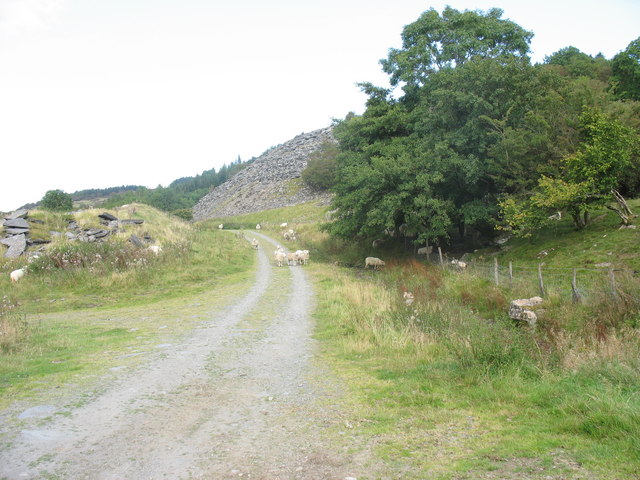
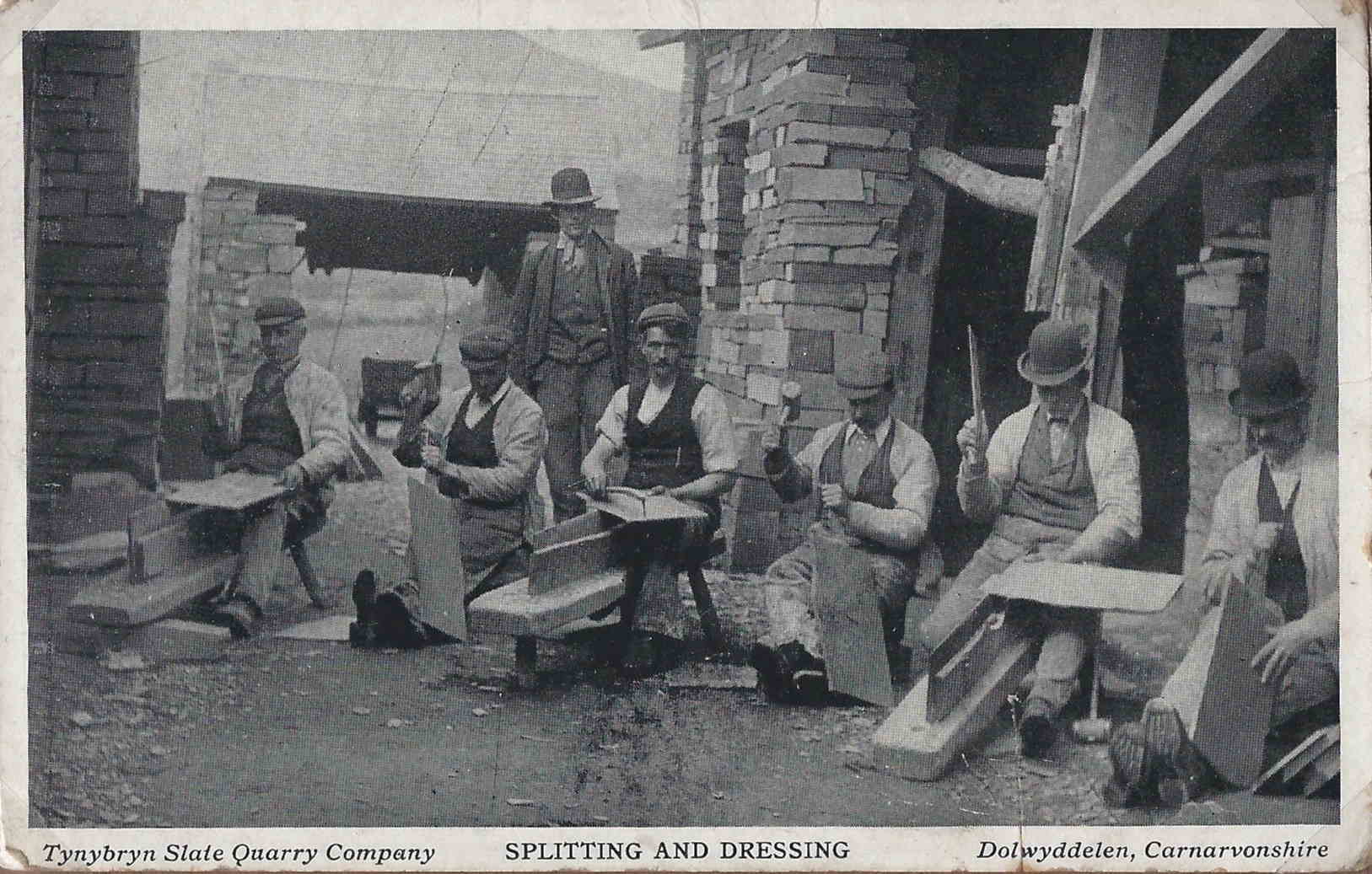
In 1875 the company took over the Penllyn quarry immediately to the east, which had been worked on a small scale since at least 1873, and the Ty'n-y-bryn mill dressed slate from both. In 1879 an incline was built from the mill down to exchange sidings at Dolwyddelan station; it was laid to standard gauge so that London and North Western Railway wagons could be taken up to the mill, one of only four slate quarries in North Wales with a standard-gauge line to the mill. At its peak, with Penllyn, output approached 2,000 tons a year; by 1898 only eight men were employed. A postcard of about 1900, issued by the Tynybryn Slate Quarry Company, shows men splitting and dressing slate at the mill. Quarrying ended in 1914. An attempt to restart Penllyn through the Ty'n-y-bryn mill ran from 1920 until 1924, when all work stopped. Four inclines with ruined drum houses, dressing sheds, a weighing machine, a wheel-pit and machine bases remain.
Geology
Slate of the Nod Glas Formation, a black shale cleaved enough to work as slate where a syncline compressed it around Dolwyddelan.
Workings
A pit on four levels linked by inclines to a water-powered mill fed from Llyn Cwm-penamnen; from 1879 a standard-gauge incline from the mill to exchange sidings at Dolwyddelan station; the mill also dressed Penllyn's slate.
Closure
Quarrying at Ty'n-y-bryn ended in 1914; Penllyn was worked through its mill from 1920 to 1924.
What remains
Overgrown and returning to nature (2022).
Four inclines with ruined drum houses, dressing sheds and other buildings, the remains of a weighing machine, a wheel-pit, machine bases and slate tips.
Redevelopment
Unknown.
Related mines
- Chwarel Ddu Quarry — Both Dolwyddelan quarries working the Nod Glas slate.
Nearby mines
- Chwarel Ddu Quarry — 1.3 miles (2.1 km) W
- Penmachno Quarry — 3.3 miles (5.2 km) S
- Cwt-y-Bugail Quarry — 3.5 miles (5.6 km) S, Gwynedd
- Blaen y Cwm Quarry — 3.6 miles (5.9 km) S, Gwynedd
- Rhiwbach Quarry — 3.7 miles (5.9 km) S, Gwynedd
Straight-line distance, within 9 miles (15 km). Show on the map.
Recorded claims
Individual factual claims, each attached to the source(s) that support it below. Where sources disagree, both are kept.
- Workings at Ty'n-y-bryn began in the 1840s. 1,2
- In 1861 the quarry was restarted and a large water-powered mill was built behind the Pentre-bont houses. 1,2
- In 1879 a standard-gauge incline was built from the mill to sidings at Dolwyddelan station. 1,2
- At its peak, with Penllyn, output approached 2,000 tons a year; eight men were employed in 1898. 2
- Quarrying ended in 1914; Penllyn was worked through the mill from 1920 to 1924. 1,2
Photographs & further reading
History, the Penllyn takeover, the standard-gauge incline and the geology.
View sourceA visitor's history and photographs of the surviving inclines and buildings.
View sourceSources
- (secondary) Ty'n-y-bryn quarry — Wikipedia
- (observational) Ty'n y Bryn slate quarry, Dolwyddelan, North Wales, May 2022 — 28DaysLater
Record created: 4 October 2026 · Last researched: 4 October 2026