 MineArchive
Chwarel Ddu Quarry
| Location | Below Dolwyddelan Castle, half a mile west of Dolwyddelan, Conwy — 53.0512, -3.9095 (approximate) |
|---|---|
| Commodity | Slate |
| Type | Slate |
| Worked | c. 1800–c. 1929 (after a 1920s revival) |
| Maximum depth | Unknown. |
| Operators | Gwydir Estate |
Overview
The earliest slate quarry in the Lledr Valley, worked on and off from about 1800 just below Dolwyddelan Castle. The Gwydir estate built a cart road from it in 1810 that is now part of the A470. It was disused by 1888, and a revival in the 1920s ended by the close of that decade.
History
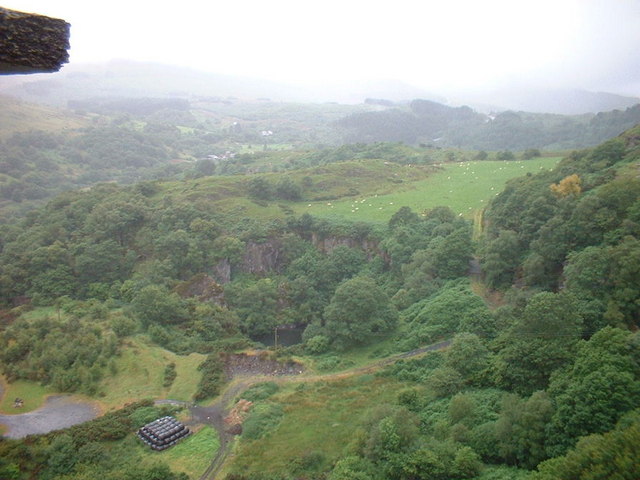
Chwarel Ddu lies about half a mile west of Dolwyddelan, above the west side of the A470 and just beneath Dolwyddelan Castle, and is reckoned the earliest slate quarry in the Lledr Valley. It is believed to have opened between 1800 and 1805, though Coflein dates sporadic working from the late eighteenth century. In 1810 the Gwydir estate, which owned the land, built a cart road from the quarry to the Holyhead road, improving earlier field tracks, and slate was carted to Trefriw. In the mid-nineteenth century the Porthmadog and Beaver Pool Turnpike took over the road, cutting through the quarry's bridged rubbish run in 1845; it is now part of the A470.
The quarry was a small open working developed into a pit on three floors, with underground trials and an internal tramway of wooden rails faced with iron strapping. Rock was hauled up out of the pit and the waste tipped across the road by a bridge; there was no mill. Output ran to a few hundred tons a year, and for several years in the late 1850s, when a stationary steam engine hauled rock from the pit, to as much as 700 tons. It was disused by the Ordnance Survey mapping of 1888-89. In the 1920s it was reopened with an oil engine in place of the steam engine and a small number of quarrymen, but it had shut again by the end of the decade. Road improvements in the 1980s disturbed much of the site and turned up pieces of the iron rail facing.
Geology
Slate of the Nod Glas Formation, a black shale that around Dolwyddelan was compressed in a syncline and cleaved enough to be worked as slate.
Workings
A small open working deepened into a pit on three floors, with underground trials; rock hauled up by a stationary steam engine in the 1850s and an oil engine in the 1920s; an internal tramway of iron-faced wooden rails; waste tipped across the road by a bridge; no mill.
Closure
Disused by 1888; reopened in the 1920s and shut again by the end of that decade.
What remains
In 1991 the pit, some small buildings including the engine house, and the incline formation could still be seen.
Redevelopment
Road improvements on the A470 in the 1980s disturbed much of the site.
Related mines
- Ty'n-y-bryn Quarry — Both Dolwyddelan quarries working the Nod Glas slate.
Nearby mines
- Ty'n-y-bryn Quarry — 1.3 miles (2.1 km) E
- Cwt-y-Bugail Quarry — 3.2 miles (5.2 km) S, Gwynedd
- Llechwedd Slate Caverns — 3.5 miles (5.6 km) S, Gwynedd
- Palmerston Quarry — 3.5 miles (5.7 km) SW, Gwynedd
- Maenofferen Quarry — 3.6 miles (5.8 km) S, Gwynedd
Straight-line distance, within 9 miles (15 km). Show on the map.
What's uncertain
Points where sources disagree or the record could not be settled; both accounts are kept. All open questions in the archive.
- Chwarel Ddu is believed to have opened between 1800 and 1805, the earliest slate quarry in the Lledr Valley. (disputed) 1
- Sporadic working at Chwarel Ddu took place from the late eighteenth century. (disputed) 2
Recorded claims
Individual factual claims, each attached to the source(s) that support it below. Where sources disagree, both are kept.
- Chwarel Ddu is believed to have opened between 1800 and 1805, the earliest slate quarry in the Lledr Valley. (disputed) 1
- Sporadic working at Chwarel Ddu took place from the late eighteenth century. (disputed) 2
- In 1810 the Gwydir estate built a cart road from the quarry to the Holyhead road, now part of the A470. 1,2
- In the late 1850s the quarry produced up to 700 tons of slate a year, with a stationary steam engine hauling rock from the pit. 1
- The quarry was disused by the Ordnance Survey mapping of 1888-89; a revival in the 1920s had ended by the end of that decade. 1,2
Photographs & further reading
The RCAHMW site record: layout, working dates, the 1810 road and the remains seen in 1991.
View sourceHistory, the 1920s revival, the iron-faced rails and the Nod Glas slate.
View sourceSources
- (secondary) Chwarel Ddu quarry — Wikipedia
- (secondary) Chawarel Ddu Slate Quarry (NPRN 420093) — Coflein (RCAHMW)
Record created: 4 October 2026 · Last researched: 4 October 2026