 MineArchive
Tilmanstone Colliery
| Also known as | East Kent Colliery |
|---|---|
| Location | Eythorne, near Dover, Kent — 51.2066, 1.2736 (exact) |
| Commodity | Coal |
| Type | Coal |
| Worked | 1906 (sinking)–1987 |
| Maximum depth | No. 3 shaft reached the Beresford seam at 1,560 ft in 1913 |
| Operators | Arthur Burr (1906–1914), Richard Tilden Smith (1926–1937) |
Overview
One of only four Kent coalfield pits, sunk by a man a judge later called 'a rogue', kept alive by a three-mile aerial ropeway to Dover harbour that never carried the traffic it was built for, and finally closed in the aftermath of the 1984-85 strike.
History
Coal had been found beneath Shakespeare Cliff at Dover in 1882 during trial borings for a Channel Tunnel, and the promoter Arthur Burr spent the following decades trying to prove a workable coalfield in east Kent. His Foncage Syndicate began sinking at Tilmanstone, near Eythorne, in 1906. It was a hard birth: No. 1 shaft needed seven months of remedial work after its walls collapsed, and in 1909 a hoisting bucket fell down No. 2 shaft, killing three men and wrecking the pumping equipment, which put the sinking back by nine months as a thousand gallons a minute poured in. Coal was finally reached in 1912, and the rich Beresford seam was proved in 1913 at 1,560 feet. The company went into receivership within a year of production starting, and Burr was dismissed and later declared bankrupt, a judge in the case calling him 'a rogue'. Richard Tilden Smith bought the colliery in 1926, found the richer Milyard seam in 1930, and built an aerial ropeway to carry coal directly to Dover harbour rather than by rail — but export demand never matched the investment, and the ropeway was little used after 1935. The National Coal Board took over at nationalisation in 1947 and modernised the pit twice, in 1949 and 1952, but never considered it fully viable. The Beresford seam closed in 1961, leaving the mechanised Milyard seam to carry the pit alone. Tilmanstone survived the 1984-85 miners' strike but closed with Snowdown Colliery in 1987, three years before Betteshanger, Kent's last colliery, followed.
Geology
The Kent coalfield is a concealed extension of the same coal measures worked across the Channel in the Nord-Pas-de-Calais field, buried beneath several hundred feet of younger chalk and clay — which is exactly why it was found by Channel Tunnel boreholes rather than by surface outcrop, and why every Kent shaft had to be sunk through difficult water-bearing ground before reaching coal at all.
Geological setting: Concealed Coalfields (well documented example)
Workings
Three shafts were sunk: No. 1 and No. 2 from 1906-07, reaching about 1,140 feet by 1911 after repeated water and sand inrushes, and No. 3 from 1910, which found the Beresford seam at 1,560 feet in 1913. The richer Milyard seam, found in 1930 at 3,035 feet, eventually became the pit's sole producer after 1961. From 1930 an aerial ropeway carried coal three miles from the colliery to Dover's Eastern Docks, moving up to 120 tons an hour in buckets spaced 46 yards apart, and passing through twin tunnels cut through the cliff to emerge partway down the cliff face above the harbour.
Closure
Designated for closure as early as 1967 but kept working, latterly supplying a struggling steel industry, Tilmanstone closed with Snowdown in 1987 after the 1984-85 strike.
What remains
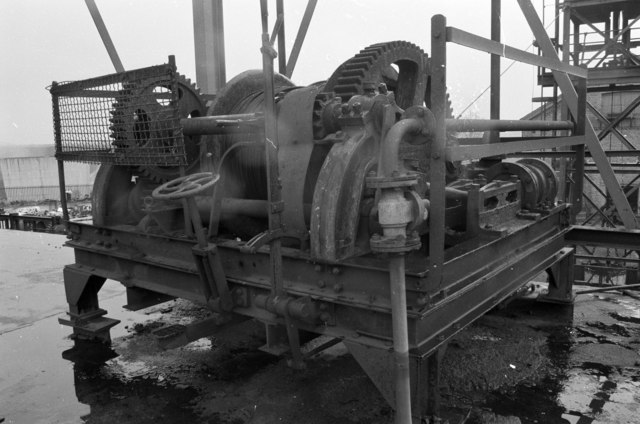
Largely demolished, with the shafts permanently sealed in April and May 1987. The Pike Road Industrial Estate now covers the upper part of the site and a salad-packing factory the lower part, cleared in 2000. Little survives at the colliery itself beyond three concrete shaft covers and a small monument, though two of the pit's original steam winches have themselves been preserved and are now displayed at the site. The ropeway's divide station and powerhouse survives in a field at East Langdon, and its bricked-up tunnel entrances are still visible in the cliffs above the Dover ferry terminal.
Three sealed shaft covers, a small memorial, two preserved steam winches, and, away from the colliery itself, the ropeway divide station at East Langdon and its tunnel portals in the cliffs at Dover.
Redevelopment
Pike Road Industrial Estate and a food-processing factory now occupy the former colliery site.
Nearby mines
- Snowdown Colliery — 2.1 miles (3.4 km) W
- Betteshanger Colliery — 3.6 miles (5.7 km) NE
- Chislet Colliery — 8.7 miles (14.0 km) NW
Straight-line distance, within 9 miles (15 km). Show on the map.
Disasters & major incidents
-
Tilmanstone Colliery shaft accident, 1909
1909 · Winding / Shaft Accident · 3 fatalities
Tilmanstone's No. 2 shaft was still being sunk in 1909 when a hoisting bucket, or hoppit, fell down it, killing three men and wrecking the pumping equipment that was keeping the workings dry. A thousand gallons of water a minute poured in, and sinking was abandoned for nine months.
Recorded claims
Individual factual claims, each attached to the source(s) that support it below. Where sources disagree, both are kept.
- Coal was found beneath Shakespeare Cliff, Dover, in 1882 during Channel Tunnel trial borings; Arthur Burr's Foncage Syndicate began sinking at Tilmanstone in 1906, and coal was reached in 1912, with the Beresford seam proved at 1,560 ft in 1913. 1,2
- The richer Milyard seam was found in 1930 at 3,035 ft and eventually became the pit's sole producer after the Beresford seam closed in 1961. 1
- From 1930 an aerial ropeway carried coal three miles from the colliery to Dover's Eastern Docks, moving up to 120 tons an hour through twin tunnels cut through the White Cliffs, but never carried the export tonnage it was built for and was little used after 1935. 1
- In 1931 a runaway tub derailed and brought down roof girders, trapping miner William Gazard; Sydney William Padfield was awarded the Edward Medal for freeing him under continuing roof falls over about half an hour. 3
- The colliery closed with Snowdown in 1987, three years before Betteshanger, Kent's last colliery, followed. 1
- The shafts were sealed in 1987 and the site largely demolished; the Pike Road Industrial Estate and a food factory now occupy it, though two of the original steam winches survive on display and the ropeway's divide station stands in a field at East Langdon. 1
Photographs & further reading
A former miners' community history and campaign page.
View sourceSources
- (primary) Tilmanstone Colliery — Subterranea Britannica — Subterranea Britannica
- (secondary) Tilmanstone Colliery — Dover Museum — Dover Museum
- (primary) Awards for Gallantry: Sydney William Padfield — Durham Mining Museum
Record created: 24 August 2026 · Last researched: 24 August 2026