 MineArchive
Shakespeare Colliery
| Also known as | Dover Colliery |
|---|---|
| Location | Foot of Shakespeare Cliff, West Hougham, between Dover and Folkestone, Kent — 51.1075, 1.2764 (exact) |
| Commodity | Coal |
| Type | Coal |
| Worked | 1896–December 1915 |
| Maximum depth | 1,632 feet (No. 2 and No. 3 shafts) |
| Operators | Kent Coalfields Syndicate (1896–1901), Arthur Burr (1896–1903), Anglo-French Consolidated Kent Collieries Corporation (1901–1905), Channel Collieries Trust (1910–1915) |
Overview
The first colliery of the Kent Coalfield, sunk from 1896 at the foot of Shakespeare Cliff, Dover, on the site of the abandoned Channel Tunnel workings, where coal had been proved by boring in 1890; water, debt and thin seams meant it raised only about 1,000 tons before closing in December 1915.
History
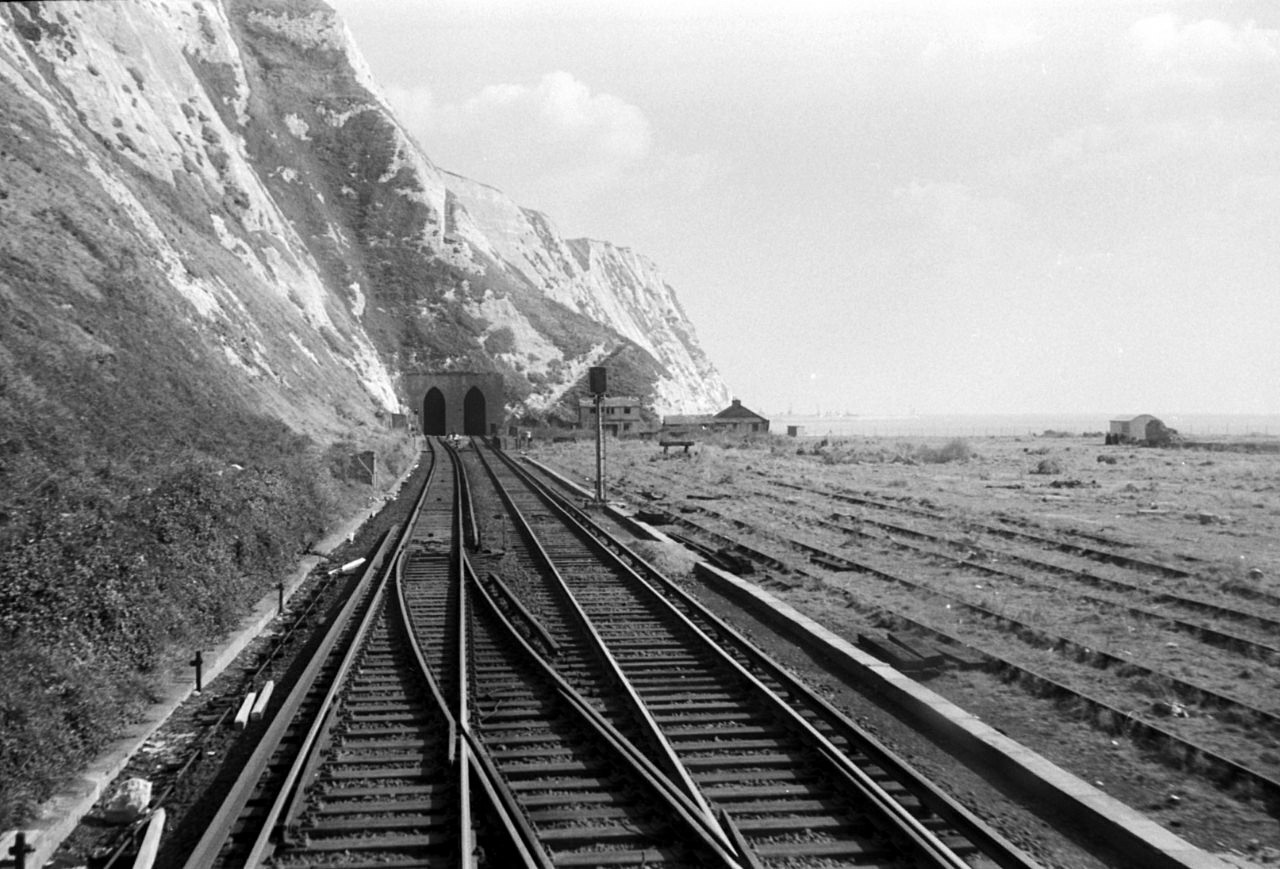
The colliery stood on a platform at the foot of Shakespeare Cliff, between Dover and Folkestone, where the first Channel Tunnel company had sunk a shaft in 1881 and driven a heading of over two thousand yards before the work was stopped in 1882. A borehole sunk there under Francis Brady and Professor William Boyd Dawkins struck the Coal Measures in February 1890 at about 1,100 feet, finding fourteen seams: the discovery of coal beneath Kent. In 1896 the speculator Arthur Burr's Kent Coalfields Syndicate took over the site, and sinking began on No. 1 (Brady) Pit in June. Water broke in at 366 feet, and while it waited for pumps the company began No. 2 (Simpson) Pit; on 6 March 1897 water burst through its floor at about 300 feet and drowned the sinkers below (see Disasters, below). A third shaft, the Borehole Pit, was begun in 1898 and met a thick bed of ironstone. Sinking stalled for lack of money and against the water until the Anglo-French Consolidated Kent Collieries Corporation lined No. 2 with cast-iron tubbing by the Kind-Chaudron method, completed in December 1904 to 1,195 feet. By February 1905 just twelve tons of coal had been raised. No. 2 Pit reached 1,632 feet in August 1905, passing seams that were thinner than the borings had promised, and in 1907 the colliery raised about eight tons a day, less than its own boilers burned; a Dover brewery briefly advertised its ale as brewed by Kent coal. The colliery went into receivership in 1909, restarted under the Channel Collieries Trust in 1910, and had raised only about 1,000 tons by 1912. In September 1912 two sinkers were killed in No. 3 shaft (see Disasters, below), and from 1913 a halt on the main line served the miners. Work stopped in 1914 and the colliery closed in December 1915.
Geology
Concealed Coal Measures of the Kent Coalfield, proved by boring in 1890 beneath water-bearing Greensand and Wealden beds; fourteen thin seams in the borehole and a thick bed of ironstone (limonite) met in the Borehole Pit.
Workings
Three shafts: No. 1 (Brady), abandoned at 520 feet in running sand; No. 2 (Simpson) and No. 3 (Borehole), both sunk to 1,632 feet, No. 2 lined with cast-iron tubbing by the Kind-Chaudron method to 1,195 feet; pumps on a cross heading at 310 feet.
Closure
Production stopped in 1914 and the colliery closed in December 1915, officially for want of labour in wartime. The shafts were sealed with concrete plugs and later capped, and the machinery was sold in 1928.
What remains
The site was cleared of colliery buildings by the mid-1950s and later obliterated by the works for the Channel Tunnel in the 1980s.
None; the site was taken by the Channel Tunnel works.
Redevelopment
Railway sidings were laid across the site in the 1950s, and it was later used for the construction of the Channel Tunnel.
Nearby mines
- Tilmanstone Colliery — 6.8 miles (11.0 km) N
- Snowdown Colliery — 7.5 miles (12.1 km) N
- Betteshanger Colliery — 9.0 miles (14.4 km) N
Straight-line distance, within 9 miles (15 km). Show on the map.
Disasters & major incidents
-
Shakespeare Colliery inrush, 1897
6 March 1897 · Flooding / Inundation · 7 fatalities
Water burst through the floor of No. 2 (Simpson) Pit at Shakespeare Colliery, Dover, while it was being sunk on 6 March 1897. Six of the fourteen men in the shaft were hauled out in the hoppit; the rest drowned. -
Shakespeare Colliery shaft accident, 1912
5 September 1912 · Winding / Shaft Accident · 2 fatalities
A 1,200-gallon water tank being wound up No. 3 shaft at Shakespeare Colliery, Dover, broke loose on 5 September 1912 and fell back on the fourteen sinkers working below, killing two of them.
Recorded claims
Individual factual claims, each attached to the source(s) that support it below. Where sources disagree, both are kept.
- Coal was proved below Shakespeare Cliff in February 1890 by a boring on the site of the original Channel Tunnel workings. 1,2
- The Kent Coalfields Syndicate began sinking in 1896; the colliery was known as Shakespeare or Dover Colliery and was the first of the Kent coal mines. 3,2
- By February 1905 only 12 tons of coal had been raised, and by 1912 about 1,000 tons. 1,2
- The colliery closed in December 1915. 1,3,2
- Shakespeare Cliff Halt was opened by the South Eastern and Chatham Railway in 1913 primarily for the miners of Dover Colliery. 4
- Two of the three shafts were sunk to 1,632 feet; the first was stopped at 520 feet. 1,2
Sources
- (secondary) Kent Coalfield — Wikipedia
- (secondary) Shakespeare Colliery — Subterranea Britannica
- (primary) Durham Mining Museum: Dover Colliery — Durham Mining Museum
- (secondary) Wikipedia: Shakespeare Cliff Halt railway station — Wikipedia
Record created: 16 October 2026 · Last researched: 16 October 2026