 MineArchive
Sortridge Consols
| Also known as | West Wheal Robert |
|---|---|
| Location | North of Horrabridge, east of the old Tavistock road, Whitchurch, Devon — 50.5179, -4.1033 (approximate) |
| Commodities | Copper, Arsenic, Tin |
| Type | Metal |
| Worked | 1853 (reopened)–1871 |
| Maximum depth | 152 fathoms (Hitchen's Engine Shaft) |
Overview
A copper mine north of Horrabridge, formerly West Wheal Robert, where a rich lode found five feet from surface in 1853 paid £3,200 in months on an outlay of £600, a 40-inch engine was started in 1855 under a triumphal arch of evergreens, and 7,792 tons of copper ore came up by 1871 from a shaft 152 fathoms deep; tin was worked above adit from 1883 to 1893 and arsenic picked from the dumps in 1924.
History
Sortridge Consols lies east of the old Horrabridge to Tavistock road, north of Horrabridge, on ground now mostly under woodland; it abutted North Wheal Robert but was not connected to it underground. Originally known as West Wheal Robert, it was reopened in 1853, when a rich deposit of copper ore was found only five feet from surface and within months £3,200 of ore had been sold on an outlay of £600. The lode yielded in places ten tons to the fathom, and the course of ore from the 20 to the 40 fathom level returned over £50,000. Below that the values fell so far that pumping was reduced and abandonment proposed, until a find in two of the south lodes reversed the policy. In 1855 a large engine house was built for a 40-inch pumping engine from Nicholls and Williams of Tavistock, and its first stroke was celebrated under a triumphal arch of evergreens across the road, fronted by a star of flowers flying the Union Jack, followed by a dinner at which each man had his favourite drink and a yard of clay.
Copper mining went on for sixteen more years, until 1871. The main shaft, Hitchen's Engine Shaft, with the Eastern and Western shafts, reached 152 fathoms from surface, though little was driven below the 100 fathom level except at the 140, and the copper shoot was probably bottomed between the 86 and 100 fathom levels. Dines records the ground blocked out on the levels down to the 62 fathom for 60 fathoms east and 140 west, with the 74, 86, 98, 110 and 140 fathom levels below, three lodes north of the Main Lode and five to the south, a crosscut north from the 40 to the Tin Lode and No. 1 Tin Lode, an adit near Sortridge Manor on the third lode and a drainage adit at the 50 fathom level cutting the south lodes. The plant was the 40-inch engine, a 22-inch winder and crusher and a 24-foot waterwheel fed from a reservoir off the Grimstone and Sortridge Leat. The output was 7,792 tons of 7.5 per cent copper ore from 1854 to 1869.
In 1883 the mine was reopened through the drainage adit to work low-grade tin above adit level, the ore stamped by pneumatic stamps, one of the first trials of them in a mine, on a hillside dressing floor with at least three round buddles; the work went on in a small way until 1893, returning 33.5 tons of black tin. In 1924 the dumps were picked over for arsenic, 14 tons of mispickel, the mine was re-examined in 1928, and the dump material went to build RAF Harrowbeer at Yelverton in the Second World War.
Geology
A copper Main Lode with three lodes north of it and five to the south, two tin lodes cut by a crosscut from the 40 fathom level, in the killas north of Horrabridge on the western edge of the Dartmoor granite; the dumps carried mispickel.
Geological setting: Veins and Lodes (historical documentary reference)
Workings
Hitchen's Engine Shaft to 152 fathoms with the Eastern and Western shafts, levels at 20, 40, 50 (drainage adit), 62, 74, 86, 98, 110 and 140 fathoms, a crosscut to the tin lodes and an adit near Sortridge Manor; a 40-inch pumping engine of 1855, a 22-inch winder and crusher, a 24-foot waterwheel fed by reservoirs off the Grimstone and Sortridge Leat, and from 1883 pneumatic stamps and a hillside dressing floor with round buddles.
Closure
Copper working stopped in 1871 after the ore shoot was bottomed around the 86 to 100 fathom level; the small tin working above adit ended in 1893; the dumps were picked for arsenic in 1924 and later carted away.
What remains
The site is marked by undulations under woodland east of the old road, with the spoil tip, two reservoirs and the outfall, the smithy site, the mine captain's and manager's houses, now the Old Mine House, and three buddles on the private dressing floor.
Spoil and ground disturbance under woodland, the reservoirs and outfall, the Old Mine House, the smithy site and three round buddles.
Redevelopment
The captain's and manager's houses are a private house, the Old Mine House; much of the spoil was used for RAF Harrowbeer in the 1940s.
Related mines
- Great and East Sortridge Consols — Great Sortridge was once part of the Sortridge Consols sett.
- North Wheal Robert — Adjoining mine north of Horrabridge, not connected underground.
Nearby mines
- North Wheal Robert — 0.6 miles (0.9 km) E
- Gem Mine — 0.9 miles (1.5 km) W
- Great and East Sortridge Consols — 1.0 miles (1.6 km) N
- Westdown Mine — 1.4 miles (2.2 km) W
- Wheal Betsy — 2.3 miles (3.7 km) NW
Straight-line distance, within 9 miles (15 km). Show on the map.
Recorded claims
Individual factual claims, each attached to the source(s) that support it below. Where sources disagree, both are kept.
- Formerly West Wheal Robert, the mine was reopened in 1853, when a rich copper deposit five feet from surface sold £3,200 of ore within months on an outlay of £600. 1
- In 1855 a large engine house was built for a 40-inch pumping engine by Nicholls and Williams of Tavistock, started under a triumphal arch of evergreens. 1
- In 1856 Great West Sortridge lay within a very short distance east of north of Sortridge Consols, and East Sortridge in its neighbourhood with North Wheal Robert. 2
- The main shaft was sunk to 152 fathoms from surface, with little driving below the 100 fathom level except at the 140. 1
- The mine returned 7,792 tons of 7.5 per cent copper ore from 1854 to 1869, 33.5 tons of black tin from 1883 to 1893 and 14 tons of mispickel in 1924. 1
- Copper mining ceased in 1871. 1
- In 1883 the mine was reopened through the drainage adit for low-grade tin above adit, stamped by pneumatic stamps, and worked in a small way until 1893. 1
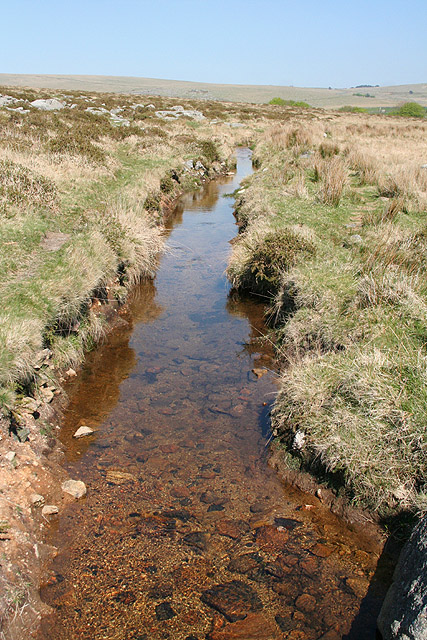
- The Grimstone and Sortridge Leat turned waterwheels at Sortridge Consols. 1,3
- Abandonment plans of Sortridge Consols, for copper ore, are held by the Mining Remediation Authority. 4
- The dumps were picked over for arsenic in 1924, the mine re-examined in 1928, and the dump material used to build RAF Harrowbeer in the Second World War. 1
Photographs & further reading
A walk over the mine with Hamilton Jenkin's and Dines's accounts, the 1855 engine ceremony, the shafts, reservoirs, Old Mine House and buddles located by grid reference.
View sourceSources
- (secondary) Sortridge Consols — Dartmoor Explorations
- (secondary) 1856 Mines in Devon and Cornwall — Grace's Guide
- (observational) Grimstone and Sortridge Leat (photograph, 2008) — Geograph
- (primary) BGS mine plan: Sortridge Consols, copper ore — British Geological Survey
Record created: 18 October 2026 · Last researched: 21 October 2026