 MineArchive
Ringleshutes Mine
| Also known as | Ringleshutts Mine, Holne Moor and Hensroost United Mines |
|---|---|
| Location | Head of Venford Brook, Holne Moor, Devon — 50.5136, -3.8694 (exact) |
| Commodity | Tin |
| Type | Metal |
| Worked | 1852 (shafts)–1855 |
| Maximum depth | Unknown. |
Overview
A mid-nineteenth-century tin mine on Holne Moor at the head of Venford Brook, sunk in 1852 into extensive late medieval openworks and given up by about 1855; the ruins of its engine house, barracks and dressing floor remain.
History
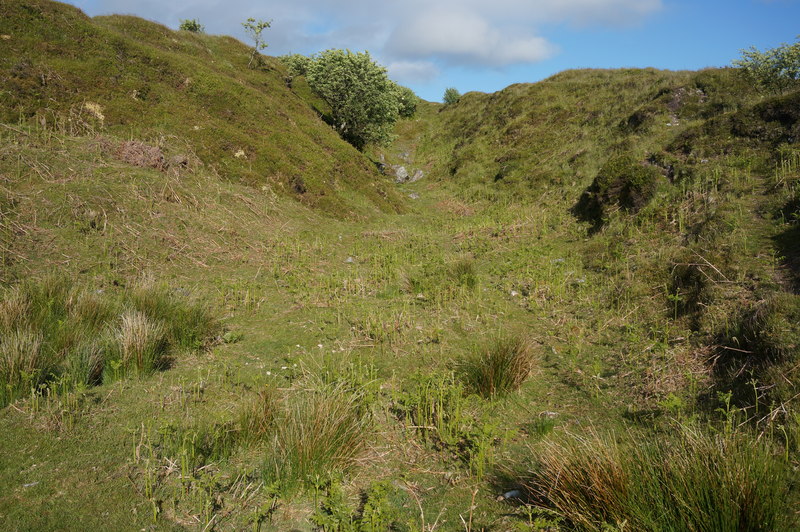
Ringleshutes (or Ringleshutts) Mine lies on Holne Moor at the head of Venford Brook, within extensive late medieval openworks and streamworks, perhaps of the fifteenth to eighteenth centuries, with at least six tinners' reservoirs. The early workings went underground only a little way. In 1852 George Bennetts was granted a licence to work the mine with Henroost as Holne Moor and Hensroost United Mines; £5,000 was raised and several shafts were sunk on three lodes, one of them beside a 42-inch Cornish engine house. The venture was short: it sold £22 12s 6d of black tin in 1854 and probably ended by 1855. William Crossing found the engine house chimney standing but the mine 'old' in 1888; it had fallen by about 1890.
A survey in 1997 identified three main shafts, seven to nine metres across, and air shafts. The engine house and main shaft were linked by a 400-metre tramway, with a horse whim, to a dressing floor with a rectangular building, at least one buddle and a wheelpit, where a 30-foot by 4-foot wheel was recorded in 1854. Beside the tramway is a large building of five rooms, about 25 by 5 metres, known as the barracks.
Geology
Three tin lodes in the Dartmoor granite, within late medieval openworks and streamworks.
Workings
Three main shafts (7-9 m across) and air shafts on three lodes, a 42-inch Cornish pumping engine, a 400-metre tramway with a horse whim, and a dressing floor with a 30 ft waterwheel and buddle.
Closure
A short-lived venture of 1852 that probably ended by 1855.
What remains
The engine house walls and the fallen stack, shafts, the barracks, the tramway line and the dressing floor survive, much of it overgrown in summer.
Engine house ruin and collapsed chimney, shafts, a five-room barracks, whim platform, tramway and dressing floor.
Redevelopment
Unknown.
Related mines
- Hooten Wheals — Worked with Henroost and, by one account, Hooten Wheals from 1852.
Nearby mines
- Hexworthy Mine — 1.4 miles (2.3 km) NW
- Druid Mine — 2.7 miles (4.3 km) NE
- Hooten Wheals — 3.5 miles (5.7 km) NW
- Eylesbarrow Mine — 4.9 miles (7.9 km) W
- Brimpts Tin Mine — 5.2 miles (8.3 km) N
Straight-line distance, within 9 miles (15 km). Show on the map.
What's uncertain
Points where sources disagree or the record could not be settled; both accounts are kept. All open questions in the archive.
- Ringleshutes was combined with Henroost and Hooten Wheals by 1852. (uncertain) 2
Recorded claims
Individual factual claims, each attached to the source(s) that support it below. Where sources disagree, both are kept.
- In 1852 George Bennetts was granted a licence to work the mine with Henroost; £5,000 was raised and several shafts sunk. 1
- Sales of £22 12s 6d of black tin were recorded in 1854; the venture probably lasted until 1855. 1
- The engine house chimney was standing in 1880 but had fallen by 1890. 1,2
- Ringleshutes was combined with Henroost and Hooten Wheals by 1852. (uncertain) 2
- The Barracks at Ringleshutes Mine, where the men 'hot bunked', survives. 1,3
Sources
- (secondary) Ringleshutes (Ringleshutts) Mine — Dartmoor Explorations
- (observational) Walk 2014-4-16: Venford Reservoir and Ringleshutes Mine — Dartmoor CAM Walks
- (observational) Walk 2010-9-8: Venford East — Dartmoor CAM Walks
Record created: 17 October 2026 · Last researched: 17 October 2026